

Amid Caution and Deep Distrust, Quintet Mechanism Launches Exploratory Meetings in Addis Ababa Tomorrow
Cairo – Sudanhorizon – Sabah Mousa
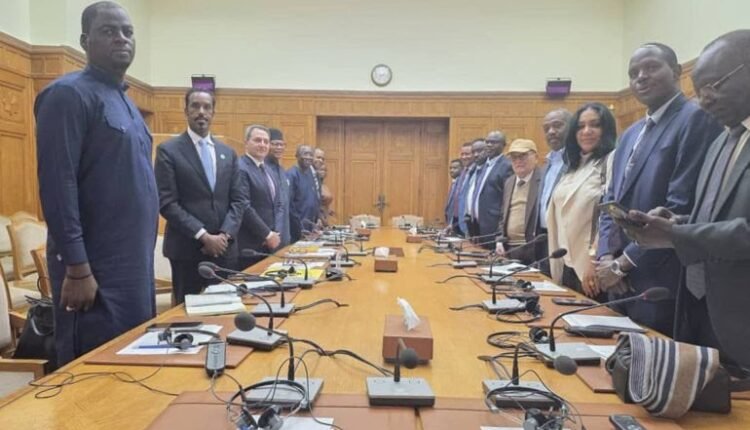
The international Quintet Mechanism, comprising the African Union, Intergovernmental Authority on Development (IGAD), League of Arab States, European Union, and the United Nations, has issued official invitations to participate in the first exploratory meeting on the establishment of a Sudanese preparatory committee and the formulation of a common position on a peaceful political transition. The meeting is scheduled to take place in Addis Ababa from June 3 to 5.
Unified Mechanism
In the invitation letter sent to participants, the head of the Quintet Mechanism, Mohamed Ibn Chambas, explained that the meeting comes in response to consultations conducted over recent months with a broad spectrum of Sudanese stakeholders.
The meeting aims to explore the possibility of establishing a unified Sudanese-led mechanism to contribute to negotiations on transitional arrangements, facilitate a cessation of hostilities, prepare for a comprehensive Sudanese dialogue, and discuss the formulation of a common position regarding a peaceful political transition.
Participation Not Final
The invitation noted that the list of participants for the first meeting was designed to ensure political, geographic, gender, and generational representation. It stressed that participation at this stage is neither final nor comprehensive and that the process will remain open and evolve under Sudanese leadership.
The letter further indicated that participation will be expanded during the second and third meetings. The second meeting is scheduled to take place in Addis Ababa on July 8–9, with broader Sudanese participation intended to enhance inclusivity. Dates for subsequent meetings will be determined during the July sessions.
Accommodating Different Positions
Before invited political groups formally accepted the invitation, the “Somoud” alliance threatened to boycott the meetings, protesting what it described as attempts to overwhelm the political process through the inclusion of parties it deemed undesirable. The alliance demanded clarification from the Quintet Mechanism regarding the invitations.
Meanwhile, national forces supporting the Sudanese Armed Forces opposed the participation of the “Ta’sis” coalition, while the Popular Congress Party faction led by Ali Al-Haj warned against attempts to include civil forces and figures associated with the former ruling National Congress Party among the participants.
In a statement, the party held the Quintet Mechanism responsible for any divisions among political forces that could slow efforts to resolve the current crisis.
Despite these objections, all invited parties announced on Monday that they would participate, in what appeared to be an effort by the Quintet Mechanism to accommodate differing positions and secure broad participation.
Concerns Over a Declaration of Principles
According to the invitation letter, the first day of meetings will be dedicated to discussions among national political forces and the Somoud alliance, while the third day will be reserved for participants wishing to continue consultations.
Sources familiar with the process told Sudanhorizon that following the first two days of meetings, the Quintet Mechanism is expected to prepare a draft Declaration of Principles and present it to participants for signature.
The sources added that the third day’s meeting is expected to bring together the Somoud alliance and the Ta’sis coalition with the aim of approving the Declaration of Principles previously associated with Somoud in Nairobi. They suggested that the Quintet Mechanism may seek to advance that declaration through the Addis Ababa meetings.
The sources also cautioned participating national forces against signing any draft document before consulting their constituencies and leadership bodies.
Exploratory Meeting
For his part, El-Tijani El-Sissi, head of the National Movement Forces, said that the Quintet Mechanism had invited a number of political and civil groups, including his movement.
He stated that they responded to the invitation by sending two representatives, though he would not personally attend. He described the Addis Ababa gathering as an exploratory meeting intended to discuss the formation of a preparatory committee and the unification of positions regarding a peaceful transitional political process.
Major Obstacles
El-Sissi told Sudanhorizon that Sudan’s political crisis has become increasingly complex and that reaching effective solutions requires a more comprehensive vision and broader representation of all parties.
He added that external interventions and the proliferation of initiatives and negotiation platforms have become among the greatest obstacles to achieving a fair settlement of the crisis.
External Interference
El-Sissi argued that external actors still fail to fully understand the nature of Sudan’s crisis and its regional complexities, particularly those involving neighboring countries.
He noted that some international circles may overlook these realities while continuing to push for settlements that take into account the interests of neighboring states.
“We will continue to advocate for the establishment of a regional and international umbrella mechanism mandated to facilitate the political process, while ensuring that Sudanese alone retain the right to determine the future of their country free from external interference,” he said.
Lack of Trust
El-Sissi emphasized that one of the fundamental challenges that must be overcome before designing any political process is rebuilding trust among Sudan’s various political components.
He stressed that conducting serious and effective dialogue among these groups remains extremely difficult given the prevailing atmosphere of mutual distrust.
Shortlink: https://sudanhorizon.com/?p=14426