

GERD: Egypt Rejects the Fait Accompli as Rights and Operating Rules Return to the Fore
Cairo – Sudanhorizon – Sabah Musa
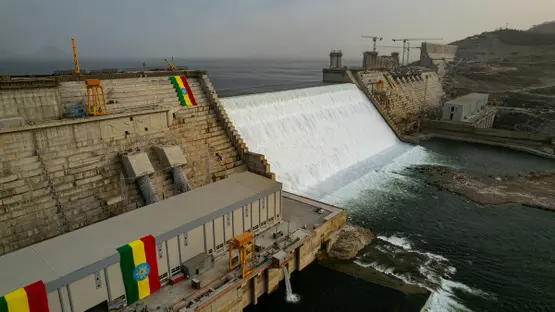
The Grand Ethiopian Renaissance Dam (GERD) is no longer merely an Ethiopian construction project, but has become a new water and political reality on a transboundary river. Yet the completion of construction has not closed the dispute or settled the most difficult question: does the fait accompli become a binding framework that the downstream countries must treat as settled, or do the dam’s operating procedures and their impact on Nile flows remain subject to negotiation, rules, and agreements?
Historical Rights
Egyptian Minister of Water Resources and Irrigation Dr. Hani Sewilam affirmed that Egypt would not relinquish its rights or those of its people, stressing that the construction of the Ethiopian dam and the passage of time do not mean that Egypt has accepted it.
Speaking Sunday during an extensive briefing for regional and foreign media, Sewilam said there is a distinction between constructing an Ethiopian facility on Ethiopian territory and constructing a dam on a transboundary river governed by international laws that extend beyond domestic legislation. He reiterated Egypt’s position that it has the right to take whatever measures are necessary to fully safeguard its rights, which he described as water, historical, political, and moral rights supported by previous treaties and binding laws.
The Core of the Crisis
Sewilam’s remarks return the GERD dispute to its core. Cairo is making clear that the project’s transformation into an operational facility does not mean the dispute over it has ended, just as the passage of years does not automatically turn a position rejected by Egypt into an accepted reality.
The issue is therefore more complicated than a disagreement over the construction of a facility inside Ethiopian territory. The river on which the dam is built does not stop at political borders, and the water regulated through it flows to other countries. Consequently, any fundamental change in the way water is managed or in the timing of releases could have direct repercussions for the two downstream countries.
What Egypt Is Contesting
The most important point in Sewilam’s remarks is the distinction between an Ethiopian facility on Ethiopian territory and a dam on a transboundary river.
Under this position, Egypt is not disputing Ethiopia’s claim that the dam is located within its territory. Rather, it is addressing the consequences of operating a facility situated on a waterway shared by several countries.
This distinction explains why the dispute has continued despite the passage of years since construction began and the dam entered its operational phase. If the existence of the dam has become an engineering reality, the question that remains open is: Has the way it is operated also become a fait accompli that can no longer be negotiated?
This is the central issue. Egypt wants clear rules governing the relationship between the Ethiopian dam and the water systems of the two downstream countries, while Ethiopia maintains that it has a sovereign right to use its water resources for development and electricity generation.
Between the two positions lies room for negotiation that could provide a path toward a solution if the discussion moves from the question of whether the dam should exist to how it should be operated in a manner that takes the interests of all three countries into account. This, however, is where Ethiopian intransigence remains an obstacle.
The fact that the dam now exists can also be viewed as an opportunity for the parties to redefine the objective of negotiations. Returning to the question of whether the dam should be built is no longer the most practical issue at the current stage. A more realistic question may be: What rules should govern the operation of the dam?
This would require direct negotiations on a defined set of issues, foremost among them data sharing, operating rules, mechanisms for dealing with drought years, coordination between dams and water facilities in the three countries, emergency management, and a clear mechanism for addressing any future dispute.
Unilateral Actions
In this context, international expert and former Sudanese Ministry of Irrigation adviser Dr. Ahmed Al-Mufti said the Egyptian minister’s remarks are “100 percent in accordance with international law,” adding that Egypt has repeated the position more than a thousand times since 2011.
Speaking to Sudanhorizon, Al-Mufti said that from the beginning of negotiations in 2011 until today, Ethiopia has acted unilaterally, a position he said has been recognized by the UN Security Council, the African Union, the United States, the European Union, the League of Arab States, the World Bank, which he said refused to finance the dam because of Ethiopia’s unilateral actions, and the United Nations.
He expressed regret that Egypt had not taken practical steps to confront those actions, adding: “We fear that this position will continue – words without action on the ground – which would turn Ethiopia’s unilateral actions into a fait accompli.”
Claiming the Land
Al-Mufti said one possible course of action would be to demand the land on which the dam was built. He explained that, according to his interpretation, the land was granted to Ethiopia under the 1902 Agreement, which explicitly stipulates that the land was granted on the condition that no water facility be constructed on Lake Tana, the Sobat, or the Blue Nile without prior notification to Sudan.
He said Ethiopia had not provided such notification.
However, he stressed that the purpose of such a demand would not necessarily be to reclaim the land, but could instead be to exert pressure on Ethiopia to accept joint management of the dam, which has now become a fait accompli.
Sudan Is Affected
Within this equation, the crisis cannot be viewed solely as an Egyptian-Ethiopian dispute. Sudan lies at the heart of the issue and is directly affected by any change in the flows of the Blue Nile.
Sudan also has interests related to managing its water resources, safeguarding its water infrastructure, and benefiting from water resources and electricity. Therefore, any stable settlement would require Sudan to be a full participant in any future rules governing the dam’s operation, rather than simply an outside party monitoring an Egyptian-Ethiopian understanding.
Practical Rules
This raises a broader question: How can the rights Egypt refers to be translated into practical and enforceable rules?
Political affirmation of those rights represents a clear position, but it cannot by itself resolve a complex crisis involving sovereignty, development, water resources, and international law.
The most realistic path is to translate these rights and concerns into specific provisions addressing what happens during drought years, how much data must be exchanged, when notification must take place, how the three countries should respond to emergencies, and which body or mechanism should intervene when a dispute arises over the interpretation of operating rules.
Against this backdrop, another question emerges concerning how Egypt can practically address potential risks while the dispute with Ethiopia continues and Addis Ababa maintains its position regarding the dam’s operating rules.
Drought Has Begun
Former Egyptian Minister of Water Resources and Irrigation Dr. Mohamed Nasr El-Din Allam said the drought season has begun and could extend for several years.
Speaking to Sudanhorizon, Allam said any mistake would exacerbate the consequences of the drought and that Egypt would be severely affected. He added that the situation requires vigilance, noting that Egypt is closely monitoring water levels through satellites and other means.
He pointed out that in the absence of water regulation, many things could occur, including floods such as those that recently occurred in Sudan, with some areas in Egypt also being affected.
A Full Conspiracy
Allam added that Egypt is dealing with what he described as an “enemy” state that takes orders from Israel. He said it is difficult to deal with Ethiopia directly and that precautions are necessary to protect Egypt’s interests.
He said the only option available now is military action, although he stressed that such an option is not appropriate at present. He described the situation as a “full conspiracy” against Egypt as a central state, saying this amounts to interference in the region and its fate, something he said the Minister of Irrigation could not state in his remarks.
He continued by saying that the objective is to destabilize Egypt or exert pressure on it from all directions in order to draw it into a manufactured war. He said this was being planned by creating security problems that could lead to clashes with Egypt and keep it occupied on multiple fronts in the Horn of Africa, Sudan, Libya, and the Red Sea, as well as through the water dispute.
At the same time, Allam stressed the importance of Egyptian national security and said that all options remain possible to protect it. He said the current solution could involve rationalizing water consumption and expanding water reuse, which he said Egypt is already doing.
A Gray Area
Ultimately, in this gray area between a reality imposed by the passage of years and an Egyptian position that rejects treating the passage of time as acceptance, the Egyptian minister’s remarks have reopened one of the most sensitive Nile water disputes.
The issue now extends beyond the dam itself to the rules governing a river shared by three countries and the future of a water relationship that will continue for decades after the dam’s construction has been completed.
Shortlink: https://sudanhorizon.com/?p=18267