

Observations from the General Command Meeting: Al-Burhan Recounts Key Events of the Past Seven Years
Khartoum – Sudanhorizon – Editor-in-Chief
This was not an ordinary gathering, the meeting held last Thursday afternoon at the General Command of the Sudanese Armed Forces(SAF),where General Abdel Fattah al-Burhan met with at least 135 male and female journalists and media professionals.. It was evident that the Chairman of the Sovereign Council arrived well-prepared, unlike us, media professionals, who had no prior idea of the topics to be discussed; each of us held our own expectations. Perhaps this explains the sheer volume of ink spilled regarding what transpired during the meeting.
– Before the Meeting:
Before boarding the buses that would transport them to the General Command complex—the meeting venue—the media professionals underwent strict security procedures. Their names had to be on the list (to borrow a phrase from the Egyptian actor-comedian, Adel Imam), and smartphones were collected. Upon entering the building housing the venue, they were searched twice and required to remove their belts and wristwatches. Consequently, as I took my seat, the person next to me asked:
“If Al-Burhan can sip coffee and juice on a public street, stroll through the crowds at the Mawlid festival, and give school students a ride in the back of his pickup truck—all without facing danger—then what exactly are these people afraid might happen to him while he is among journalists inside the General Command building?” Truth be told, despite my best efforts, I could not come up wih a convincing answer.
– Inside the Hall:
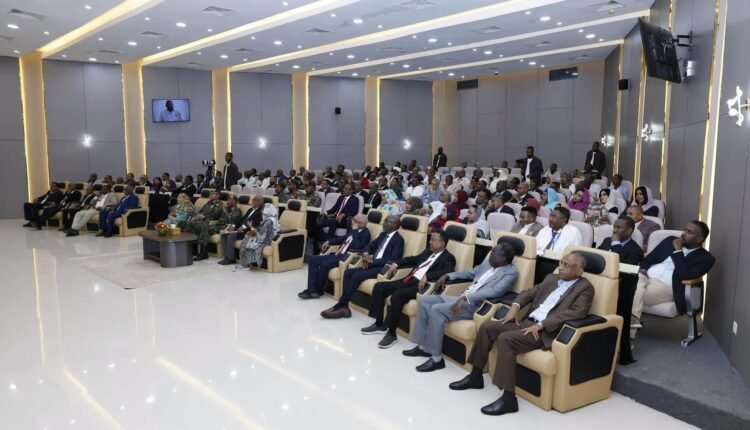
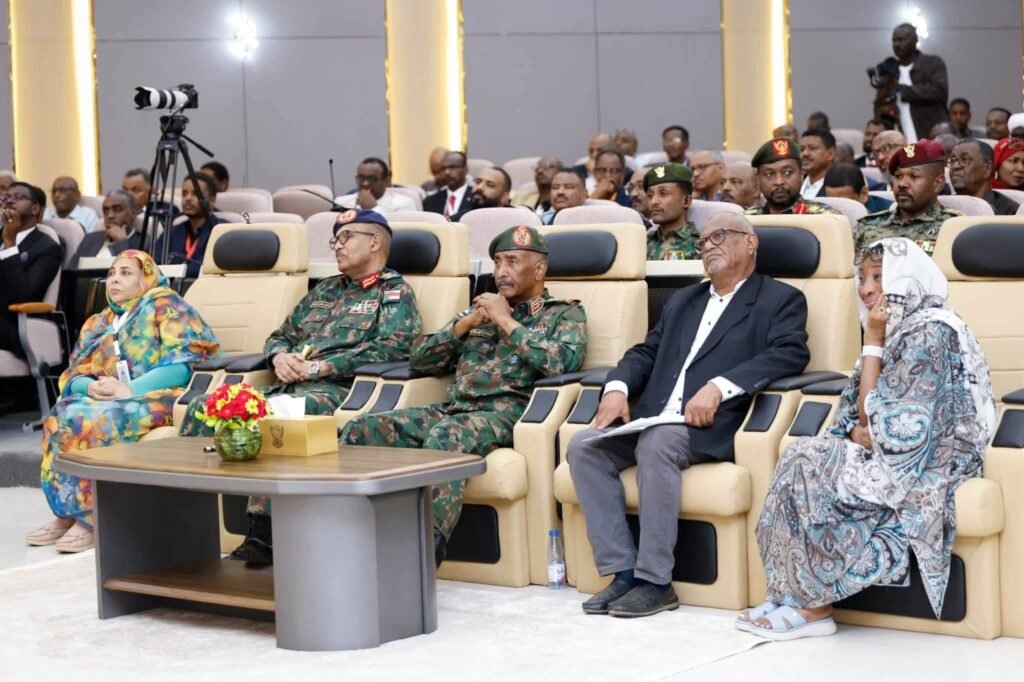
The layout of the spacious hall—divided into three sections by a central longitudinal aisle—was meticulously organized. Seating in the front row (spanning all three sections) was pre-arranged for dignitaries, elders, and the entourage of the Chairman of the Sovereign Council, while the central seats of the second row were reserved for security personnel. In the rest of the hall, seating was open, allowing attendees to choose wherever they pleased.
By late morning, the seating arrangements were complete, and the sound systems and display screens had been tested. Photographers from the Sovereign Council arrived with their equipment, setting up their cameras and tripods. Once preparations were finalized, the Chairman of the Sovereign Council entered, accompanied by Lieutenant General Ibrahim Gabir. He greeted the audience, the national anthem was played, and everyone took their seats.
Dr. Abdul-Malik Al-Naeem served as the program moderator. He announced that we would watch a short film about the media professionals’ forum and another about Khartoum, summarizing its story of rising from the rubble. He also informed us that we would hear a video message from the renowned veteran media professional, Professor Ali Mohammed Shammo—all of which took place as announced. He then invited Professor Abdellatif Al-Bouni (seated next to Al-Burhan in the front row) and Dr. Bakhita Amin to present the forum’s recommendations to the Chairman of the Sovereign Council, which they did.
– The Chairman’s Address:
The Chairman of the Transitional Sovereign Council took the podium. He reiterated his greetings and welcome to the attendees, pledged that the recommendations he had received would receive due attention, and directed the formation of a follow-up committee to oversee their implementation. He then proceeded to deliver his address.
He did not read from a prepared script, nor did I notice any notes or talking points before him; yet, it was evident that he had thoroughly prepared what he wished to convey to this major media gathering. In fact, he addressed every key issue that has preoccupied the public and shaped opinion over the past seven years, presenting his own account of each. He spoke about the past and future of the Rapid Support Forces (RSF); the civil-military partnership with the Forces of Freedom and Change—detailing “how it unfolded, how it ended, and how it disintegrated prematurely”—as well as the war, the performance of the armed forces during the conflict, and the army’s current and future status. He also discussed foreign relations, specifically regarding the stances of various nations on the war; economic and living conditions; the performance of the civilian government—which he dubbed the “government of professors”—and the prospects of the Sudanese-Sudanese dialogue.
In short, Al-Burhan sought to present a comprehensive narrative containing significant new details regarding the country’s major events, while simultaneously conveying a series of messages concerning the future—points I intend to elaborate upon in this article.
– Regarding the Rapid Support Forces (RSF) and their future:
Al-Burhan stated—paraphrasing here—that it is incorrect to claim the RSF numbered 20,000 when the Salvation (Ingaz) regime fell; rather, they numbered around 75,000, a figure resulting from the merger of Border Guard forces and other groups into the RSF. He added that the Salvation regime was the one that adopted the RSF, and that Al-Bashir—in the presence of military leaders—refused to integrate the RSF into the Armed Forces.
(He recounted: “I went to see him accompanied by Abdelrahim Hussein, Awad Ibn Auf, and Mohamed Atta, and we proposed integrating the RSF into the army; however, he asked Mohamed Atta if he agreed to have the RSF placed under the authority of the Intelligence Service, and Atta agreed”—as he put it. The Chairman of the Sovereign Council went even further, stating that the Salvation regime had actually planned to integrate the *SAF* into the RSF.
As for the current stance on the RSF, Al-Burhan emphasized that their position has remained consistent since the Jeddah negotiations in May 2023—a stance reiterated to every mediator who has approached them. In short, the options are either for the RSF to be defeated, with its leaders surrendering and laying down their arms voluntarily, or for a truce to be reached involving the RSF’s withdrawal from the cities and civilian facilities it currently occupies. Under this latter scenario, fighters would be assembled at locations previously specified to the mediators, subsequently undergoing demobilization and reintegration processes, while those who committed crimes would face trial. It is crucial to emphasize, however, that there is no political or military future for the RSF.
– Partnership with the Forces of Freedom and Change:
Al-Burhan stated that the SAF had no desire to assume governance of the country. He explained that when the military supported the revolution in April 2019 and entered into a partnership with the Forces of Freedom and Change, it had hoped for a smooth democratic transition culminating in free elections where the Sudanese people would choose their own leaders. However, they discovered that the primary aim and objective of the parties comprising the coalition was to seize power and pursue their own agendas. When these parties later sensed the army leadership’s dissatisfaction with this approach, they approached him, He met with Yasir Arman, Mariam al-Sadiq, and Babiker Faisal, who proposed that he remain Chairman of the Sovereign Council for ten years—with all necessary guarantees—provided he stepped aside and allowed them to do whatever they wished with the government; however, he rejected this offer.
He added that the then-Prime Minister, Abdalla Hamdok, had complained about the conduct of the Forces of Freedom and Change (FFC) parties. He noted that he and the army were in agreement regarding the “corrective measures” taken on October 25, 2021—maintaining that the events of that date did not constitute a coup, but rather a correction of the revolution’s course. He also mentioned telling a group of December Revolution youth recently that both parties—the revolutionaries and the army—had been deceived by the FFC parties, and that those parties which had aligned themselves with foreign interests had no place in Sudan’s political future.
– The Army’s Status: Pre-War vs. Present:
General Al-Burhan stated that they had prior intelligence regarding the Rapid Support Forces’ (RSF) intentions. When the war broke out, the army’s weaponry did not match that of the RSF; however, thanks to the fierce determination of the armed forces’ soldiers and officers—and the support of Sudanese citizens who joined army camps early on—they managed to hold their ground and repel the initial waves of attacks. He noted that the cost of the first military supplies they received—fifty million dollars each—was covered by two Sudanese businessmen.
Al-Burhan also provided new details regarding his exit from the General Command and the accompanying decoy operation. He described how he oversaw subsequent battles and personally directed the campaign to liberate Khartoum—fighting street by street and house by house—until the last Janjaweed fighter had left the city. He emphasized that the armed forces are currently at their peak in terms of readiness and armament, noting that they have constructed new airbases across several states—whereas previously, they possessed only a single base vulnerable to the enemy—and affirming that the plan to defeat the insurgency will proceed exactly as planned.
– Foreign Relations:
It appeared to me that Al-Burhan has solidified his stance on foreign engagement and defined the trajectory of future relations, guided by the positions various parties have taken regarding the war Sudan is enduring. He specifically named countries that stood by the Sudanese people during their ordeal—providing financial aid, humanitarian assistance, and diplomatic support in international and regional forums. He cited nations such as Saudi Arabia, Qatar, Kuwait, Algeria, Turkey, Egypt, and Eritrea as having unhesitatingly offered all forms of support to the Sudanese people. Conversely, he noted that other states—specifically the UAE, Ethiopia, Chad, and eastern Libya—harbored hostility toward the Sudanese people and provided full support to the rebels, who have committed every conceivable crime against civilians. While repeatedly acknowledging Saudi Arabia’s role, he hinted that the war has charted a new course for Sudan’s foreign relations.
He also did not shy away from expressing dissatisfaction with Western nations that attempted to blockade the Sudanese state and insisted on equating the country’s national army with the rebellious Rapid Support Forces (RSF) militia. He indicated an openness to mediation efforts but maintained that there are red lines which cannot be crossed—namely, disarming the RSF and dismantling its military structure, as previously outlined.
– Economic and Living Conditions:
Al-Burhan expressed dissatisfaction with the state of the country’s economy, hinting that an economic war had been waged against the nation. He noted that at the outbreak of the conflict, hundreds of state-owned companies held accounts abroad—mostly in Emirati banks—and that the UAE had seized the majority of these funds, diverting them to the Rapid Support Forces (RSF). He stated that the state controls only a fraction of gold production and receives a meager share from concession-holding companies. He indicated that they would not stand idly by regarding this situation, even though they had previously delegated these matters to the civilian government.
However, what struck me—and those beside me—most was his clear reference to the gap between the government and the general public. He referred to the administration as the “government of professors” and mentioned that he had urged them to engage more closely with the public and address their concerns. Some imaginative attendees drew a connection between these “criticisms” and the tense, alert demeanor displayed by Prime Minister Professor Kamil Idris when we met him about two hours later.
– The Sudanese Dialogue:
Regarding the Sudanese-Sudanese dialogue, the most significant point Al-Burhan made was his support for the initiative and his hope for its success, despite noting that he had not explicitly adopted it. In response to a question, he clarified that the current dialogue is not concerned with power-sharing or participation in the transitional period; rather, it focuses on the country’s future regarding comprehensive peace, national reconciliation, a permanent constitution, and other post-transition issues. When asked about his potential reaction should the participants recommend the return of the RSF to the political landscape, Al-Burhan stated that there are “red lines” drawn by the people that would not be allowed to be crossed.
Shortlink: https://sudanhorizon.com/?p=18090