

Arab League To Official Rejects Imposition of External Solutions on Sudan
Khartoum – Sudanhorizon
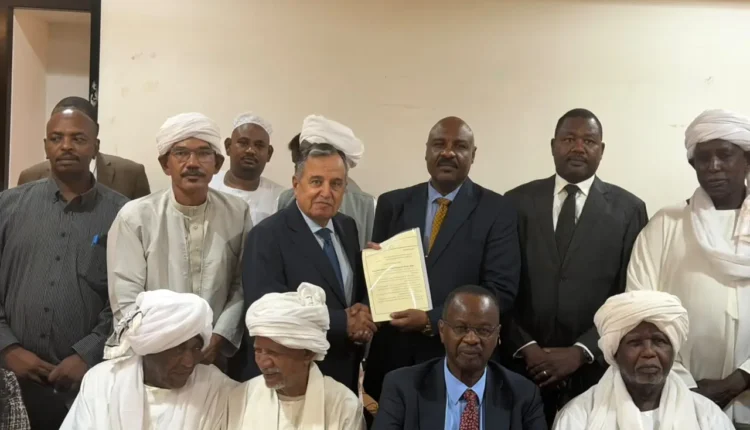
During a meeting with Nabil Fahmy, the Assistant Secretary-General of the League of Arab States, the National Forces Alliance presented its vision regarding the developments of the Sudanese crisis.
The Alliance urged the Arab League to take a clear stance against foreign interference and the supply of arms to the militia, while also calling for increased support for the Sudanese people and their legitimate institutions within international forums.
In the meeting—held in Khartoum on Monday and attended by the Arab League’s Assistant Secretary-General, Ambassador Zaid Al-Sabban—the Alliance affirmed its rejection of any attempts to establish parallel administrations or partition the country. It further emphasized its support for an intra-Sudanese dialogue—conducted within Sudan—free from foreign tutelage or interference.
The Alliance’s delegation included leaders and representatives from various political forces, national movements, traditional native administrations, Sufi orders, as well as women’s and professional organizations. Notable attendees included the Alliance’s General Coordinator, Mohamed Sayed Ahmed Al-Jakoumi, along with Dr. Tijani Sisi, Ismail Katar, Amin Mahmoud, Taj al-Din Banga, and Yusuf Mohamed Zein, among other representatives of various national forces and entities.
The Secretary-General of the League of Arab States opened the meeting by commending the diversity of the National Forces Alliance, noting the participation of women and youth. He mentioned that, during his visit to Sudan, he had met with the Chairman of the Sovereign Council, the Prime Minister, and the committee tasked with preparing the environment for an intra-Sudanese dialogue.
He emphasized that his presence in the country was intended to assess the situation on the ground firsthand.
Expressing his regret over the scale of the destruction in the capital, Khartoum—recalling his previous visits there during his tenure as Foreign Minister—he then invited members of the Alliance’s delegation to present their perspective on the Sudanese crisis and the role the Arab League should play in addressing it.
For their part, the delegation members welcomed the visit of the Secretary-General and his assistant. They praised the Arab League’s consistent support for the Sudanese people and their legitimate institutions in international forums, asserting that the events in Sudan transcend a mere internal crisis, constituting instead an act of external aggression that threatens both Sudanese and broader Arab national security.
The speakers pointed out that foreign interference—specifically the support provided by the United Arab Emirates to the Rapid Support Forces—has contributed to prolonging the war. They urged the Arab League to take a clear stance against such interventions and to play a more proactive role in supporting Sudan and countering attempts to undermine its unity and institutions.
The Alliance further requested that the Arab League serve as a voice for Sudan within the “Quintet” mechanism (the five-party group), act as a supporter and guarantor of the intra-Sudanese dialogue, and monitor the implementation of its outcomes.
They underscored that Sudan has consistently responded to peace initiatives, provided they are rooted in national principles and respect for the country’s sovereignty and territorial integrity.
Regarding the economic sphere, the Alliance called for the development of a comprehensive plan to support the Sudanese economy and the establishment of an Arab fund for the reconstruction of what has been destroyed by the war.
It also advocated for the activation of cross-border trade between Sudan and Arab nations. Furthermore, the Alliance emphasized the urgent need to bolster humanitarian aid for displaced persons and refugees—especially given the decline in funding for humanitarian organizations, with the delegation noting that budgets from supporting entities have shrunk by more than 60%.
The Alliance urged the Arab League to take action to mobilize the resources required to meet growing humanitarian needs. Additionally, the Alliance called for support for youth capacity-building and training programs, the creation of a platform for Sudanese women under the auspices of the Arab League’s General Secretariat, and backing for initiatives aimed at mending the social fabric and fostering peaceful coexistence among the various components of Sudanese society.
The Alliance expressed its appreciation for the stances taken by Fahmy and Ambassador Zaid Al-Sabban, commending the Arab League’s refusal to recognize any parallel government. It also affirmed the Sudanese people’s confidence that the League will play a supportive role in addressing the challenges currently facing Sudan.
For his part, Fahmy underscored the Arab League’s commitment to the Sudanese issue, noting that his meetings with various national forces revealed a consensus on the importance of preserving Sudan’s unity.
He stressed the rejection of any externally imposed solutions, affirming the League’s readiness to provide material and moral support for any serious initiative—specifically supporting an intra-Sudanese dialogue held within Sudan, free from foreign interference.
He explained that developments and achievements on the ground would assist the League in conveying an accurate picture of the situation in Sudan to other parties, thereby strengthening its efforts to promote stability and national unity.
Shortlink: https://sudanhorizon.com/?p=19483