

The Sudanese Memory: The Kababish Dogs – Harnessing Sudanese Experience

Mohamed El-Sheikh Hussein
Do the Sudanese possess a culture suited to their age? This question is both present and absent from the broader discourse on awareness and consciousness surrounding projects for change aimed at resolving the crises that pervade our lives.
But what cultural sources drive our disagreements and animosities? In other words, do the Sudanese have the knowledge to understand the wider world and engage with it successfully, using the country’s resources and heritage to develop Sudanese experience and expertise?
(1)
There is little room here for an extended discussion or a comprehensive answer. However, with more than 40 years of experience using police dogs to solve crimes, the General Directorate of Criminal Investigation and Research of the Sudanese Police has developed a Sudanese approach based on a practice long used by the Kababish tribes: using dogs to guard and tend their livestock.
Culturally, this experience represents an effort to draw on local heritage to improve contemporary life. The General Directorate of Criminal Investigation and Research, however, regards it as an investment in Sudanese experience, with the ambition of extending the practice throughout the Arab world.
(2)
The story dates back to the Police Dog Unit’s establishment in 1967. Since then, the unit has carried out specialised work, training police dogs and using their intelligence to solve certain crimes.
Initially, the unit used German Wolof dogs. It continued to perform its duties efficiently, achieving one success after another thanks to the German dogs’ high intelligence.
Over the years, as experience with police dogs grew and the unit’s personnel continued their research, they identified several Sudanese dog breeds used by local tribes. Particular attention was paid to the Kababish, who employ dogs to guard their property and help tend their camels.
(3)
This discovery attracted the attention of researchers in the Police Dog Unit, who began studying the Kababish experience to assess the intelligence and capabilities of these dogs.
The experiment proved successful. The researchers developed and trained the dogs and employed them for the same purposes as the German dogs.
One of the principal advantages of this approach is that it avoids some disadvantages of German dogs, which are accustomed to particular temperature ranges and have different dietary requirements. Kababish dogs, by contrast, are adapted to Sudan’s hot, arid environment. They require less care and attention and can survive on ordinary Sudanese food.
(4)
This successful experiment deserves careful consideration. The General Directorate of Criminal Investigation and Research presents it as a distinctive example of harnessing Sudanese community experience, developed by officers with considerable expertise in police-dog training.
A comparative study has been undertaken to examine the Sudanese experience alongside that of German dogs, highlighting the advantages and strengths of the local approach. The ultimate aim is to extend this experience throughout the Arab world.
The idea of employing Kababish dogs arose partly from the understanding that the German Wolof dogs belong to a breed whose name can be rendered in Arabic as German Shepherds. These dogs are traditionally used to herd sheep and cattle in northern Europe.
(5)
This interpretation gave rise to the idea of using Kababish dogs, which perform similar functions by tending different kinds of livestock and providing effective protection for herds.
A question then emerged: why not employ the herding dogs already used in Sudan for police work, given the widely recognised view that herding dogs are among the most suitable breeds for police duties?
(6)
The Kababish tribes inhabit the northernmost parts of North Kordofan State. Their traditional homeland, known as Dar al-Kababish, stretches from the Khartoum State border in the east to the North Darfur border in the west.
The Kababish are renowned for raising and herding camels and sheep. The Kabashi sheep is particularly prized, followed by the Hamari sheep, which is raised by the Hamar tribes.
(7)
The Kababish raise dogs for guarding and hunting, particularly hunting gazelles and rabbits.
They place great importance on good dog bloodlines and seek out quality dogs wherever they can find them.
For the Kababish, dog breeding is not a luxury; it is a necessity. Dogs help their owners track their livestock when animals stray, go missing or are stolen by thieves and highway robbers.
They also alert their owners to unusual or suspicious movements while they are out in the open countryside or among the valleys. In addition, the dogs satisfy their owners’ passion for hunting.
Each type of dog is bred, cared for and trained, with particular attention paid to preserving its bloodline.
(8)
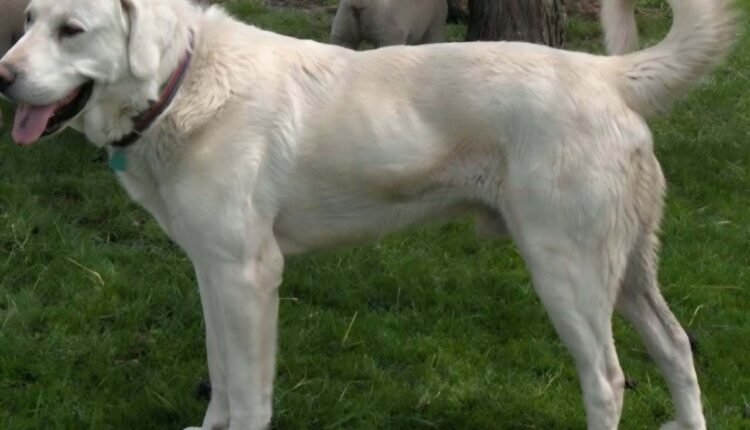
Kababish dogs are regarded as a native Sudanese type associated with the Kababish tribe. They are distinguished by their outstanding guarding and tracking abilities, keen intelligence and strong capacity to respond to different forms of training. They are also considered adaptable and amenable to handling.
In temperament and behaviour, Kababish dogs form strong bonds with human beings. They are not naturally aggressive and tend to excel at guarding property and protecting their surroundings.
Stories about successful dogs and their achievements circulate widely. A reference to a dog belonging to a particular person is often enough to indicate it comes from an excellent bloodline.
Among the best-known examples are the dogs belonging to Sheikh Mohamed Ali al-Tom, known as al-Murr, who served as regent of the Kababish tribal leadership from 1945 to 1952.
(9)
Sheikh al-Murr’s dogs were reputed to be of the Nimr type, powerful, fast hunting dogs likened to a tiger in strength and speed.
His most famous dog was called Akkam. It was large, powerfully built and formidable in appearance. A line of poetry was composed in its honour:
As though it were fashioned from a solid block of rock, firmly bound upon sturdy spears.
(10)
The Kababish are a camel- and sheep-herding people. For them, a dog is not an ornamental animal but a working companion entrusted with several essential tasks:
Guarding sheep enclosures: protecting flocks at night against wolves and hyenas.
Hunting: pursuing rabbits and gazelles.
Symbolising strength and wealth: owning many dogs signals power and prosperity, much like owning camels.
(12)
The Kababish type of dog does not have an internationally registered breed standard. It is, however, described as a cross between the desert hunting dog, the Saluki, and the Sudanese herding dog.
These dogs are tall, lean and fast, with a strong ability to withstand heat and thirst. They are wary and potentially aggressive toward strangers, yet affectionate and familiar with household members.
Shortlink: https://sudanhorizon.com/?p=18781