

Lifting Sanctions on Eritrea: How Is Washington Redrawing the Red Sea Equation, and What Awaits Sudan?
Cairo – Sudanhorizon – Sabah Mousa
The United States’ decision to lift sanctions on Eritrea at this juncture was not merely the closure of an old file tied to the Tigray war. Rather, it opens the door to broader questions about the reshaping of US influence in the Horn of Africa and the Red Sea, and the possible repercussions for Sudan and the wider region.
Lifting the Sanctions
Yesterday, Friday, the US Treasury Department ended the state of emergency Washington imposed in 2021 against the backdrop of the Ethiopian crisis between the federal government and the Tigray region. It removed several individuals and entities linked to the issue from its sanctions list. These included Eritrea’s People’s Front for Democracy and Justice, Eritrean individuals and entities, and the Eritrean Defence Forces. The sanctions had been linked to Eritrea’s role in the Tigray war, as well as human rights and humanitarian concerns. Their lifting now comes amid regional shifts that have made the Red Sea and Bab al-Mandab more sensitive in international calculations, particularly amid security tensions and intensifying competition over ports and influence in the Horn of Africa.
The move raises several questions: What does Washington want from Asmara? Is it looking for a new partner in the Red Sea? And where does Sudan stand in this equation?
Sudan Is Close By
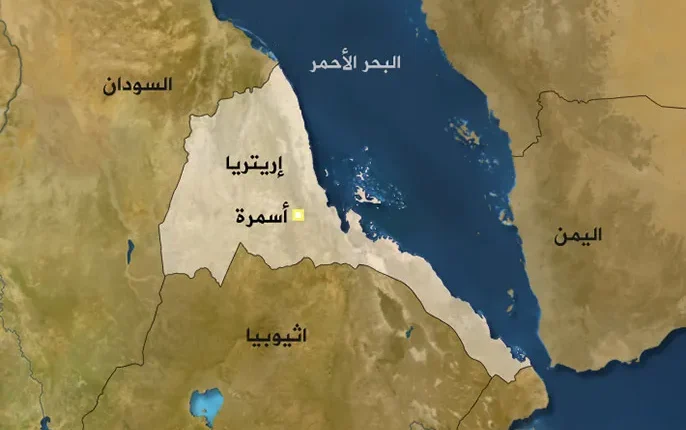
It is difficult to view the US shift towards Eritrea separately from Sudan. The two countries share a direct border, while Eritrea lies close to Sudan’s Red Sea coast. As the war in Sudan continues, the country’s east has assumed increasing security and political importance, given the region’s links to Red Sea security, trade and energy flows, and refugee movements. Consequently, improved US relations with Asmara give Washington an additional window onto eastern Sudan and the Red Sea, without necessarily implying a desire to use Eritrea against Sudan.
At the same time, however, the move increases Eritrea’s strategic value at a moment when Sudan has become part of a broader regional and international conflict.
A New Partner?
There are not yet sufficient indications to conclude that Washington has decided to turn Eritrea into a strategic ally. However, lifting sanctions on the Eritrean military, the ruling party and entities associated with it represents a shift from a policy of pressure towards broader engagement.
Reuters has linked the move to Eritrea’s strategic location along the Red Sea shipping route, while other reports have tied the shift to growing competition in the region. Accordingly, talk of a “new partner” remains a political possibility, whereas what is clear is that Washington has opened the door to a different relationship with Asmara.
If that relationship develops into political, security or maritime cooperation, Eritrea could become more prominent in issues concerning Sudan, the Red Sea, borders, refugee movements and maritime security. This would not necessarily mean that Asmara would become a “US tool” in Sudan, however, as Eritrea has its own calculations. It also maintains close relations with Egypt and has an openly stated position supporting Sudan’s unity and sovereignty.
The Difficulty of Substitution
Egyptian expert on African affairs Dr Hamdy Abdel Rahman ruled out the possibility that the United States is seeking to replace Eritrea with Ethiopia in its calculations in the Horn of Africa. He stressed that Washington is seeking to build relations with both countries simultaneously, although the nature and areas of those relationships may differ.
Speaking to Sudanhorizon, Abdel Rahman said that the circumstances that had prompted Washington to impose sanctions on Eritrea in 2021 had changed considerably. He explained that the sanctions had been linked to the Tigray war, human rights issues and the humanitarian situation. In contrast, current developments in the Red Sea and the Horn of Africa had produced a different agenda.
He noted that Red Sea security and freedom of navigation, tensions associated with the Houthis and Bab al-Mandab, and competition over ports and influence in the Horn of Africa had become key issues in US calculations. Eritrea’s long Red Sea coastline gives it particular strategic importance, he said.
Abdel Rahman added that Eritrea could be a “partner” of the United States rather than an “ally”, based on an interests-driven approach, arguing that this was consistent with the current US administration’s approach.
Egyptian Challenges
Abdel Rahman explained that improved US relations with Eritrea were not necessarily directed against Egypt. He pointed to the meeting between Egyptian President Abdel Fattah el-Sisi and Eritrean President Isaias Afwerki in Cairo about two months ago, during which they discussed Red Sea issues and freedom of navigation. This came alongside Egyptian-Eritrean-Somali coordination and US contacts concerning Red Sea security.
He said one scenario of interest to Cairo was that improved US relations with Asmara could lead to greater American interest in the Eritrean coast, potentially altering the balance of power in the Red Sea.
Egypt, he stressed, has coordination with Eritrea, but the United States will not abandon Ethiopia given its continuing importance to Washington. This does not necessarily mean the United States views Addis Ababa and Asmara as competing parties; rather, it reflects the complexity of its relations with countries in the region.
Abdel Rahman noted that the Sudan file is particularly sensitive for Egypt, given the direct border between Sudan and Eritrea and Egypt’s extensive interests in Sudan. In his view, Eritrea could serve as a link between the Red Sea, Sudan and the Horn of Africa.
An Incomplete Move
For his part, journalist and political analyst Dr Khalid Al-Tijani, editor-in-chief of Elaph newspaper, said that lengthy talks had taken place in recent months between the United States and Eritrea through Egyptian mediation, as part of moves related to developments in the Horn of Africa and the Red Sea.
Speaking to Sudanhorizon, Al-Tijani said Washington was increasingly concerned about developments in the Horn of Africa and the Red Sea, particularly following developments associated with the Gulf War and tensions in the Strait of Hormuz.
He noted that the United States was working to reshape the regional landscape, which required building relations with various relevant parties. He questioned Washington’s ability to manage tensions between Ethiopia and Eritrea and the importance of Ethiopia in US calculations given its internal complexities.
The Ethiopian scene, he stressed, involves considerable complexities. US moves could encounter national interests and domestic complications in both Ethiopia and Eritrea, in addition to the difficulty of reaching final solutions given the two countries’ complex historical legacy.
Al-Tijani stressed that any US move to reorder the landscape in the Horn of Africa and the Red Sea would be “incomplete” without Sudan, an active and influential party in the region’s equations. Sudan’s geographical position and regional interconnections, he said, make it difficult to ignore in any new arrangements.
Rapidly Changing Dynamics
Sudanese researcher specialising in African affairs Dr Mohamed Torshin believes the lifting of US sanctions on Eritrea comes amid rapidly changing political and security dynamics in the Horn of Africa and the Red Sea.
Speaking to Sudanhorizon, Torshin said developments associated with the Houthi movement and security threats in the Strait of Hormuz had imposed a new reality on US calculations, alongside Ethiopian influence and Addis Ababa’s continuing desire to secure maritime access to the Red Sea.
He explained that these factors had prompted Washington to reconsider its relations with Eritrea and seek a maritime foothold of its own. Asmara, he said, could enter into understandings with Washington even if these did not rise to the level of alliances, thereby strengthening the US presence in Red Sea security arrangements.
He added that Eritrea’s good relations with Egypt, Saudi Arabia and Jordan, together with what he described as its reluctance to open the door to powers such as Russia and China, helped explain the growing American interest in Asmara.
Torshin stressed that Ethiopia had succeeded in rebuilding its relations with Washington and remained highly important in US calculations in the Horn of Africa. Nevertheless, Ethiopia could not replace Eritrea, just as Eritrea could not replace Ethiopia, because their roles and interests differ.
He explained that Eritrea’s position on the Red Sea makes cooperation with the United States important for maritime and security calculations. At the same time, Ethiopia is a pivotal state in other areas, including combating armed groups such as al-Shabaab and countering growing Chinese influence in the Horn of Africa.
He continued that any other party, including Sudan, could not fully replace the US presence through Eritrea. At the same time, however, he stressed that Sudan was no less important in regional calculations because of its geographical position, its Red Sea coastline, and its role in the dynamics of the Horn of Africa.
He concluded that Washington was seeking to ensure that both shores of the Red Sea formed part of a regional environment conducive to its interests and distant from powers it regards as competitors or sources of threat, whether Russia, China or certain other regional powers.
Conclusion
Lifting sanctions on Eritrea may ultimately prove to be no more than a legal measure ending sanctions associated with the Tigray period. If, however, it is followed by further US steps, such as expanding diplomatic relations, security or maritime cooperation, or investment, it could have a broader strategic impact.
In that case, Washington would add to its network of regional relationships a country occupying an exceptional position on the Red Sea. Sudan would be among the countries most directly affected by this development—not because Eritrea has any say over Sudan’s decisions, but because its geography makes it part of the strategic environment surrounding Sudan.
Sudan therefore faces two interconnected scenarios: an internal war that will determine the future of the state, and regional and international competition that will largely determine the scale of the pressures, interventions, and opportunities surrounding it.
Lifting sanctions on Eritrea directly concerns the second scenario. It may expand Washington’s tools for dealing with the environment surrounding Sudan, without necessarily implying an automatic change in the US position on the Sudanese war.
Shortlink: https://sudanhorizon.com/?p=18196