

Where will the Convergence of Visions Between Egypt and Sudan Lead?
Cairo – Sudanhorizon Sabah Moussa
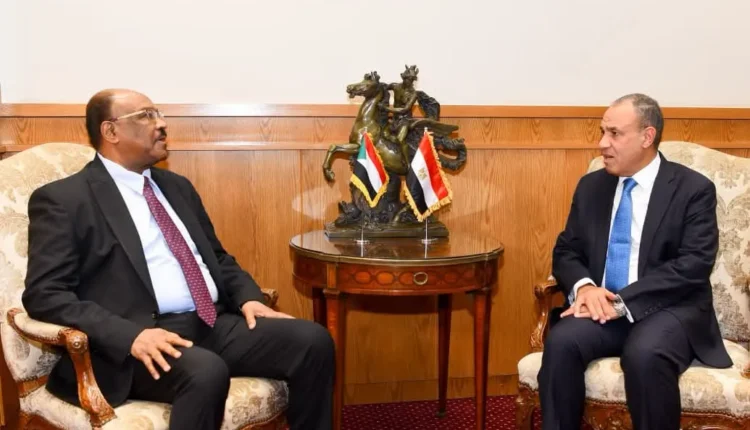
The quadrilateral meeting held , Monday, between the foreign ministers and ministers of water resources and irrigation of Egypt and Sudan, is of paramount importance, extending beyond bilateral coordination regarding the water issue and the Grand Ethiopian Renaissance Dam (GERD). It reflects the two countries’ keenness to unify their visions and enhance political and strategic consultation regarding shared challenges, given the rapidly evolving regional and international dynamics and the convergence of interests that necessitate increased coordination between Cairo and Khartoum to protect their interests and common security.
Support for Sudan
Egypt and Sudan reaffirmed the need for preserving Sudan’s unity, territorial integrity, and national institutions, and rejected any threat to its sovereignty or any attempt to establish parallel entities. This came during the third round of meetings of the (2+2) Consultative Mechanism between the two countries’ foreign and irrigation ministers, held in Cairo on Monday. According to a statement from the Egyptian Ministry of Foreign Affairs, the Egyptian side emphasized its support for the Sudanese people and their national institutions, stressing the direct link between the national security of the two countries and Egypt’s readiness to take all necessary measures guaranteed by international law and the Joint Defense Agreement to support Sudan.
Political Messages
Cairo’s stances, as reflected in Monday’s meetings, carry clear political messages regarding Egypt’s continued commitment to Sudan’s unity, sovereignty, and territorial integrity, the preservation of its national institutions, and the rejection of any attempts to establish parallel entities or interfere with its independent national decision-making. These messages are particularly significant given the multitude of regional and international initiatives and moves concerning the Sudanese crisis, and the accompanying divergences in visions and interests. Cairo is not merely reaffirming its steadfast position on the crisis, but is also keen to maintain active channels of direct consultation with Khartoum, considering this a political and strategic necessity for both countries. The nature of the challenges facing Egypt and Sudan, whether related to regional security or the future of stability in Sudan, necessitates that coordination extend beyond public pronouncements to include the exchange of information, the unification of visions, and the integration of actions. This is essential to protect shared interests and mitigate the repercussions of regional interventions and rivalries.
Protecting Rights
Regarding the Nile waters, both sides, according to the Egyptian statement, reiterated their rejection of unilateral actions in the Eastern Nile Basin and emphasized the necessity of protecting their water rights based on the 1959 Nile Waters Agreement. They stressed that the Ethiopian dam poses a continuous threat to downstream countries due to its unilateral management and the absence of a legally binding mechanism governing its operation and management. The two sides also condemned the targeting of Sudanese infrastructure, particularly power stations and water facilities, by drones launched from a neighboring country. They emphasized their respect for Sudan’s sovereignty and their support for its national institutions. The two sides discussed ways to enhance cooperation in Sudan’s reconstruction. The Sudanese side commended the Egyptian initiative to assess the damage to the Jebel Aulia Dam and the ongoing maintenance work by Egyptian experts in cooperation with the Sudanese Ministry of Agriculture and Irrigation. Furthermore, both sides affirmed their rejection of any attempts to militarize the Red Sea or infringe upon the sovereignty of its riparian states. They stressed the importance of strengthening cooperation and coordination among the riparian states and rejected any maritime presence or access by non-riparian states.
Alignment of Positions
The alignment of the Egyptian and Sudanese positions on the Grand Ethiopian Renaissance Dam (GERD) represents one of the most prominent outcomes of coordination between the two countries. This is not only due to the direct link between the issue and the water security of both nations, but also because it necessitates a unified vision regarding the management of Nile resources and addressing the repercussions of the Ethiopian dam in accordance with the rules of international law. This approach safeguards the rights of the downstream countries and the interests of their people. Furthermore, a similar Egyptian-Sudanese stance grants both countries greater weight in regional and international initiatives and consultations concerning the future of the Nile issue. It also strengthens their ability to defend their rights against unilateral actions, especially since the repercussions of this issue extend beyond water resources to regional security and stability.
Translation of Links:-
The importance of political coordination is inseparable from the necessity of developing Egyptian-Sudanese relations on a practical level. This involves transforming historical ties and a shared destiny into tangible cooperation programs encompassing reconstruction, infrastructure, water resources, training, and the exchange of expertise. In this context, the memorandum of understanding signed Monday by both sides regarding development projects in Sudan’s water sector reflects a trend toward expanding cooperation from the level of political positions to the level of practical projects. However, the real challenge remains ensuring the implementation of these projects on the ground and translating the agreements into tangible results that contribute to supporting Sudan and strengthening integration between the two countries.
Important Timing:
For his part, former Egyptian Assistant Foreign Minister, Ambassador Hossam Issa, emphasized the importance of the quadrilateral meeting held today between Egypt and Sudan, noting that it comes at a crucial time, given what he described as the Ethiopian side’s attempts to provoke the countries of the region and its pursuit of ambitions not sanctioned by international law. Former Egyptian Ambassador to Khartoum, Issa, told Sudanhorizon that the meeting coincided with Ethiopia’s announcement of its intention to build more dams on the Blue Nile and target power stations in Sudan. He explained that the drones that targeted power stations in various parts of the country were launched from Ethiopian territory, according to Khartoum’s announcement. He added that Ethiopia, through these actions, is pursuing a policy that will destabilize its regional environment, seeking to achieve its ambitions in neighboring countries and their water resources and seaports. He clarified that the meeting reflected the convergence of Egyptian and Sudanese visions on a number of issues, including agreement on the 1959 Nile Waters Agreement and its importance to both countries, support for peace and stability in Sudan, and the Egyptian role in the country’s reconstruction. Regarding Red Sea security, he noted that the meeting also welcomed the new development in the Nile Basin Initiative, namely opening the door to amending its terms and listening to the countries that have not yet joined, particularly Egypt and Sudan, in order to ensure their water interests are taken into account.
A Shared Threat
Issa added that the meeting reflects a fundamental reality: the unity of Egyptian and Sudanese water security, given that both countries are downstream nations. Any threat to this security constitutes a shared threat to them, making the coordination and alignment of positions essential to protecting their water rights. He observed that the steadfastness and convergence of the Egyptian and Sudanese positions have begun to influence the Ethiopian stance on the Nile Basin Initiative, pushing towards new positions that pave the way for amending the initiative to take into account the interests of all riparian states, including the downstream countries. He continued that this coordination contributes to establishing a clear front comprising the countries affected by Ethiopian policies, foremost among them Egypt, Sudan, and Somalia. He emphasized that the message to the Ethiopian leadership is now clear: it must reconsider actions that disregard the rules of international law. He warned that the continuation of these policies could lead to Ethiopia’s regional isolation and make it a pariah state in the East African region.
A Successful Meeting:
For his part, Sudanese strategic expert Dr. Amin Ismail Majzoub considered Monday’s meeting one of the most successful meetings to address the Nile water issue and joint cooperation between the two countries. Majzoub told Sudanhorizon that the loan provided by the World Bank for development was among the successful initiatives that witnessed coordination between the two countries, in addition to joint agricultural projects between Egypt and Sudan. He added that the most notable aspect of the meeting was the convergence of views between the two countries regarding the Grand Ethiopian Renaissance Dam (GERD) and the binding agreements demanded by both sides, as well as water flows and the preservation of Sudanese reservoirs. These issues were discussed extensively during the meeting. He explained that coordination in the coming period will move to the work of joint committees, with the blessing of the two countries’ presidencies. He also indicated that cooperation will address many other issues, including efforts related to achieving peace in Sudan.
In conclusion, the quadrilateral meeting between Egypt and Sudan cannot be viewed as merely another round of technical consultations regarding the Nile waters and the Grand Ethiopian Renaissance Dam (GERD). Rather, it represents a confirmation that Cairo and Khartoum consider their water and political security as interconnected spheres, and that protecting common interests requires continuous coordination that extends beyond traditional bilateral issues to encompass all matters affecting the stability of both countries and their regional environment. Given the regional and international competition for influence in the Horn of Africa, the Nile Basin, and the Red Sea, maintaining a unified Egyptian-Sudanese position based on shared interests and respect for international law, while preserving the independence of each country’s national decision-making, is of paramount importance. The most crucial test of this meeting’s outcome remains the extent to which Cairo and Khartoum can translate this political consensus into sustainable coordination mechanisms and joint practical positions, particularly concerning the GERD, supporting Sudan’s stability, and securing the Red Sea. This will ensure that the unity of positions does not remain a mere political affirmation, but rather transforms into a tangible force for protecting the interests of both countries.
Shortlink: https://sudanhorizon.com/?p=19765