

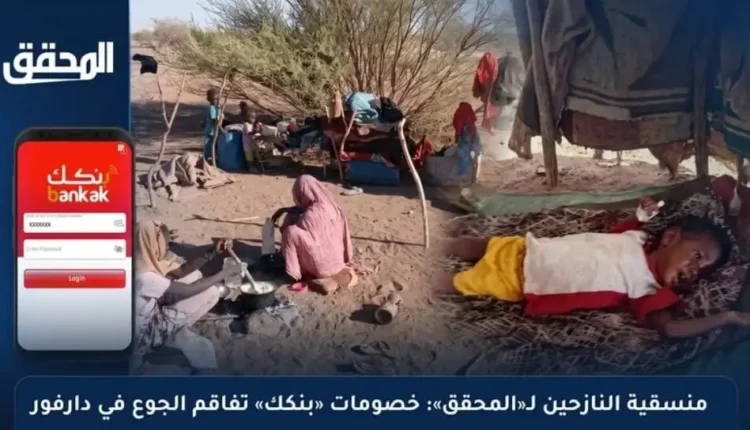
IDPs Coordination Body: “Bankak” App Deductions Exacerbate Hunger in Darfur
Sudanhorizon– Nashwa Ahmed Al-Tayeb
Adam Regal, spokesperson for the General Coordination for Displaced Persons and Refugees in Sudan, has warned that conditions in Kalma IDPs camp—and other camps across Darfur—have moved beyond mere aid shortages, evolving into a “daily survival crisis.” He emphasized that many families are now unable to secure even a single meal a day, with children and mothers frequently going to sleep hungry.
Speaking to this news outlet, Regal stated that critical humanitarian issues are not receiving sufficient attention—most notably the rapidly deteriorating food security situation and the decline in humanitarian aid. He pointed to the widening prevalence of malnutrition, particularly among children, women, and the elderly, in the Kalma, Tawila, Kassab, and Nierteti camps, as well as the Qolo and Al-Hamidiya camps in Zalingei and others throughout the region.
The spokesperson explained that soaring prices for basic food baskets, the loss of income sources, dwindling employment opportunities, and a severe lack of liquidity have made obtaining food extremely difficult for many families. Compounding this is the deduction of 40% to 50% from the value of financial transfers made via the “Bankak” mobile banking application.
Regal added that one of the most alarming trends observed by the Coordination body on the ground is that families are being forced to cut back on daily meals, take on debt, sell off their remaining possessions, and subsist on food with very limited nutritional value. He pointed to the presence of children suffering from malnutrition and anemia, as well as pregnant women facing dire health and living conditions. He further noted that the deterioration of the agricultural season, a scarcity of rainfall, and a decline in local production are exacerbating the vulnerability of communities that rely on farming and daily-wage labor.
Regarding the number of families at risk of losing their sources of food, Rijal stated that the coordination body does not yet possess comprehensive, up-to-date field surveys to provide an exact figure, and that it wishes to avoid offering unsubstantiated estimates. However, he emphasized that field indicators point to a concerning expansion in the number of those affected, and that families have exhausted all their coping mechanisms.
The spokesperson cited the Integrated Food Security Phase Classification (IPC), which indicates that 19.5 million Sudanese are suffering from severe food shortages, including 5 million who are in an emergency phase. He explained that the number of people affected in Darfur is extremely high.
“When a family is forced to choose between buying food or medicine, and when children go to sleep without a sufficient meal, the crisis has moved well beyond the bounds of typical humanitarian need,” Rijal said. He expressed concern that the situation could deteriorate significantly further over the next three to six months.
The spokesperson addressed the international community, humanitarian organizations, and UN agencies, urging them not to wait for a formal declaration of famine before taking action. He noted that such a declaration would imply that lives have already been lost, stressing that saving lives requires a response before signs of hunger escalate into irreversible human casualties.
Shortlink: https://sudanhorizon.com/?p=19785