

Isnad Cultural Forum Launches “Religious Education in Darfur” Book
Cairo – Sudanhorizon
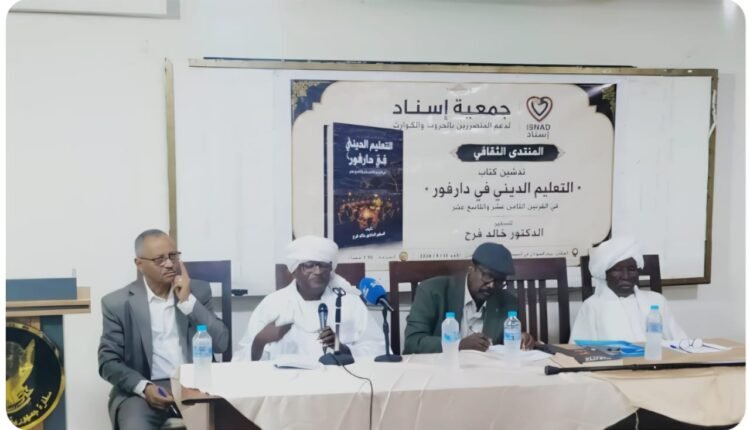
“Sudan House” in Cairo’s Sayeda Zeinab district hosted a new event organized by the Isnad Cultural Forum on Sunday evening. The event was organized by the Isnad Association for Supporting People Affected by Wars and Disasters and featured the launch of the book Religious Education in Darfur by Ambassador Dr. Khalid Farah. The event drew a notable audience of diplomatic, cultural, media, community, and academic figures, as well as a number of people interested in Sudan’s history and intellectual and cultural heritage.
The forum was attended by Dr. Asim Mohammed Hassan, Cultural Counselor at the Sudanese Embassy in Cairo; Ms. Amira Al-Fadil, Chairperson of the Board of Directors of the Isnad Association; along with a number of journalists, media professionals, prominent community figures, and a large group of invited guests and those interested in Sudanese cultural affairs.
The forum was moderated by Ambassador Al-Obaid Marouh, who led the discussion on the book and its contents and provided participants with ample space for interaction and debate on an important chapter in the scholarly and cultural history of Darfur.
During the book launch, author Ambassador Dr. Khalid Farah spoke about the motivations behind his decision to address the subject of religious education in Darfur and the importance of this aspect in understanding the history and scholarly and cultural development of the region.
He said the book opens a window onto the history of religious education and Sufism in Darfur, examining the origins of religious education, centers of learning, prominent scholars and Sufi figures, and Sufi orders and their role in shaping the region’s intellectual and cultural life. It also highlights Darfur’s civilizational significance as a meeting point for cultures and knowledge.
The book offers a historical account based on documentation and sources, shedding light on the depth of Darfur’s scholarly and religious experience and contributing to a renewed understanding of an important aspect of Sudan’s history, away from stereotypical portrayals and fragmented interpretations.
Ambassador Dr. Khalid Farah stressed that documenting this heritage represents a scholarly responsibility, particularly because many aspects of Sudan’s intellectual and cultural history require further research, documentation, and dissemination to future generations so that important chapters of the country’s collective memory are not lost.
For her part, Ms. Amira Al-Fadil, Chairperson of the Board of Directors of the Isnad Association, stressed the importance of extending the association’s mission into the cultural and intellectual sphere alongside its humanitarian and community roles.
She welcomed the launch of the book, describing the documentation of Sudan’s history and scholarly and cultural heritage as a form of protecting the national memory. She said that holding forums of this kind gives younger generations an opportunity to learn about their country’s history and the contributions of its regions and communities to the development of knowledge and civilization.
Amira noted that the Isnad Cultural Forum forms part of the association’s efforts to create spaces for dialogue and interaction and to highlight Sudanese creativity and intellectual production. She stressed that the people Isnad seeks to support need not only assistance during times of crisis, but also knowledge, culture, and the preservation of their identity and collective memory.
The forum featured rich contributions and discussions from attendees, addressing the importance and documentary value of the book, the role of religious education in shaping Darfuri society, and the contribution of scholars and centers of learning to the dissemination of knowledge. Discussions also highlighted the need for continued research into the history of Sudanese education and culture and for its sources to be properly documented.
The participation of journalists, media professionals, and community figures further enriched the discussion and added another dimension to the event, reflecting the role of the media as an essential partner in introducing Sudanese intellectual and documentary works to a wider audience.
The launch of the book was not merely an occasion to introduce a new publication, but evolved into a space for dialogue on the scholarly and cultural memory of Darfur and Sudan. It brought together diplomatic, cultural, media, and community figures around a subject closely connected to the history of knowledge and the formation of society.
The Isnad Association affirmed that organizing the event forms part of its vision to strengthen the role of culture and documentation within its activities, and its belief that protecting people also means protecting their memory, history, identity, and cultural and intellectual heritage.
The forum concluded in an atmosphere reflecting the attendees’ appreciation for the book and the initiative launched by the Isnad Association, with participants emphasizing the importance of continuing cultural forums that open avenues for dialogue on Sudanese history and provide intellectual and documentary works with the space they deserve.
Shortlink: https://sudanhorizon.com/?p=18025