

UNIDO Lays Out a Roadmap for Economic and Industrial Recovery in Sudan
Sudanhorizon – Nazik Shamam
The Sudanese economy is facing significant structural imbalances in the aftermath of the war. Uncontrolled exchange rates, declining agricultural and industrial production, scarce exports, the state budget’s reliance on taxes and government fees, the absence of services, and widespread unemployment are all problems stemming from a severe economic downturn following a war that depleted resources for over three years.
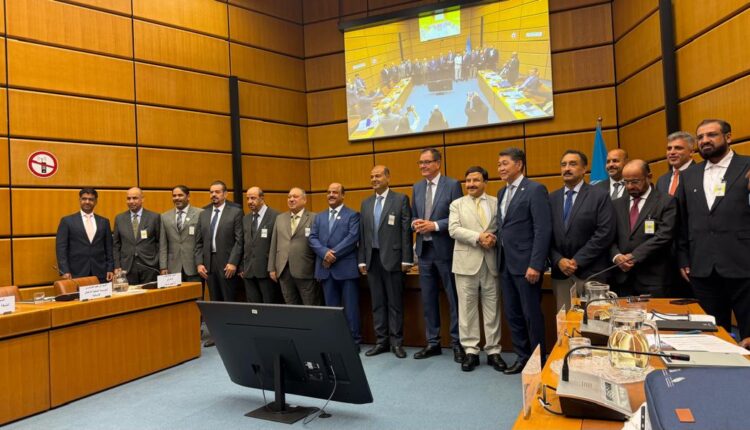
This situation persists while Sudan remains isolated from any international development assistance. Therefore, the meetings held in Vienna, Austria, on Monday, under the auspices of the United Nations Industrial Development Organization (UNIDO), and dedicated to supporting economic and industrial recovery in Sudan, Syria, and Palestine, were a welcome development for the Sudanese private sector, which is heavily relied upon for reconstruction in the coming phase.
Sudan participated in meetings focused on supporting economic and industrial recovery in Sudan, Syria, and Palestine, with a delegation from the Sudanese Employers’ Federation. Representatives from UNIDO, the Arab-German Chambers of Commerce, donor agencies, development and humanitarian organizations, and government and private sector representatives also participated.
Industrial Recovery Fund:
Participants emphasized the importance of shifting from the traditional reconstruction concept to a sustainable economic recovery approach. This approach focuses on rebuilding value and production chains, creating jobs, and enhancing the private sector’s contribution to the economy. They stressed the importance of small and medium-sized enterprises (SMEs) as the fastest drivers of economic activity, job creation, and the integration of youth and women. They also emphasized the need to provide these SMEs with the necessary financing and technical services.
Participants proposed the establishment of an Industrial Recovery Fund to serve as a platform for mobilizing and directing financial resources toward productive projects and projects aimed at rebuilding industrial and economic capacities in the targeted countries.
A New Investment Mission:
During the meetings, an investment mission organized by the United Nations Industrial Development Organization (UNIDO) to Sudan was announced. The mission, scheduled for September 5-11, 2026, will include European and German companies and investors, as well as representatives from international financing and development institutions. Its aim is to identify available investment opportunities and build direct partnerships with the Sudanese private sector.
This investment mission is considered one of the most important practical outcomes of the meetings, necessitating early preparation by the Sudanese Employers’ Federation and the national private sector. This preparation should include compiling a list of projects ready for investment and financing and holding the necessary preparatory meetings to ensure maximum benefit.
The Sudanese Ambassador to Austria, Magdi Mufaddal, revealed the extent of the damage inflicted on the Sudanese economy as a result of the war. He explained that what occurred was not merely partial damage, as is the case in traditional wars, but rather systematic looting and sabotage targeting both public and private institutions. He pointed out that the war struck at the heart of the Sudanese economy, as it erupted in Khartoum, which accounted for more than 75% of the country’s economic activity. This led to widespread destruction of infrastructure, industrial, service, and commercial facilities, directly impacting production, employment, and investment.
The Resilience of the Sudanese Economy:
In his remarks, Mufaddal explained that Sudan is facing one of the world’s largest humanitarian crises in terms of the number of internally displaced persons, refugees, orphans, and widows. He noted that the Sudanese economy has demonstrated remarkable resilience despite the exceptional circumstances the country is experiencing.
He highlighted the resilience of the Sudanese economy by mentioning the World Food Programme’s purchase of 20,000 tons of maize from Sudan’s strategic reserves to be distributed to those affected by the humanitarian crisis in South Sudan. This reflects the continued capacity of the Sudanese agricultural sector to produce despite the significant challenges.
For his part, the Director-General of the United Nations Industrial Development Organization (UNIDO), Gerd Müller, stated that the time has come to move from discussions and conferences to practical implementation. He noted that the organization has technical teams and specialized expertise already working within the target countries and is ready to work directly with governments and the private sector to develop viable projects.
During his meeting with a delegation from the Sudanese Employers’ Federation on the sidelines of the meetings, Müller emphasized that UNIDO views the Sudanese private sector as a key partner in the economic and industrial recovery process and is keen to work directly with private sector institutions, alongside government entities, in developing and implementing future programs and projects.
Müller also highlighted the organization’s interest in strengthening cooperation with Sudan in the coming phase and working to build practical partnerships that contribute to supporting economic and industrial recovery.
Alternative Solutions to Gold Smuggling:
In his meeting with Sheikh Ibrahim bin Khalifa Al Khalifa, Chairman of the Board of Trustees of the Accounting and Auditing Organization for Islamic Financial Institutions (AAOIFI) and a member of the Board of Directors of Faisal Islamic Bank of Egypt, on the sidelines of the meetings, Muhannad Awad, head of the Sudanese Employers’ Federation delegation, explained that Sudan produced approximately 70 tons of gold in 2025. However, less than 20% of this production is reflected in the formal economy, while the larger quantities are smuggled into foreign markets.
He pointed out that the solution does not lie in tightening security measures, but rather in creating economic incentives that make keeping gold within Sudan more profitable than smuggling it. This can be achieved by establishing a modern gold refinery in Sudan and developing the associated value chains, including calibration, stamping, manufacturing, and re-export.
He clarified that what is being done in a number of regional countries does not exceed a certain level of processing such as refining, calibration, sealing, and re-export are activities that can be carried out within Sudan, adding direct economic value and significantly reducing smuggling.
During his meeting with Hashim Hussein, Head of the Investment and Technology Promotion Office at the United Nations Industrial Development Organization (UNIDO), Awad emphasized the importance of representing the Sudanese Employers’ Federation and the Sudanese private sector on any future committees or mechanisms established to follow up on the outcomes of these meetings. He noted that information, studies, and data related to investment and production are more readily available to the private sector.
Bilateral Meetings:
During his meeting with Akos Kozegvary, Head of the Public Partnerships, Sustainable Development Goals, and Economic Transformation Division at UNIDO, Sudanese Employers’ Federation board member Muhannad Awad highlighted the importance of involving the Sudanese private sector in all stages of planning and implementation of economic and industrial recovery programs.
Shortlink: https://sudanhorizon.com/?p=15153