

Zambia General Elections 2026: Hichilema the Frontrunner
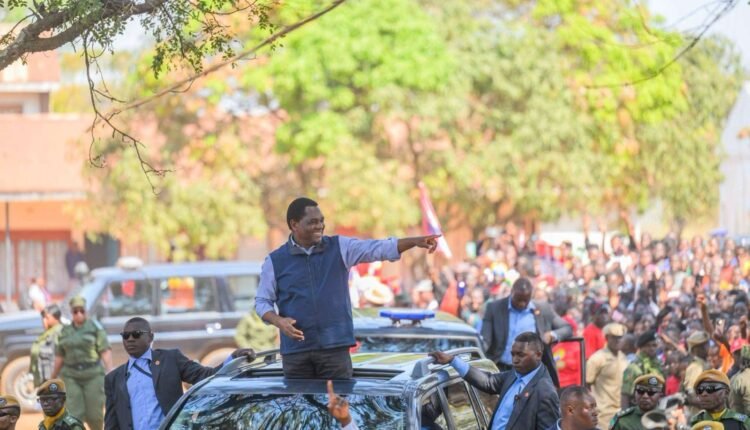
Lusaka – Sudanorizon – Ali Al-Baseer
More than eight million voters in the Republic of Zambia will head to the polls early Thursday morning (August 13, 2026) to elect a new president and members of the National Assembly, as well as local councils, following the expansion of Parliament. This makes parliamentary control a strategic objective for the next phase.
Meanwhile, Zambia’s electoral commission announced the completion of ballot distribution for the general election and the updating of voter registration for 8.7 million registered voters. A record 26 presidential candidates are running (14 of whom have been approved), including incumbent President Hakainde Hichilema, who is seeking a second term after his election in 2021.
His main rivals include Brian Mondobele of the National Reconciliation for Unity and Prosperity (NRPUP) party, Fred Mbembe, Harry Kalaba, and several others.
President Hichilema is running on a platform focused on economic recovery, investment, debt restructuring, increased copper production, improved public services, and job creation.
Despite the 14 candidates on the ballot, the presidential race appears to be primarily a contest between Hichilema and Mondobele. Recent analyses indicate that Mondubel has successfully regrouped a portion of the opposition, capitalizing on existing opposition alliances and growing criticism of the government regarding the cost of living, unemployment, political freedoms, and the performance of public services. Mondubel therefore represents the most significant electoral challenge facing President Hichilema.
Mondubel leads the National Reconciliation for Unity and Prosperity (NRPUP) party and is running for president alongside Mikibe Zulu as his running mate. The party’s platform focuses on job creation, reducing the cost of living, restoring trust in state institutions, and delivering direct economic benefits to citizens.
In contrast, the opposition camp faces a fundamental problem: organizational and political fragmentation. Since 2024, the opposition has reshuffled its alliances several times, while former opposition forces, particularly those associated with the Patriotic Front (PF), have splintered into competing factions and alliances. This fragmentation has limited their ability to present a unified alternative to the ruling party.
This year’s parliamentary elections are particularly significant due to the restructuring of the National Assembly. The number of constituencies increased from 156 to 226, a rise of 70, as part of a redistricting process. The new system also allocates 40 seats by proportional representation, reserved for women, youth, and people with disabilities, in addition to up to 11 appointed members and three ex-officio members, bringing the total potential membership of the National Assembly to 280. Control of parliament has thus become a strategic objective on par with winning the presidency.
The elections remain a crucial test of Zambia’s democratic reputation, which it has cultivated over the past decades as one of the African countries that has experienced peaceful transfers of power between different political parties, including in 1991, 2011, and 2021. However, the current political environment is more tense, with human rights organizations criticizing restrictions on political freedoms, assembly, and expression.
This makes the performance of electoral and security institutions on and after election day a critical factor in assessing the credibility of the process. Election studies indicate that economic performance and public services will be key determinants of voting behavior.
Zambian citizens are far more concerned with tangible results, such as the availability of services, jobs, and the affordability of food and energy, than with the ideological details of political programs. Therefore, the major parties focused their campaigns on development, improving living conditions, and creating employment opportunities.
Data available up to August 10, 2026, suggests that President Hakainde Hichilema remains the frontrunner for a second term, benefiting from his incumbency, a relative improvement in economic indicators, and the weakness and fragmentation of the opposition. However, this lead should not be considered a foregone conclusion, especially given the high cost of living, the opposition’s concerns about the political environment, and the growing support base of Mondobel in certain regions and among certain voter demographics.
The competition for seats in the National Assembly is likely to be more significant than the number of presidential candidates themselves. Even if Hichilema wins the presidency, his ability to implement his political and economic program during a second term will depend largely on the size of the majority the UPND and its allies can secure in the new 280-member parliament.
Conversely, the opposition’s best chance lies not necessarily in winning the presidency, but in reducing the ruling party’s parliamentary majority and forming a parliamentary bloc capable of oversight and negotiating legislation and public policy. Therefore, the 2026 elections could produce a different political landscape than the 2021 elections, even if Hichilema is re-elected.
As the 2026 elections approached, the Zambia Election Research Network surveyed public opinion on the past four years, including the government’s policy choices, the quality of services provided, and pre-election expectations.
The survey included questions about political parties and election campaigns, assessments of the national situation and government performance, trust in institutions, and voting intentions. The survey was conducted between June and November 2025.
Regarding voting preferences, several factors influence decisions. Zambian voters prioritize the quality of services as an end result over political debates about how to achieve them. This has led political parties to focus their campaigns on development rather than policy content.
Projections indicate that the opposition failed to field candidates and secure nearly two-thirds of the parliamentary seats, giving the ruling party an absolute advantage in those constituencies. Consequently, the ruling party is expected to dominate and return to power with a landslide majority in parliament, and the current president, Hichilema, is likely to be re-elected for a second term.
Shortlink: https://sudanhorizon.com/?p=16883