

Foreign Affairs and Culture Ministers Welcome Professor Ali Shomo Upon His Return to Sudan
Khartoum – Sudanhorizon
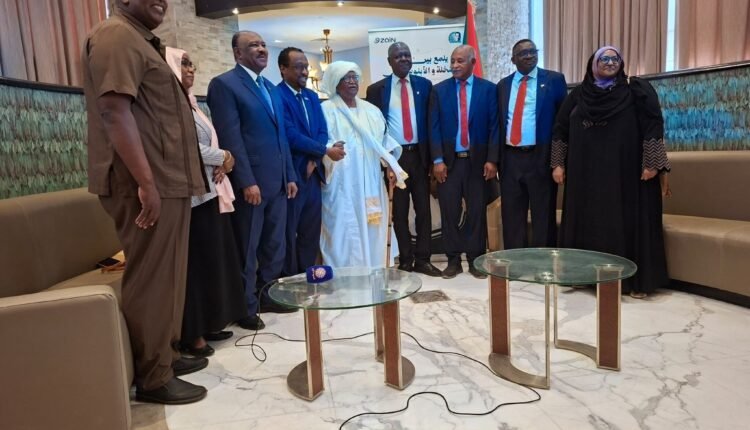
The Minister of Foreign Affairs and International Cooperation, Mohi El-Din Salem, and the Minister of Culture, Information, Antiquities and Tourism, Khalid Al-Aiser, received national icon Professor Ali Mohamed Shomo at Khartoum Airport on Tuesday upon his return to Sudan after an absence of more than two years due to the war that followed the outbreak of conflict in April 2023.
Also present at the reception were Dr. Graham Abdel Gader and Ms. Sumaya Al-Hadi, undersecretaries of the Ministry of Culture, Information, Antiquities and Tourism, alongside members of the Board of Trustees of the Tayeb Salih Award and a number of media professionals.
Minister Khalid Al-Aiser said the reception was intended as a gesture of appreciation, recognition, and celebration of one of Sudan’s most prominent cultural and media figures.
He welcomed Professor Shomo’s return, describing him as one of the leading figures of Sudan’s independence generation, and noted that the return carries symbolic significance on many levels. According to the minister, it reflects the broader voluntary return movement taking place as part of Khartoum’s recovery process.
Al-Aiser added that Professor Shomo had witnessed the outbreak of the war while in Khartoum and praised what he described as his patriotic stance and efforts to uphold the national idea during the conflict.
The minister further stated that Shomo’s return symbolizes a stage in overcoming divisive regional and exclusionary narratives, emphasizing that the professor’s views regarding the Sudanese Armed Forces reflect what he described as a longstanding Sudanese national tradition.
For his part, Professor Ali Shomo expressed admiration for the performance of the Sudanese Armed Forces, stating that many observers had not imagined it would be possible to retake Khartoum after it had fallen under the control of opposing forces.
“We never imagined that we would return to Khartoum after leaving it,” he said.
Shomo noted that although he had been physically absent from Sudan for more than two years, he closely followed developments until what he described as the liberation of Khartoum by the Sudanese Armed Forces and allied forces.
He also reflected on the experiences he had witnessed throughout his life and on the historical stages through which the Sudanese military had passed, saying that no one could have anticipated the scale of destruction and devastation caused by the conflict.
According to Shomo, the war highlighted broader challenges in the international system, including what he characterized as a lack of justice, imbalances in global affairs, and insufficient support for countries facing aggression.
He also criticized the use of the slogan “State of ’56” as a justification for the conflict, arguing that those invoking the term are now using it to promote war.
Professor Shomo praised the role of Sudan’s national media during what he referred to as the “War of Dignity,” stating that the country’s media institutions played a critical role during the conflict.
“Had it not been for the media, the country might have been lost,” he said.
He added that the destruction suffered by Sudan’s media sector has been extensive and requires a comprehensive assessment of losses, calling on the government to recognize the strategic importance of media as a powerful national asset.
Shortlink: https://sudanhorizon.com/?p=14658