

Enabling Atrocities in the Middle East, North Africa and Sudan: Fake Accounts, Bots and Digital Information as Instruments of Harm in Times of War (2–2)
Sudanhorizon – Mohamed Osman Adam
In the first part of this study, we noted that it may provide a key to understanding why the world appears unmoved while atrocities continue in Darfur, Gezira, White Nile, Khartoum, Sennar and Kordofan. The study argues that one reason lies in the overwhelming flood of tweets, hashtags, replies and AI-generated narratives, confronting individuals and official media outlets that still rely primarily on human effort and communication networks that may not possess comparable reach or influence.
By contrast, the official and unofficial institutions supporting the Sudanese Armed Forces operate with resources that are negligible compared with those financing and managing the networks and platforms aligned with the Rapid Support Forces (RSF). According to the study, RSF supporters employ artificial intelligence to address global audiences in numerous languages. In contrast, most advocates of the Sudanese Armed Forces and of General Abdel Fattah al-Burhan can communicate effectively in only one language, or two at best. In other words, those supporting the RSF utilise virtually all major Western languages across social media platforms, search engines and websites. At the same time, supporters of the army rely primarily on Arabic, with English used only to a limited extent.
Below is a concise summary of the University of South Carolina’s report.
The Operational Structure of the Networks
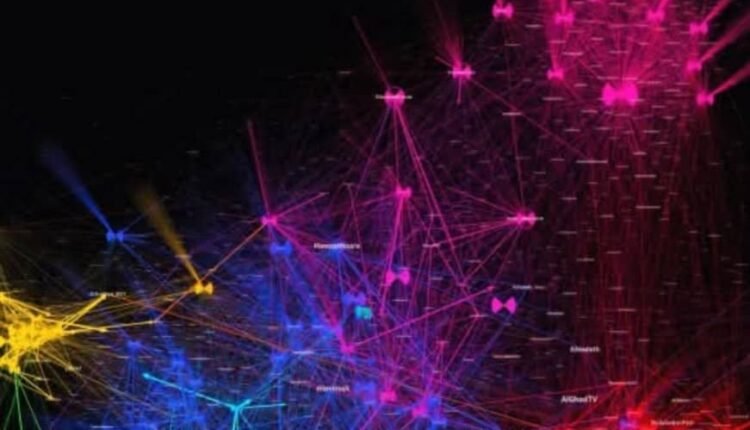
The report examined three distinct yet interconnected influence networks comprising thousands of fake social media accounts operating throughout Sudan and the wider Middle East and North Africa (MENA) region.
Taken together, these networks demonstrate that contemporary disinformation in conflict zones is multilayered. It exploits platform capabilities in different ways, ranging from long-term networks that sustain influence over extended periods to disposable “shock forces” designed to manipulate trends and dominate engagement during crises. Despite their different functions, all contribute to reshaping the information environment precisely when prevention, accountability and civilian protection are most vulnerable.
The findings from all three networks indicate that atrocity-related propaganda functions through the manipulation of information ecosystems during periods of mass violence.
In Sudan, these campaigns unfolded during one of the world’s gravest humanitarian crises, including periods when international investigators warned of risks of genocide and famine conditions in Darfur.
Under such circumstances, manipulation of information ecosystems carries profound consequences for atrocity prevention, humanitarian response and accountability itself.
Undermining Atrocity Prevention
The study found that all three networks weakened each of the major atrocity-prevention pathways identified in the report.
At the structural level, they contributed to the erosion of pluralistic and trustworthy information environments by continuously simulating civic participation.
The first network functioned as a long-term influence infrastructure operating across countries, languages and issue areas over several years. Through hundreds of fictitious personas and thousands of automated accounts, it manufactured the appearance of widespread public support while simultaneously amplifying pro-UAE geopolitical narratives, anti-Islamist messaging and support for the RSF.
Over time, such activity can undermine trust in credible journalism, blur the distinction between spontaneous and coordinated participation, and facilitate the spread of authoritarian narratives among audiences that appear decentralised and organic.
Crisis Intervention and Narrative Manipulation
At the operational level, the networks demonstrated the capacity to intervene aggressively during triggering events.
The second network, which emerged immediately following the El Fasher massacre, illustrates this particularly clearly. It activated thousands of highly coordinated accounts within a short period, employing sequential hashtag campaigns, intensive posting and repetitive messaging to dominate trending content across Sudan and the wider region.
The campaign imposed a narrative portraying the Sudanese Armed Forces, Islamists, Iran and regional rivals as responsible for famine and suffering, while presenting the RSF as a humanitarian actor committed to stability and prepared to pursue a ceasefire.
In practice, this distorted perceptions of responsibility at a time when independent reporting and verification were already severely constrained.
This dynamic is particularly significant because atrocity prevention depends heavily on timely warning signals and credible identification of responsibility. When journalists, investigators and humanitarian workers face restricted access, digital information environments increasingly become alternative arenas for understanding events on the ground.
As a result, coordinated inauthentic networks can distort perceptions of escalation itself.
Triggering events accompanied by simultaneous counter-narratives can weaken warning signals, obscure causal responsibility, and slow the response of policymakers, journalists and the public to emerging atrocities.
The degradation of clarity and reliability during moments of crisis can directly affect the conditions under which prevention, intervention and response become possible.
Impact on Humanitarian Response
The implications for humanitarian action are particularly serious.
Humanitarian protection and accountability efforts depend heavily on continuous documentation, agenda-setting and sustained visibility of civilian suffering.
The networks identified in this study repeatedly sought to suppress, overwhelm or weaken such processes through narrative saturation.
Within both the first and second networks, the RSF was systematically rehabilitated through emotionally charged humanitarian imagery, compelling personal stories and repeated portrayals of stability and recovery.
El Fasher itself was reframed through hashtags such as “Life Returns to El Fasher”, featuring imagery of normalisation and recovery shortly after allegations of mass killings, famine and ethnically motivated violence had emerged.
Conclusion
This report documents how coordinated bot networks and fake-account operations throughout the Middle East and North Africa function as enduring infrastructures of digital influence, seeking to shape political discourse by manipulating information environments during periods of conflict and humanitarian crisis.
By identifying and analysing three distinct but interconnected types of networks—from long-term narrative infrastructures and crisis-response clusters to AI-assisted conversational personas—the findings demonstrate how contemporary influence operations are increasingly adapting to platform features, generative artificial intelligence and weaknesses in platform governance.
In the context of the Sudanese civil war, the report warns that these networks systematically amplified pro-RSF narratives, obscured responsibility, promoted actors accused of mass violence and contributed to creating information conditions that threaten to undermine atrocity prevention, humanitarian response and accountability efforts.
The report also highlights the transnational nature of modern influence operations. These networks operated across Arabic, English, French, Turkish and Persian, translating and reframing narratives for foreign audiences, journalists, policymakers and the wider international public.
Through these efforts, they sought to shape and create broader geopolitical narratives about political Islam and Middle Eastern and North African affairs.
Beyond Sudan, the networks also engaged in broader reputation-management and political influence campaigns, including efforts to rehabilitate Bashar al-Assad during periods of regional normalisation with Syria and attempts to shape perceptions surrounding elections.
Key Finding
The report’s principal conclusion is that contemporary digital influence operations can facilitate and legitimise atrocities—and may even function as catalysts for them—without explicitly calling for violence.
By shaping what is visible, these operations help determine whether mass harm is recognised as a crime, reframed as a tragedy, or normalised as an unavoidable reality.
Shortlink: https://sudanhorizon.com/?p=14307