

Submarine Cables in the Strait of Hormuz and the Red Sea: How Could Iran Threaten the Global Internet?

Engineer Tareq Hamza Zein Al-Abidin
A world long accustomed to worrying about oil tankers being detained in the Strait of Hormuz and Houthi attacks in Bab el-Mandeb, the Gulf of Aden, and across the central, northern, and southern Red Sea near the Yemeni coast, now faces a new nightmare: digital strangulation capable of paralysing entire economies within moments.
First: The Background — What Lies Beneath the Water?
The world relies on a network of more than 570 active submarine cable systems stretching over 1.48 million kilometres beneath the oceans, carrying more than 99% of global international internet traffic. These cables are not ordinary wires; they are thinner than a garden hose and far more fragile than most imagine, yet they form the invisible backbone of the global digital economy.
The world’s two most strategically dangerous maritime chokepoints — the Strait of Hormuz and the Red Sea — are not merely corridors for oil and commercial shipping. They are also critical digital bottlenecks through which pivotal cables carrying data from entire continents pass.
The global digital network, often assumed to be decentralised and impossible to disable, is in reality compressed into a handful of narrow geographical chokepoints whose security could be compromised by a single tool deployed in the right location.
Second: The Strait of Hormuz Cables — The Gulf Gateway at Risk
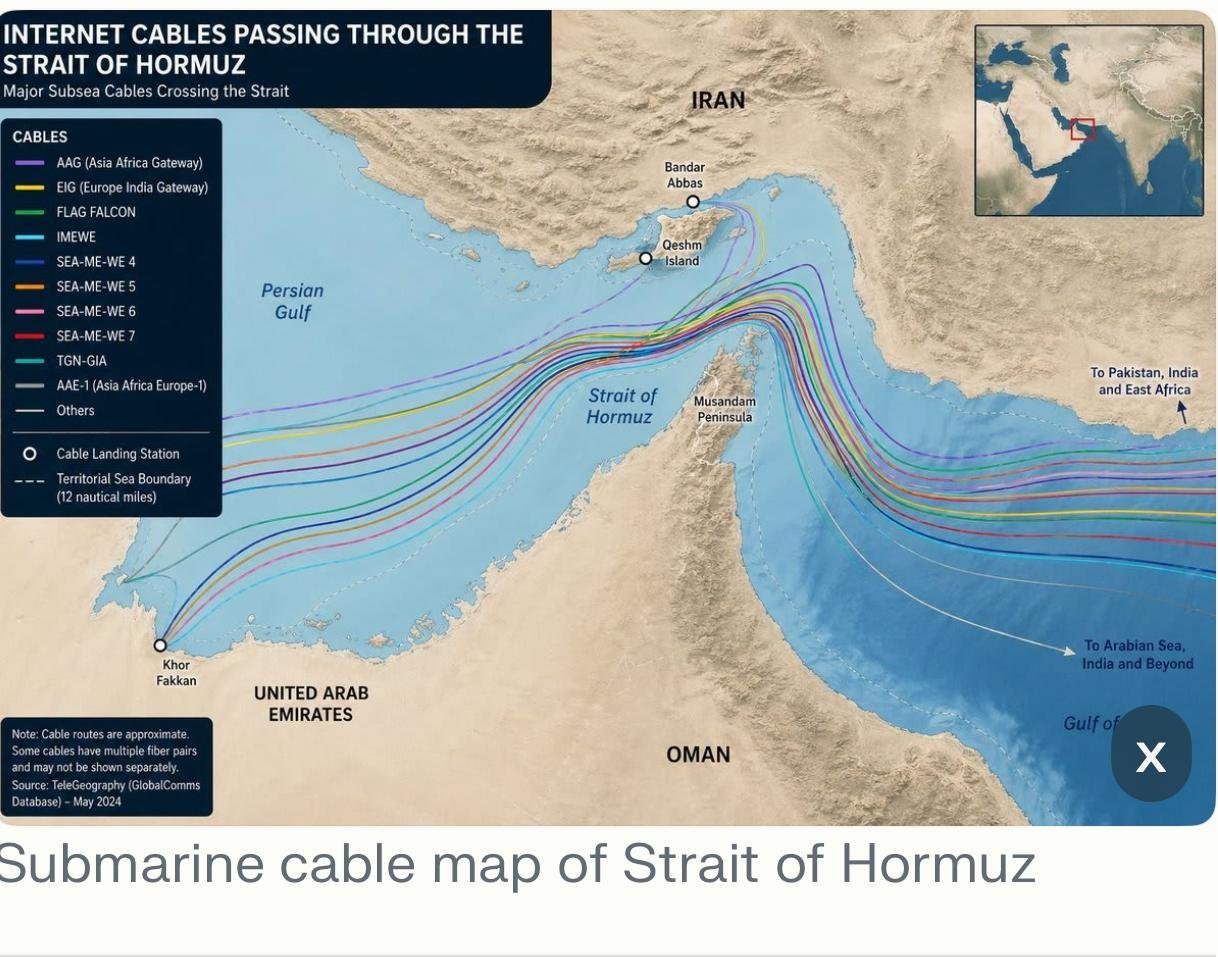
According to TeleGeography, one of the world’s foremost providers of telecommunications infrastructure data, three major active cable systems pass through the floor of the Strait of Hormuz.
The first is the AAE-1 (Asia-Africa-Europe 1) cable, the most regionally significant system, extending 25,000 kilometres from Hong Kong through Southeast Asia, India, Pakistan, the Gulf region, and Egypt before reaching Greece, Italy, and France.
The second is the FALCON cable linking India and Sri Lanka with the Gulf states and North Africa.
The third is Gulf Bridge International, which functions as the Gulf’s internal digital artery, connecting all Gulf states, including Iran.
In addition to these three systems, the Iranian state-aligned Tasnim News Agency stated in a strategic report published in April 2026 that at least seven major cable systems cross the Strait. These include FALCON, AAE-1, TGN-Gulf, and SEA-ME-WE as operational links connecting Gulf states with data centres in Europe and Asia.
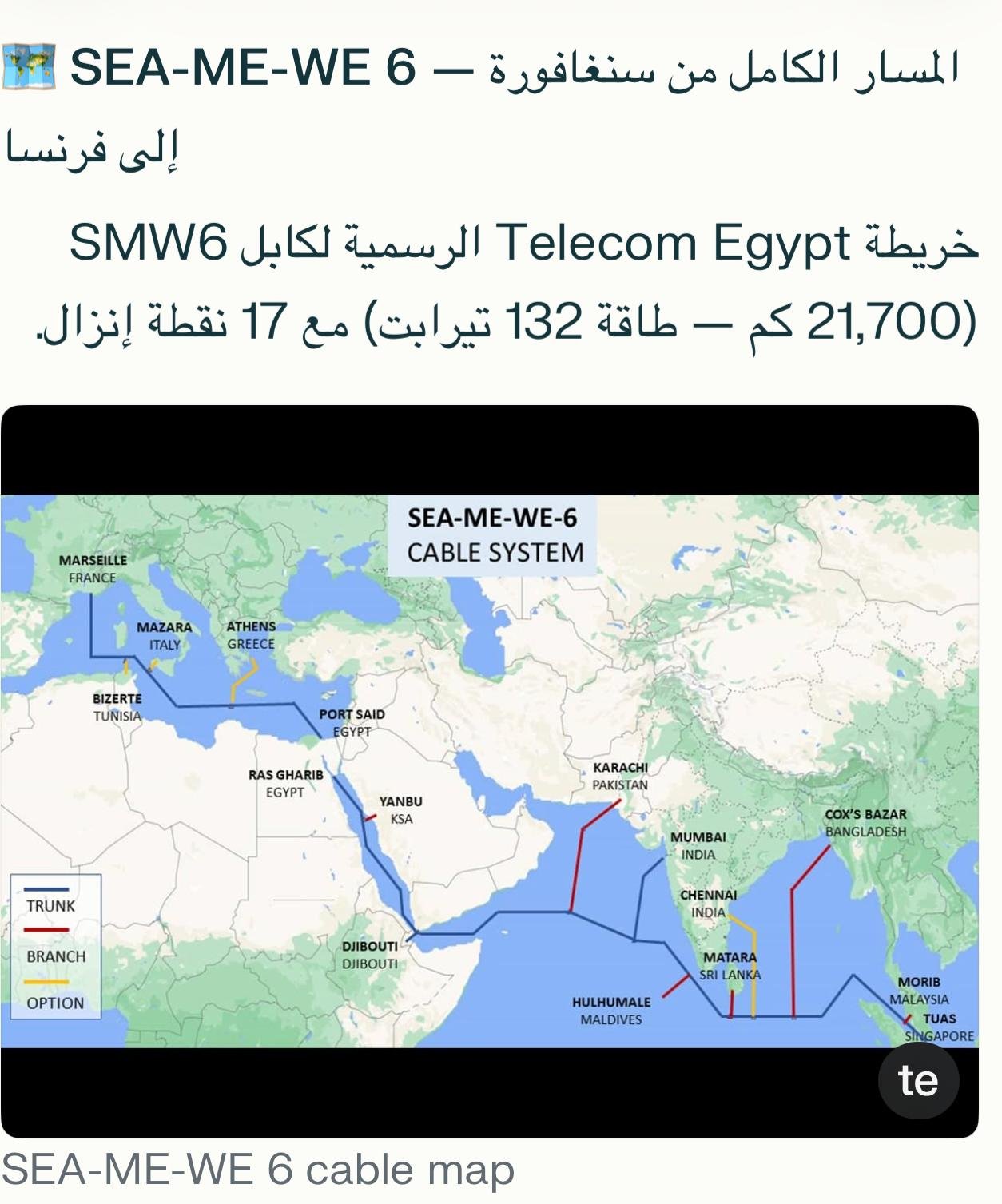
Planned or under-construction projects include Qatar’s US$500 million Fibre in Gulf (FIG) project, the 2Africa Pearls extension of Meta’s giant cable initiative, and SeaMeWe-6, which had hoped to avoid the Red Sea by routing through the Gulf.
The Geographical Vulnerability: Cables in Omani Waters
A highly dangerous geographical vulnerability often goes unnoticed.
Because of longstanding diplomatic disputes with Iran, all cables crossing the Strait of Hormuz were routed through Omani waters. This has confined them to a single narrow corridor with extremely limited redundancy.
This forced geographical concentration effectively makes the three cables an ideal target: a single precise strike could deactivate all of them simultaneously.
Third: The Red Sea Cables — The Open Wound
The Red Sea is even more fragile, both operationally and geographically.
Seventeen submarine cable systems pass through it, carrying approximately 17–18% of global internet traffic. It is effectively the only efficient route linking European and Asian data traffic.
Among the most prominent is the SEA-ME-WE 5 cable, spanning 20,000 kilometres and offering a transfer capacity of 24 terabits per second, connecting Southeast Asia to the Middle East and Europe.
It is joined by the giant SEA-ME-WE 3 system, which extends 39,000 kilometres and serves 32 countries across three continents, as well as the previously mentioned AAE-1 cable, which also traverses the Red Sea.
Additional systems include EIG and SEACOM, which connect sub-Saharan Africa to Asia and Europe, alongside the enormous 45,000-kilometre 2Africa cable designed to provide internet connectivity to more than three billion people across Africa.
Damage History — Repeating Patterns
In February 2024, three cables — AAE-1, SEACOM, and EIG — were damaged after a Houthi attack on a commercial vessel caused its anchor to drag for two weeks before the ship eventually sank. Repairs took six full months.
In September 2025, four cables in the Red Sea were severed, causing widespread internet disruption affecting India, Pakistan, the United Arab Emirates, Kuwait, and Saudi Arabia. Three were repaired after five months, while the fourth remains out of service to this day.
Collectively, these incidents disrupted more than 25% of internet traffic between Europe and Asia during 2024.
Fourth: The Numbers — The Threat in Data
The global submarine cable network currently consists of 570 active systems, with 81 additional systems under construction, spanning 1.48 million kilometres according to TeleGeography’s 2025 data.
These cables carry between 95% and 99% of global internet traffic according to International Telecommunication Union standards.
Specifically, three major active cables pass through the Strait of Hormuz, according to TeleGeography, or seven according to Iranian estimates, while 17 systems cross the Red Sea, carrying 17–18% of global internet traffic.
The daily financial transactions flowing through these cables are estimated at US$10 trillion.
Yet the world possesses only 63 specialised repair vessels capable of servicing submarine cables — with merely two to four operating across the entire Gulf region.
Each repair operation takes at least 40 days under normal conditions and costs between US$1 million and US$3 million.
These figures alone reveal the profound structural fragility of one of the world’s most vital communications systems.
Fifth: The Iranian Threat — From Oil to Data
In early May 2026, the Islamic Revolutionary Guard Corps announced what it described as full jurisdiction over seven submarine cables passing through the Strait of Hormuz.
It demanded a three-tier system of compliance from foreign operators:
Initial licensing fees for all foreign companies operating in the Strait.
Annual “protection fees” targeting technology giants such as Meta, Amazon, and Microsoft.
Exclusive Iranian control over maintenance and repair operations.
This followed the publication by Tasnim News Agency in April 2026 of a detailed map showing cable locations in the Strait of Hormuz — interpreted by analysts as less technical documentation and more of a strategic warning.
Potential Military Tools
The Revolutionary Guard possesses a range of tools capable of implementing such threats.
It could deploy naval mines in the narrow corridor through which the cables pass in Omani waters, severing multiple cables in a single strike.
Alternatively, submarines and armed boats could physically cut cables underwater.
Commercial ships might even be deliberately sunk so that their anchors drag across the cables — precisely what occurred in the Red Sea in 2024.
Most dangerously of all, Iran could inflict devastating damage without firing a single shot simply by blocking repair vessels from entering its waters, thereby prolonging outages for months.
This could be supplemented by coercive licensing fees and regulatory pressure functioning as a gradual form of economic extortion.
Sixth: Economic and Strategic Impact on Gulf Economies
The Gulf states are currently undergoing a highly sensitive strategic transformation.
They are investing billions in artificial intelligence and data centres, making them especially vulnerable to digital coercion.
Saudi Arabia is investing US$800 million in the SilkLink fibre network. Qatar is building the US$500 million FIG project, while the UAE, which relies heavily on its technology hub G42, depends critically on these cables to access African and Asian markets.
Meanwhile, NVIDIA, Microsoft, and Oracle Corporation have invested billions in Gulf-based data centres that themselves rely entirely upon these cables.
Should the cables be disrupted, analysts expect paralysis in electronic payment systems and digital commerce, disruption to high-frequency trading in financial markets, collapse of airline and shipping reservation systems, and major instability in the cloud computing services upon which governments and large corporations rely.
Military Infrastructure
The military implications are equally severe.
In March 2026, The New York Times documented damage to communications and radar systems at at least seven American military bases in the region, including Al Udeid Air Base, Camp Arifjan, and the headquarters of the United States Fifth Fleet.
Modern armed forces rely heavily on these cables for command-and-control systems, remote drone operations, allied coordination, and the operational infrastructure of CENTCOM and NATO in the region.
Seventh: Structural Vulnerabilities
The repair crisis represents the most immediate and realistic danger.
The world has only 63 specialised cable repair ships, with merely two to four operating throughout the Middle East.
Every repair requires at least 40 days under safe conditions and depends upon diplomatic clearance to enter territorial waters — permissions that may be entirely denied during conflict.
The 2024 Red Sea crisis demonstrated this clearly: three cables remained unrepaired for six months, while a fourth, severed in September 2025, remains offline.
The Limits of Alternatives
Satellite internet systems such as Starlink are often proposed as alternatives.
However, they are incapable of supporting the demands of entire cities.
Low-Earth orbit systems may provide 100–200 Mbps for individual users, but they cannot sustain a city such as Dubai or regional data centre networks.
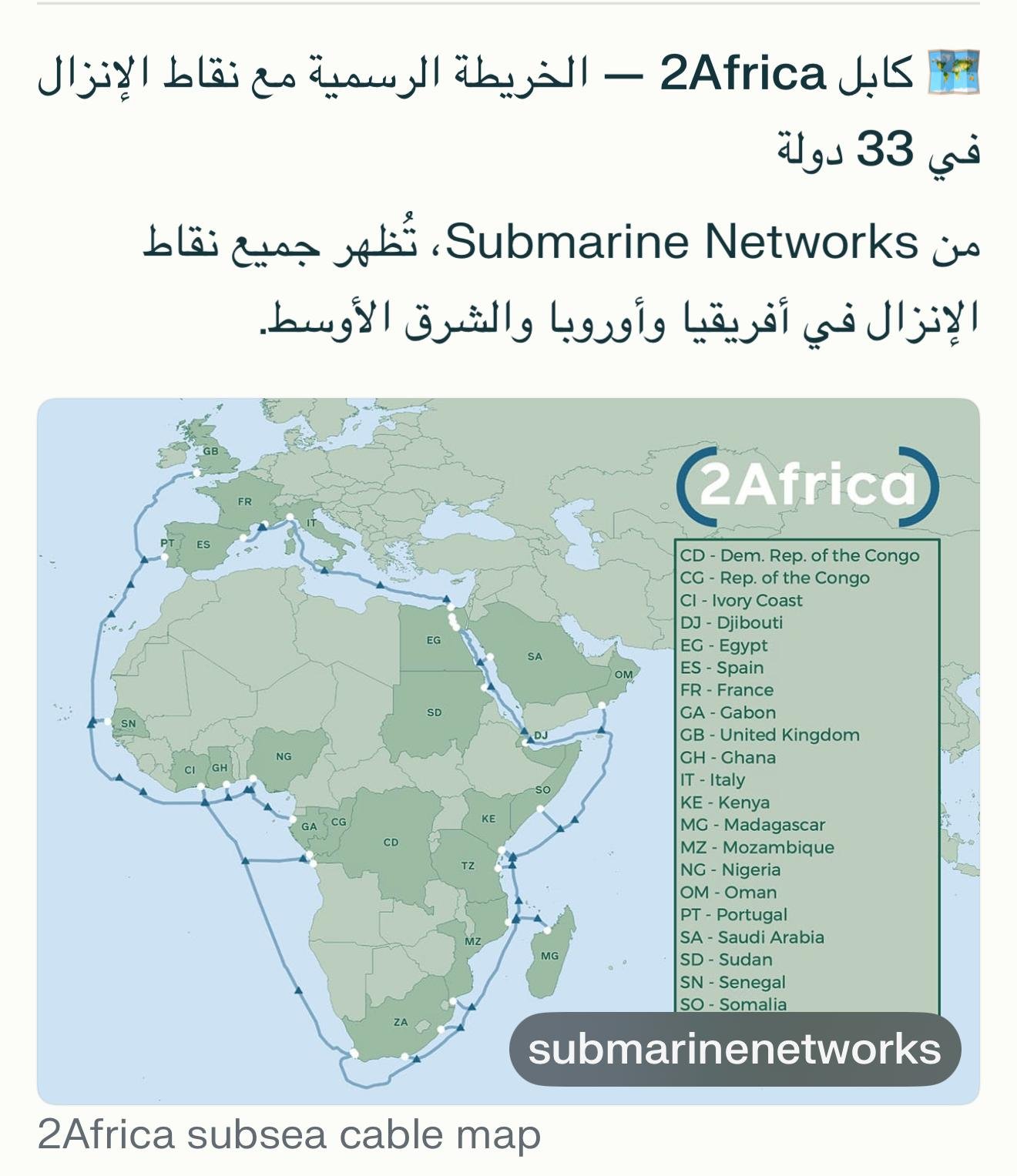
The 2Africa cable alone was designed to carry 21 terabits per fibre pair — equivalent to more than one million simultaneous Starlink connections.
Terrestrial cables face legal barriers, higher costs, and rights-of-way complications across multiple states, making them unable to replace current maritime traffic volumes should submarine systems fail.
Eighth: The Strategic Map — Dual Chokepoint Strangulation
The strategic picture reveals an unprecedented dual chokepoint scenario.
Data traffic between Europe and Asia normally passes south through the Suez Canal into the Red Sea, where seventeen major cables carry 17–18% of global internet traffic, before exiting via Bab el-Mandeb into the Indian Ocean.
From there, cables either continue eastward directly towards Asia or head north through the Strait of Hormuz to serve the Gulf states.
The only alternative route circles southern Africa, dramatically increasing latency and sharply reducing carrying capacity.
Should both the Red Sea and Hormuz digital corridors be simultaneously disrupted — a scenario now technically plausible — a vast region stretching from East Africa to South Asia and Eastern Europe could find itself in near-total digital isolation, with consequences for economies and security comparable to a complete oil blockade.
Ninth: International Legal Framework — A Fragile Structure Facing a New Threat
Professor Robert Beckman of the Centre for International Law at the National University of Singapore, one of the world’s foremost experts in maritime law and author of the reference work Submarine Cables: The Handbook of Law and Policy (April 2013), concluded that:
“There are clearly serious security gaps in the current legal framework, and neither the 1884 Cable Convention nor UNCLOS adequately addresses deliberate damage to submarine cables.”
Beckman explicitly called for a comprehensive new international treaty criminalising such acts “regardless of location, nationality, motive, or objective”.
The root cause of this legal vacuum lies not in negligence but in tragic historical timing.
When UNCLOS was drafted between 1973 and 1982 and entered into force in 1994, the internet was still a privilege limited to a small group of government employees and university academics. No one anticipated that it would become the backbone of the global economy.
As Alexander Lott of the Norwegian Centre for the Law of the Sea noted in his March 2025 report for HCSS:
“The architects of UNCLOS did not foresee this radical transformation in the structure of societies.”
He added that the cables carrying 95–99% of intercontinental data traffic today “were left without effective protection against deliberate or accidental damage”.
By the time states ratified the convention, the world had already changed fundamentally — but the legal texts had not evolved alongside it.
** Engineer Tareq Hamza Zein Al-Abidin is an expert in digital technology, telecommunications, digital infrastructure security, and telecommunications regulatory policy in emerging markets.
Former Technical Director of AT&T in West Virginia, USA.
Former Chief Executive Officer and Managing Director of Sudatel Group.
Engineer Tareq Hamza Zein Al-Abidin is an international telecommunications and technology expert with more than 33 years of professional experience spanning North America, Europe, Africa, and the Middle East. He began his career at the heart of the American telecommunications industry before ultimately leading one of Africa’s largest telecommunications groups.
At present, he applies this accumulated expertise to advanced consultancy and development projects focused on three intersecting areas: cybersecurity, where he addresses escalating threats to critical telecommunications infrastructure — particularly in African and Gulf markets; artificial intelligence and its applications within telecommunications, from network optimisation to process automation and big data analytics; and digital infrastructure security alongside telecommunications regulatory policy in emerging markets.
This rare combination of deep technical expertise acquired within American research and operational environments, together with practical leadership experience across African and Middle Eastern markets, has made him an authoritative voice in discussions surrounding digital security and international telecommunications policy.
Shortlink: https://sudanhorizon.com/?p=13955