

Discovery of the “Great Church of Jesus” in Old Dongola
Dongola – Sudanhorizon
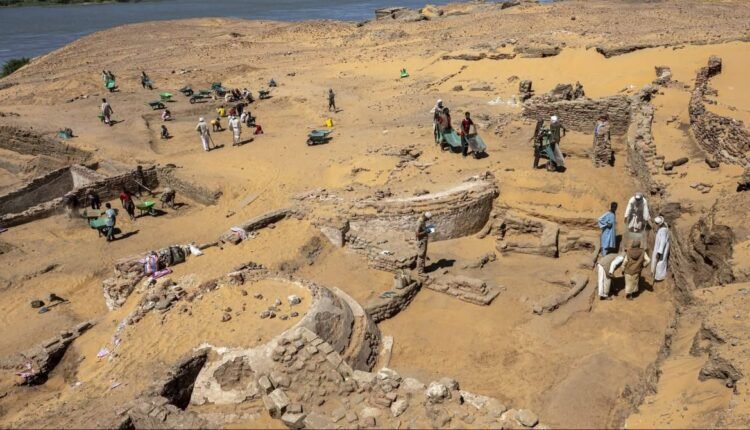
The joint Sudanese-Polish archaeological mission working at the Old Dongola site, the capital of the ancient Nubian Kingdom of Makuria, has announced new findings revealing extensive sections of the archaeological structure known as the “Great Church of Jesus”. Details were officially published on Friday on the website of the Polish Centre of Mediterranean Archaeology.
Recent excavations have revealed the exceptional architectural dimensions of the monument. The building is estimated to be approximately 57 metres long and 47 metres wide, with a presumed height of around 21 metres.
The latest excavations uncovered a monumental staircase leading to the main entrance, as well as massive wall supports added to reinforce the apse.
For the first time, the team managed to reach the building’s original floor level, while some of the walls surrounding the stepped seating area stand 11 metres high.
The head of the archaeological mission, Polish Nubiologist Professor Artur Obłuski, said the building had served as a major centre of architectural and design influence in the region, acting as a trendsetter in much the same way as the Hagia Sophia in Constantinople.
The discovery is expected to prompt a reassessment of the planning and function of other archaeological buildings outside the city walls, which had previously been thought to constitute the main cathedral.
The excavation and archaeological documentation work coincided with urgent measures to protect the site from the effects of the flash floods that affected the area in the autumn of 2024. As part of archaeology’s broader social responsibility, the mission, in coordination with the National Corporation for Antiquities and Museums (NCAM) and with support from the Polish Aid programme, oversaw the operation of a solar-powered water supply system.
The system operates pumps that draw water from the Nile to serve more than 10,000 local residents and supply eight water-pressure booster stations serving homes in elevated areas. This initiative directly connects archaeological fieldwork with the development needs of the local community surrounding the site.
The research was conducted under the European Research Council (ERC)-funded “Afropolis Tungul” project and the “Kyriakós oíkos” project, funded by Poland’s National Science Centre (NCN). Both projects aim to reconstruct the urban and social history of the Makurian capital between the fourth and fifteenth centuries AD.
Shortlink: https://sudanhorizon.com/?p=19962