

Her government’s legacy—tarnished by accusations of supporting perpetrators of genocide in Sudan—haunts her, American newspaper criticizes Emirati diplomat’s bid for UN Secretary-General
Sudanhorizon– Mohamed Osman Adam
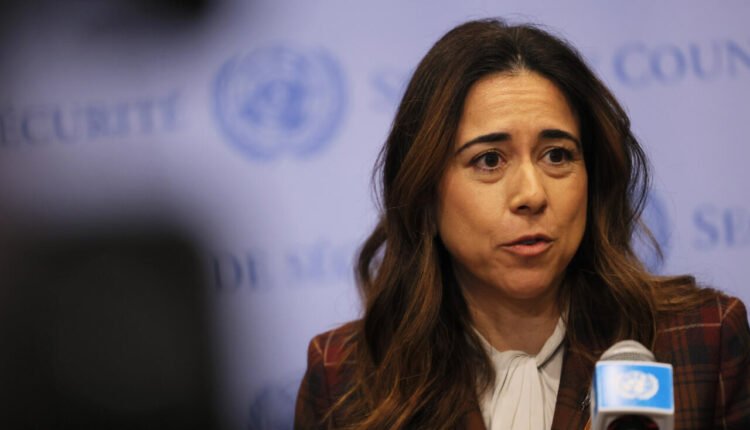
The American outlet “Politico”, which specializes in political and security affairs, published a story on Friday, sharply criticizing the candidacy of a UAE diplomat who has joined the race for the position of UN Secretary-General, describing her as a new—and perhaps controversial—face entering the competition for this post.
Following her official nomination on Wednesday, Emirati diplomat Lana Nusseibeh announced on Thursday that she would be entering the race, injecting new momentum into a contest that had previously reached a stalemate.
Sudanhorizon notes that the former Senegalese president withdrew from the race last week—according to the African news agency PANA—without providing a compelling reason. It appears, however, that an informal vote or poll within the UN Security Council prompted his withdrawal. This leaves the African continent with one remaining candidate: Ugandan national Olara Otunnu. Otunnu has Sudanese roots—specifically from the Acholi ethnic group, with most of his kin hailing from what is now South Sudan. He visited Sudan shortly before the country’s partition, during which time his people sang songs for him that moved him to tears while he was visiting a camp for displaced persons in the outskirts of Khartoum.
Meanwhile, the Politico noted that members of the UN Security Council—including the United States—have so far been unable to reach a consensus on any of the seven candidates already in the running. The outlet pointed out that Nusseibeh’s role in championing the United Arab Emirates’ foreign policy on the international stage could make her a divisive figure.
The publication also cited U.S. intelligence reports, as well as findings from UN sanctions monitors, suggesting that the UAE has been supplying weapons to the Rapid Support Forces (RSF) paramilitary group in Sudan. This has placed the UAE under intense scrutiny for its support of a group accused of committing genocide—an allegation the UAE denies.
When asked by Reuters about these accusations, Nusseibeh avoided a direct response, though she emphasized that, should she become UN Secretary-General, she would focus on the humanitarian crisis in Sudan.
In a video statement released Thursday , Nusseibeh expressed her hope to inject greater “urgent momentum” into UN peace-making efforts, affirming her commitment to the international organization—a sentiment underscored by her firsthand experience of the vital role of diplomacy in her own region.
Nevertheless, it appears highly likely that the issue of Sudan—and the material and diplomatic support her country has provided to the RSF, a group accused of genocide—will ultimately lead to her exiting the race empty-handed. It is no secret that such positions are often subject to prior arrangements and agreements—sometimes reached through behind-the-scenes deals—long before the race officially begins. This is a tactic for which the United Arab Emirates is well-known, having frequently sought to “secure” such roles. Should this occur, the European Union, Asian nations, and the United States would lose any moral standing to speak on human rights or respect for international law; by doing so, they would be endorsing an individual who has recently defended and promoted a group currently committing genocide.
Furthermore, it is known that during her time in Europe, she collaborated with far-right groups within the European Parliament to shield the UAE from condemnation—specifically by blocking the designation of the Rapid Support Forces (RSF) as a terrorist organization.
Her nomination for this position may well be a reward from her home country for those efforts. This implies that even if she does not win, she could still strike a diplomatic deal to withdraw from the race in favor of another candidate, in exchange for the position of UN Deputy Secretary-General or another key senior post within the organization.
It is likely that this position will be assigned to an Arab diplomat from the Middle East—much like the precedent set when the Nigerian official Fatima Mohammed secured a high-level post following the withdrawal of an African candidate from the race that brought Guterres to his current position a few years ago.
Argentina, Costa Rica, Senegal, Uganda, the United Arab Emirates, Ecuador, and Guyana have all put forward candidates. To advance to the next stage—a vote in the UN General Assembly—a candidate must secure at least 11 votes from the 15 members of the Security Council, while ensuring that none of the five permanent members (Russia, the United States, China, the United Kingdom, and France) exercise their veto power against them.
Naturally, most of these candidates are well aware that their chances of winning are extremely slim. However, remaining on the list of candidates serves as a bargaining tool, potentially allowing them to secure a high-ranking position from the eventual winner. This appears to be the tactic currently being employed by the United Arab Emirates.
Regardless of the outcome of this race, the legacy of the UAE government’s actions will continue to follow it—unless a peace agreement is reached in Sudan, and unless the UAE—a staunch supporter of the Rapid Support Forces—acknowledges its involvement in the atrocities committed there (a scenario deemed unlikely) and agrees to rectify its errors on political, moral, material, and diplomatic fronts.
Shortlink: https://sudanhorizon.com/?p=19348