

Sudan Line and Sea Ports’ Partnership to Break Int. Shipping Monopoly
Port Sudan – Sudanhorizon
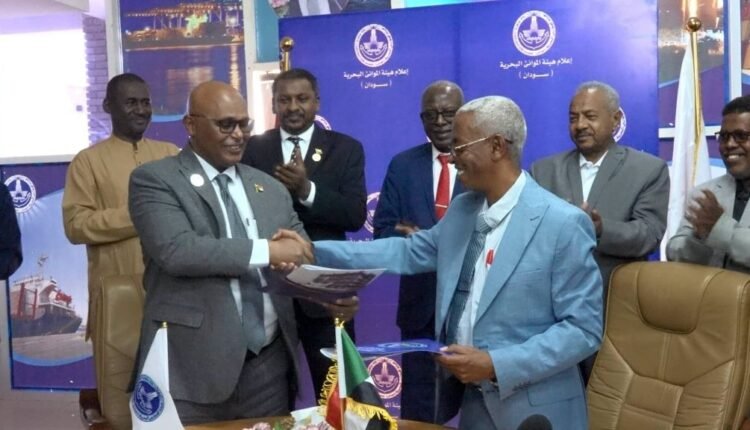
The Sea Ports Corporation and Sudan Shipping Lines Company signed a twinning and cooperation agreement in Port Sudan on Tuesday in the presence of the Ministers of Transport and Infrastructure, as well as the State Minister of Finance.
The initiative aims to revive Sudan’s national maritime fleet and activate the country’s blue economy strategy, reducing dependence on foreign shipping carriers whose costs have reportedly risen by 120 percent following the crisis in the Strait of Hormuz.
Minister of Transport Engineer Saif Al-Nasr described the revival of the national fleet as “a fundamental building block in Sudan’s renaissance” and a step toward transforming the country’s ports into a gateway to Africa.
The minister linked development efforts with support for what he referred to as the “War of Dignity,” stressing that the ministry is working simultaneously to address development gaps and rehabilitate productive sectors.
“We hope to see Sudanese ships sailing the seas once again, carrying Sudan’s name proudly,” he said. “Today we have begun with the first vessel, and soon we will celebrate the second, third, and eventually the tenth.”
For his part, the State Minister of Finance and Chairman of the Sudan Shipping Lines Board announced the company’s official return to service through the acquisition of the vessel Arkaweet, the first ship of the new fleet. The vessel was named after the first ship owned by Sudan in 1962.
He described the achievement as “a victory for the Sudanese people” and stated that the long-term objective is to build a fleet of 60 vessels.
“The national carrier is not merely a shipping tool,” he said. “It is a symbol of state sovereignty and an economic necessity for combating inflation and securing supply chains for strategic commodities such as fuel, wheat, and medicine.”
Meanwhile, Engineer Gilani Mohamed Gilani, Director of the Sea Ports Corporation, explained that the partnership goes beyond traditional cooperation agreements and will involve joint operations. Under the arrangement, the ports authority will oversee technical and logistical functions, while Sudan Line will manage commercial operations.
He noted that this administrative model could reduce maintenance and cargo-handling costs by as much as 40 percent. He also announced that a second container vessel is already on its way to Port Sudan to help meet the needs of passenger, petroleum, and livestock transport sectors.
Omar Al-Khalifa, Director of Sudan Shipping Lines, expressed pride in the return of the company’s “green ships,” traditionally named after Sudanese cities and historical landmarks.
He described the agreement as a “historic day” that restores the national carrier’s role as a “mobile embassy” representing Sudan in ports around the world.
Al-Khalifa also praised the Ministry of Finance for providing the support needed to relaunch the company and argued that the blue economy represents Sudan’s most promising future if its resources are effectively utilized.
The initiative comes in response to Sudan’s urgent need to reduce maritime transportation costs. According to officials, the national strategy behind the move seeks to achieve three key objectives:
* Breaking dependence on foreign shipping operators and restoring Sudan Line’s role in international maritime trade.
* Reducing inflationary pressures by lowering import transportation costs and preserving foreign currency reserves.
* Supporting reconstruction efforts by ensuring the affordable transport of strategic building materials such as steel and cement through a nationally controlled shipping fleet.
Shortlink: https://sudanhorizon.com/?p=15134