

Between Repositioning and External Pressure: Has the Equation Changed, or Only the Discourse?
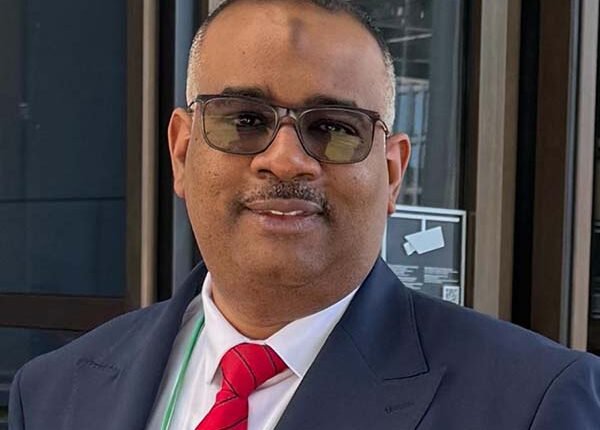
Mohannad Awad Mahmoud
What is currently unfolding in the Sudanese scene does not appear as a set of isolated events; rather, it suggests an attempt to rearrange the overall picture at a highly sensitive moment. The appointment of Mr Amjad Fareed as adviser to Al-Burhan on political affairs and external relations, the appearance of General Abdel Fattah al-Burhan at the Ramadan iftar hosted by the Nazir of the Rubatab in Abu Hamad, and circulating reports about the return of the Empowerment Removal Committee—all are signals that raise a central question: are we witnessing a genuine transformation, or merely a reconfiguration of the scene using different tools?
Mr Amjad Fareed is not known as a traditional party figure; rather, his name has been associated with the civilian current linked to the December Revolution, and his most prominent role was as an adviser to the former Prime Minister Abdalla Hamdok. This trajectory gives him political visibility within elite circles, though without an independent organisational base. This makes his appointment a subject of inquiry: is the aim to introduce a civilian voice into decision-making circles, or to present a political façade to recalibrate public perception?
At the Rubatab Nazir’s iftar in Abu Hamad, Al-Burhan stated:
“We do not recognise Muslim Brothers, communists, or anyone else… we recognise only Sudan.”
This statement, despite its simplicity, opens wide avenues for interpretation. Is it a declaration of disengagement from ideological alignments, or an attempt to reduce the cost of association with them under increasing international pressure—especially following the designation of the Muslim Brotherhood in Sudan under terrorism-related classifications, and the political and economic repercussions that followed?
In this context, the question of the relationship between the military leadership and Islamist currents remains one of the most sensitive. It cannot be reduced to a simple “alliance” or “rupture”; rather, it appears closer to a relationship shaped by the realities of war, where converging interests produced a form of mutual dependence. This was evident on the battlefield, where armed groups associated with this current fought alongside the army in a shared trench—reflecting a functional rather than formally organised political relationship.
Such relationships naturally evolve with changing phases. As the intensity of full-scale confrontation declines, questions arise about the costs and extent of continuation. This may explain some of the recent signals as attempts to recalibrate or redefine the relationship within the public sphere.
The announcement of the Empowerment Removal Committee’s return adds another layer of complexity. Between a committee dissolved by sovereign decree and leaders facing legal proceedings, practical questions loom larger than slogans: does the committee actually possess the tools to operate, or is the announcement once again ahead of reality?
Within this framework, discussion of its return has been described as a “political firecracker” without legal grounding—a characterisation that, regardless of one’s stance, reflects the depth of scepticism surrounding the possibility of its re-emergence as an effective body rather than merely a rhetorical label.
From one angle, the scene carries a degree of irony. Some voices appear to have suddenly regained activity, as if a shift in the political climate alone were sufficient to revive a project that had stalled years ago. Yet reality suggests that reviving slogans does not necessarily mean reviving the instruments required to implement them.
At a deeper level, the central question persists: does what we are witnessing reflect a genuine shift in the balance of relations with power, or merely a reordering of discourse to suit the pressures of the current phase?
In terms of the evolution of the war, the shift of operational weight towards Darfur and Kordofan does not indicate its confinement there; rather, it signals a change in its centre of gravity, not its end. This raises an additional question: has the nature of the phase changed sufficiently to redistribute roles, or has only the form of the conflict changed while its essence remains the same?
In sum, the picture appears closer to an incomplete repositioning: appointments carrying signals, rhetoric carrying messages, and announcements preceding realities. Amid all this, the question remains open: are we facing a real transformation, or a new management of the same scene in a different language?
Shortlink: https://sudanhorizon.com/?p=12182