

The Sudanese Memory: Hassan al-Turabi — Manifestations of the Man and the Idea in Our Lives

Mohammed Al-Sheikh Hussein
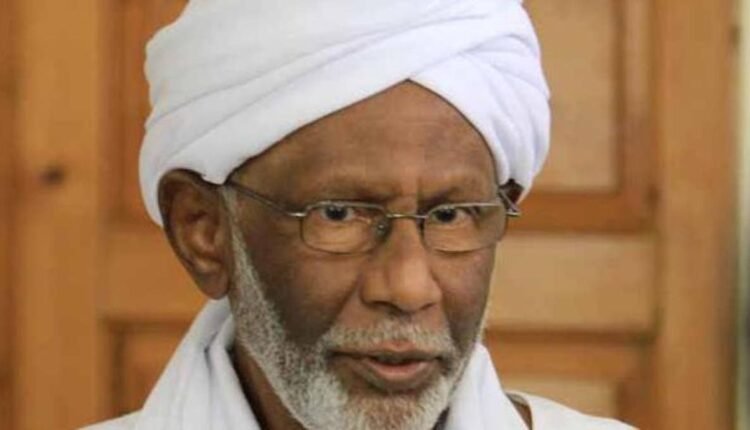
Ten years after the passing of Dr Hassan al-Turabi, we ought to look upon him as a prominent figure in Sudan’s modern history.
It is useful, in doing so, to recall certain moments or manifestations associated with him that reflect an important aspect of contemporary Sudanese history. The direct benefit of such reflection is that it allows us to consider al-Turabi in both dimensions: the man and the idea.
I need hardly stress that the biography of Dr Hassan al-Turabi matters in two respects: first, because it helps us to understand our political and social history; and second, because it contributes to a broader public awareness of al-Turabi’s role and influence in the life of the Sudanese people.
What follows are a number of moments and manifestations of his role in Sudanese life.
(1)
The passing of Ahmed Abdel Rahman Mohammed [Al-Murr] on 10 February 2025 coincided with the absurdity of Sudan’s political age, in which personal interests rise above all other considerations, and even above the law itself. Thus, our country loses its wise men, its noble figures, and its masters of dignified speech.
Among the more hidden aspects of Ahmed Abdel Rahman’s political experience was that historic meeting at his home between Dr Hassan al-Turabi and Ali Othman Mohammed Taha. This meeting took place only a short time before Dr al-Turabi’s death.
For the sake of truth and history, Ahmed Abdel Rahman said that “al-Turabi, as usual, was in a state of remarkable clarity and elevation in that meeting. He did not linger much over the past. His speech was instead focused on the future, on looming dangers, and on the unity of Sudan.”
(2)
Al-Turabi, may God have mercy on him, “feared—whether people were living or dead—that Sudan might fragment. Indeed, he believed it could become worse than Somalia if we did not act to prevent it, because all the tribes in Sudan, Arab and non-Arab alike, had access to weapons and had opportunities for training from the conflict zones surrounding them. That is why security had to be the foremost priority.”
Ahmed Abdel Rahman fully agreed with al-Turabi’s remarks. He added that “his own fear also concerned the Islamic Movement, which was at that time under pressure, whether in the Popular Congress or the National Congress. It therefore had no option but reunification if it was to continue its course. In that context, al-Turabi expressed the hope that someone would arise to achieve this aim.
“Al-Turabi spoke as though he sensed that he was about to leave this life. He believed this to be the first building block in reform and in reuniting the activist Islamic ranks in both their branches. The second step would be to bring together the people of the qibla, and the third, the whole nation.”
(3)
In the view of Abbas Mahmoud al-Aqqad, poetic language is inherent in Arabic because it is “a language built on the pattern of poetry: in its totality it is an ordered art, harmonised in rhythm and sound, and sounds are never wholly separable from poetry in any speech formed from it, even if it is not the speech of poets.”
This raises the question: in al-Turabi’s case, was poetic language a set of transparent linguistic bridges that could drown the reader?
Perhaps the first to answer this question and draw attention to al-Turabi’s language was the veteran politician, the late Khidr Hamad, the originator of the idea of transforming the Graduates’ Club into the Graduates’ Congress, and deputy to President Ismail al-Azhari. In his memoirs on the October Revolution of 1964, he spoke of the language used by the constitutional law lecturer at the University of Khartoum, Dr Hassan al-Turabi, when he said: “The crisis is not the crisis of the South alone; it is the crisis of both North and South, in terms of the loss of freedom and democratic life.”
(4)
Al-Turabi wrote in a style that nearly pierced the barrier represented by poetic language when that language crouches like a cunning fox between writer and reader. Turabi’s language penetrates the reader so as to convey what is stirring within the writer in all its dimensions. Yet at the same time it can appear resistant, even difficult, demanding from the reader a mental presence greater than the minimum attention ordinarily required in reading.
The poetic quality in Turabi’s language gives the reader the impression of being presented with a new, vivid, and powerful idea. Yet that impression slips away unless the reader exerts significant effort to preserve the proper distance between himself and the writer.
If such effort is absent, no real communicative relationship arises with the author. The reader may instead join the procession of those who see Turabi’s writings as “mere misleading interpretations suggested by the cunning fox of language, through the evasive spaces it leaps across from time to time, merely to prove to the reader its extraordinary mastery of language”.
Yet the secret of Turabi’s language lies in his narrative method. He moves the reader across entirely different worlds, linking them through poetic language that becomes the sole common element. But the reader’s mind, stimulated by the writer’s language, does not stop there: it tries to connect those worlds and search for new shared relations between them. The result of this mental effort is that, in the course of reading, the reader finds himself entering, leaving, sinking, and resurfacing among multiple terms he would never have imagined he could move between so swiftly.
(5)
There may not be room here to delve deeply into the folds of Turabi’s poetic language, but it should be pointed out that the knowledge of his earliest upbringing is clearly visible in his lines. It is well known that by the age of eleven, with the help of his father Sheikh Abdullah al-Turabi—“the first to enter the سجل القضاء الشرعي [register of the Sharia judiciary] in Sudan”—he had memorised large portions of the Holy Qur’an, and mastered Ibn Malik’s ألفية [Alfiyyah], the متن الآجرومية [Ajurrumiyyah], and Awdah al-Masalik in the jurisprudence of Imam Malik.
His excellence in language and jurisprudence is attributed to the fact that his father, Abdullah, took his son Hassan out of the isolated village environment and into the broader world of the scientific institute and traditional learning. He singled him out, among his brothers, for a special share of his knowledge when he discerned in him sound judgement and a quick receptivity to learning. The point is that reading foundational books at an early age gives one a strong, living, and renewable linguistic ذخيرة [store], especially when formal education neither values nor encourages such reading.
(6)
When al-Turabi published his first book, Faith and Its Effect on Human Life, in 1974, he wrote in a poetic language that treated “the creed of faith founded upon divine unity from a total standpoint, whose field is not the mere modes of expression, but the whole theatre of human life”.
This is what Dr Bashir Nafi, head of the Centre for the Study of Islam and the World in Washington, expressed when he said: “I read the earliest writings of Dr al-Turabi as a student at Cairo University in the 1970s. At the time I was anxious and frustrated, and his ideas gave me—and I believe many of my generation as well—a sense of confidence and the ability to form an independent opinion.”
(7)
There may be some resemblance between Turabi’s style of sudden transitions between different terms, causing them to overlap in a distinctively Turabian manner, and the aim of the French school of writing in seeking an interpenetration between the worlds of the ideal and the real. The strength of the French school is that it does not drown in the ideal as a substitute for reality, nor does it become so absorbed in a dream that reality is forgotten and the ideal turns into a mere falsehood designed only to escape reality.
(7)
It seems to me that Turabi’s intellectual production has not received the discussion it deserves, for the dominance of argument over his political positions overshadowed the figure of the author, to the point that Turabi the thinker disappeared, became lost, or receded behind Turabi the politician. There are many examples: most criticism directed at the first volume of al-Tafsir al-Tawhidi focused entirely on Turabi’s political persona and his positions on the disputed issues. Some even went so far as to regard him as a magician of the night who rarely offered serious intellectual production grounded in balanced realism.
(8)
Yet Turabi’s poetic language attracted the attention of Dr Rifaat al-Said. At the beginning of 2004, the late al-Turabi presented him with a copy of his book Politics and Governance: Authoritarian Systems between Foundational Principles and the Laws of Reality. Rifaat al-Said, the veteran Egyptian politician, who at the time was Secretary-General of Egypt’s Tagammu Party and a Marxist to the core, paused at length over Turabi’s statement: “The building of the Islamic order of government can only be achieved through the fullest freedom, the broadest consultation, and the social contract founded on consent and choice.”
(9)
When al-Turabi published, at the beginning of the third millennium, a small booklet of 84 pages entitled Political Terminology in Islam, the political climate in Sudan, following the repercussions of the Memorandum of the Ten, meant that this booklet, despite its solid scholarly effort, did not receive the discussion it deserved.
Returning to the question of language, al-Turabi notes in the introduction that “the language which expresses political life in any environment develops in breadth of usage and firmness of meaning in proportion to the development of that life and culture, whether in growth and stability or in misery and upheaval”.
In Political Terminology in Islam, we encounter Turabi as he works to convey reality and delineate it from within language itself, so that the reader can scarcely tell while reading whether he is in the domain of words or the domain of reality, and no longer knows at what point he leaves reality and swims in language. In the introduction, Dr al-Turabi points out that Muslims may be forced to coin new words to accommodate political concepts incidental to their cultural traditions. He gives an example: in the past, the term Dar al-Islam was widespread, whereas today our lives are filled with the term federal government.
This is how things proceed with Turabi’s terminology. His language demolishes the barrier of evasive language. He does not try to appear intellectual by distancing us from the subject through the regurgitation of names and definitions. To understand this text, we must grasp the condition of the language of writing about terminology and compare it with its condition in Turabi’s hands, for he divides its history into a before and an after—especially since Western civilisation, when it overwhelmed Muslims, brought with it expressions for values, systems, relations, means, and terms alien to their previous experience.
Indeed, the language of writing about terminology in Sudan before this book was closer to that of an official who issues a statement and its opposite from an ivory tower, without so much as blinking or observing the reactions his statements provoke.
(10)
Perhaps Turabi’s distinction lies in the fact that he did not keep company with that official throughout the period from his political rise in October 1964 until he retired from formal political activity in December 1999. He was therefore one of the few politicians who knew how to summon that official into his own home, strip him of his formal attire, send him to the bathroom to wash the grease of ceremony and etiquette from his hands, and perhaps let him lie down exhausted until sleep overtook him. Then, upon waking, he would find himself wearing the simple vest and loose trousers of ordinary life—where formality is set aside, Turabi the politician is held in check, and Turabi the thinker begins to write.
Political Terminology contained an attempt to discipline the meanings of some twenty-three terms that fill our public life. The book also shatters mistaken conceptions of public life in terms of its most heated activity (politics), the most effective impact of politics within it (governance), the supreme force of governance (sovereignty), the highest frame of sovereignty (the state), and what lies beyond.
The point here is that the term public life was not widespread in the Muslim past, because, as their religiosity declined, their lives became largely private. What remained public in the ties of society and politics weakened as their faith waned, becoming confined to those within the circles of power alone.
Thus the transparent bridges of Turabi’s language proceed to demonstrate to the reader that the serious writer is not merely a researcher bound by the rigour of method, but a thinker enamoured of renewal to such a degree that he does not willingly abandon the abstraction of method in order to dwell in the method of reality and fill it with thought and renewal.
(11)
Does the reader drown in his own imaginings under the spell of Turabi’s language? It seems to me that Turabi succeeded in going beyond theories of unequal worlds, surpassed even parallel worlds, and rejected closed worlds, in order to create instantaneous linguistic bridges whose transparency is so abundant that the reader scarcely feels himself crossing from one term to another. He experiences meanings as overlapping worlds, no longer able to distinguish between reality and ideal.
This Turabian skill, grounded in an intense realism, consists in deliberately compressing and intensifying reality, confronting it like a wrestler who grapples with his opponent, crushes him, pins him down, and reshapes his ribs rather than fleeing from him.
In this unique way, Turabi succeeded in turning his writing attempts—his excavations in search of a real-world significance for language through the pursuit of meanings and relations—into a new and lasting inscription that will not disappear from the reality of contemporary Arab politics.
Although Turabi’s modes of writing drew from both European and classical traditions, they bestowed great value on the Arabic language they employed, elevating it and manifesting it in an attempt to discover the features of the network of ideas and connections. For all these reasons, people may one day find themselves compelled to fall once more into the orbit of Wad al-Turabi, the grandson.
Shortlink: https://sudanhorizon.com/?p=12088