

Saudi–UAE Differences and Sudan’s Crisis: Sudanhorizon Analysis
Sudanhorizon – Mohamed Osman Adam
Michael Hanna has written a comprehensive article for Just Security, entitled “A New Middle East Security Architecture to Address the Growing Saudi-UAE Rift”, examining the increasingly strained relationship between the United Arab Emirates and the Kingdom of Saudi Arabia, the factors driving their divergence, and the regional consequences that have emerged in the aftermath of the American-Iranian war.
While the article focuses primarily on the broader Middle East, it also addresses issues directly relevant to Sudan, analysing how this increasingly acrimonious relationship—which has reportedly escalated to direct military friction in Yemen—is shaping Sudan’s security and political landscape. Hanna concludes that the first step towards repairing relations between Washington’s two principal Gulf allies should be to end the war and achieve peace in Sudan.
The article, published on the Just Security website on 30 June 2026, argues that what it calls the American-Israeli war against Iran was a strategic setback for the United States and raised fundamental questions about the future of the Middle East and America’s role in it.
Among these questions, Hanna highlights the viability of the regional security arrangements that the United States has built over several decades. The extensive network of American military bases across the region, originally intended to provide security guarantees, has instead created vulnerabilities. During the conflict, Iran targeted not only American military installations but also critical infrastructure throughout the Gulf. Beyond raising doubts about America’s credibility as a security guarantor, the war also intensified existing concerns over Israel’s increasingly militarised regional posture and Washington’s ability to restrain its closest ally.
The author notes that although the United States remains deeply embedded within the security architecture of its Gulf partners and closely intertwined with their economies, successive American administrations—including the current one—have at least rhetorically committed themselves to establishing a more sustainable regional security system that relies less on a permanent American military presence.
However, unlike the Suez Crisis of 1956, which marked Britain’s imperial decline and the emergence of the United States as the dominant post-war power, no viable alternative has yet emerged to replace Washington as the principal guarantor of regional security. Nor are there any indications that the United States is prepared to reassess its regional strategy fundamentally.
Hanna argues that building a more stable Middle East, less dependent on American military involvement, would be challenging under any circumstances. Yet that task has become even more complicated by the widening gulf between two of Washington’s principal partners—the Kingdom of Saudi Arabia and the United Arab Emirates.
According to the article, the two countries are now divided by fundamentally different visions for the region, with disagreements becoming increasingly pronounced over key regional issues.
For Washington, which has traditionally sought to promote cooperation and strategic alignment among its Gulf partners, these divisions point towards a future in which Gulf security is undermined by growing rivalries, making it increasingly difficult for the United States to objectively reassess and rationalise its regional military presence—a task it has so far failed to accomplish.
An Escalating Confrontation
Hanna argues that Saudi-Emirati tensions predate the American-Iranian war and have persisted despite the shared security threats faced by Gulf states, all of which found themselves exposed to Iranian retaliation.
He warns that unless these tensions are effectively contained, they are likely to destabilise an already fragile region further, undermine the collective approach required for regional security, and draw the United States into increasingly strained relationships with its own allies.
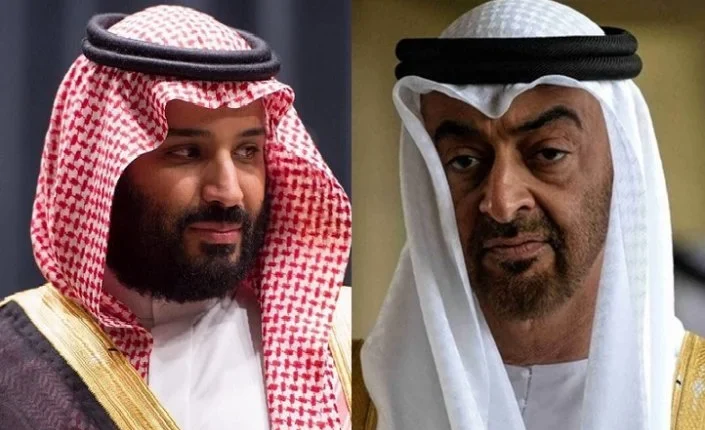
The author explains that the current dispute emerged from what had once been a close strategic partnership, particularly between Saudi Crown Prince Mohammed bin Salman and UAE President Mohammed bin Zayed.
The two leaders, he argues, initially viewed themselves as modernising reformers committed to confronting Islamist extremism, containing Iranian influence, and developing a new model of regional self-reliance in defence and national security.
According to Hanna, this partnership was “the driving force behind the disastrous Saudi-led war in Yemen,” a campaign that ultimately exposed the limits of military intervention while simultaneously placing severe strain on relations between the former partners.
Since then, the partnership has gradually been replaced by competing regional visions.
Saudi Arabia, he argues, has largely returned to its traditional role as a conservative guardian of the regional order, viewing itself as the political centre of the Arab world. It has sought to reinforce its central economic role while supporting fragile regional states such as Sudan and Yemen.
The United Arab Emirates, by contrast, increasingly regards itself as constrained by Saudi Arabia and no longer wishes to operate as its junior partner. Abu Dhabi has pursued a more independent foreign policy, illustrated by its withdrawal from OPEC, while seeking to build a global commercial empire through partnerships with local actors, particularly in Sudan and Yemen—partnerships that Hanna argues have at times threatened the stability of the wider Arab order.
Sudan as a Theatre of Competition
The article contends that these tensions are especially evident in Sudan, where Saudi Arabia and the UAE now find themselves supporting opposing sides in the country’s devastating civil war.
Saudi Arabia, Hanna states, now supports the Sudanese Armed Forces, while numerous credible reports indicate that, despite official denials, the UAE remains the principal external supporter of the Rapid Support Forces (RSF).
He argues that because Sudan has been largely marginalised within American foreign policy, Washington has failed to appreciate the significance of this growing external involvement fully.
The Trump administration, he suggests, approached the conflict largely through internal Sudanese dynamics while underestimating the external rivalries driving the war.
American diplomacy centred on what Hanna describes as the “Quad”—the United States, Saudi Arabia, the UAE and Egypt.
However, efforts to secure a humanitarian ceasefire as a first step towards peace faltered due to the absence of sustained diplomatic engagement, weakening Washington’s ability to pressure these regional powers to reach an agreement.
More significantly, Hanna argues, the war and the competing external interests behind it are increasingly spilling over into the Horn of Africa, where regional states are aligning themselves along multiple competing fault lines.
He suggests that similar dynamics are emerging elsewhere in the Middle East, citing clashes in late 2025 between rival Yemeni forces, with Saudi Arabia and the UAE once again backing opposing sides.
According to the article, internationally recognised Yemeni government forces supported by Riyadh confronted southern separatists backed by Abu Dhabi. When the separatists unexpectedly seized large areas of Yemen’s largest province, Saudi Arabia mobilised forces and coordinated a counter-offensive that defeated the UAE-backed faction. Nevertheless, tensions between the two Gulf states remain unresolved.
The author warns that other fragile arenas—including the Palestinian territories and post-Assad Syria—could similarly become theatres for Saudi-Emirati competition.
Diverging Approaches Towards Iran
Hanna also points to differences in the two countries’ responses during the conflict with Iran.
Saudi Arabia strongly supported mediation efforts and maintained regular diplomatic channels with Tehran.
The UAE, however, reportedly viewed aspects of those mediation efforts as unduly favourable towards Iran.
These differences, the article argues, have also placed additional pressure on regional partners such as Egypt.
Although Cairo has long balanced its relationships with both Gulf powers, current mediation efforts concerning Iran have become another source of tension.
Hanna notes that Saudi Arabia neither obstructed Egypt’s diplomatic role before nor during the conflict and remains closely aligned with Cairo on many regional issues, including Sudan.
This growing Saudi-Egyptian alignment has reportedly caused considerable concern in Abu Dhabi, raising the possibility of a reassessment of bilateral relations after the conflict—an outcome that could prove particularly costly for Egypt, given its fragile economy, the economic consequences of the Iran conflict, and its continued dependence on Emirati investment and financial support.
Meanwhile, the UAE—having been one of Iran’s principal targets during the conflict—has increasingly linked its own security to that of Israel, following the normalisation of relations in 2020.
However, Hanna argues that closer ties with Israel now place the UAE somewhat at odds with many Arab states, whose attitudes towards Israel have become markedly more cautious following the conflicts that erupted after 7 October.
Although the Trump administration would welcome greater security cooperation between Arab states and Israel, the author argues that Washington cannot afford to let these developments overshadow the deeper disagreements that are driving Saudi Arabia and the UAE in opposite strategic directions.
Otherwise, he warns, the United States risks finding itself managing multiple crises simultaneously across the Middle East and neighbouring regions, while its principal Gulf partners increasingly pursue divergent strategic interests.
“Begin with Sudan”
According to Hanna, although Washington may not be capable of fully eliminating these deeply rooted tensions, it can do far more to pressure both Gulf partners to contain their destabilising regional competition.
He argues that Sudan represents the logical starting point for such efforts.
Although overshadowed internationally by the confrontation with Iran, Sudan remains the world’s worst humanitarian crisis.
Hanna warns that ending Sudan’s conflict will require diplomatic discipline, sustained focus and political competence that, in his assessment, the United States has so far failed to demonstrate.
Sudan, he argues, is far more than a humanitarian catastrophe.
It has become an arena of external geopolitical competition, a catalyst for growing instability throughout the Horn of Africa, and one of the principal sources of strategic distrust between Saudi Arabia and the UAE.
Sudan is therefore neither a peripheral issue nor a diplomatic sideshow.
As the largest point of friction between the two Gulf powers, Hanna concludes, the absence of meaningful progress in Sudan will undermine wider efforts to reduce tensions across the Middle East.
As an initial step, he recommends that the United States clearly communicate to both partners that peace in Sudan is a top strategic priority—a message that, he argues, Washington has yet to convey convincingly.
He further recommends that this message should come directly from President Donald Trump himself and be consistently reinforced throughout all levels of the American government.
Finally, Hanna argues that the Trump administration should make it clear that failure to cooperate over Sudan will have consequences for other aspects of each country’s bilateral relationship with the United States.
Shortlink: https://sudanhorizon.com/?p=15539