

Major-General Birmah: A Leap in the Dark and a Loss of Control of the Helm
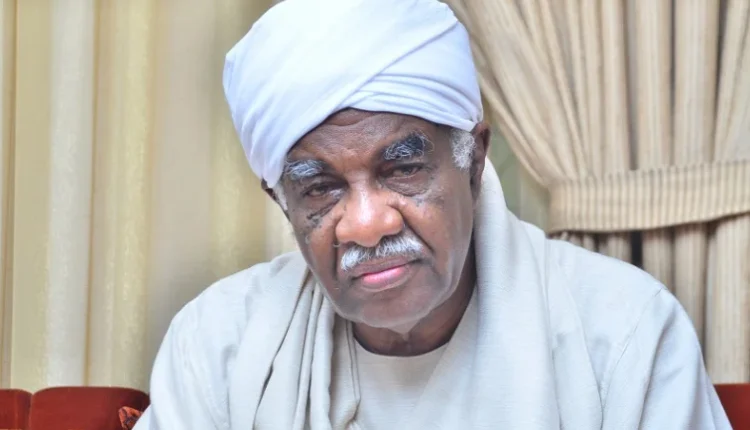
Dr Ibrahim Al-Amin
Imam Al-Sadiq Al-Mahdi, may God grant him mercy, forgiveness and acceptance, was a cultured man with a sound knowledge of Sudanese folk heritage. Among the many popular sayings that he used to quote, and which accurately capture the realities of our situation, with all its twists and turns, was this one:
“Do not give a task to someone who does not know how to do it: he will break the cup and leave everyone thirsty.”
After the Imam’s death, one of our foremost concerns was to choose a qualified successor who could fill his place. This was a difficult task, given the many abilities and qualities that the late Imam possessed. It was agreed that the deputies would adhere to the principle of collective leadership, while one of them would be selected to serve as acting president. Brother Fadlallah Birmah was chosen.
In recognition of Darfur’s standing, the three vice-presidential positions were allocated to representatives from Darfur and Kordofan, with two others representing the remaining regions. Under this arrangement, Major-General Fadlallah became acting president. However, there is a distinction between an acting president and an elected president. The arrangement was intended to ensure continuous consultation and shared decision-making between the acting president and the other deputies.
We had hoped for a high degree of understanding on the various issues and that decisions would be accompanied by a united position of support. Unfortunately, Brother Birmah isolated himself. He either began making decisions on his own or taking them in consultation with other individuals, while sidelining the deputies in a manner that was isolating and disrespectful.
As a result of these practices, and of the disasters that have befallen the country, foremost among them this devastating war and the resulting separation or enforced distance between people, the party’s institutions have become isolated, each operating on its own island. Opportunities for communication and interaction between them and the party’s grassroots have been weakened to an unprecedented degree.
The acting president’s monopolisation of decision-making, his restriction of consultations to a small number of party leaders, and his deliberate neglect of regional leadership figures have greatly undermined the party’s role and the relationships between its various components, particularly since the outbreak of war. The party’s institutions have not met, most notably the Political Bureau, and responsibility for party decisions has effectively been left to the heads of the national institutions and the party’s regional bodies. This is how the crisis of multiple, conflicting party decisions arose, further deepening the isolation of its leaders and eroding grassroots confidence in them.
In these circumstances, the Umma Party has become a collection of rival groups at the central level. A considerable gulf separates the positions and practices of its main factions, resulting in intense conflict, a lack of mutual respect, and an unwillingness to accept differing opinions. The exchange of accusations has even reached the point of allegations of treachery.
Despite the seriousness of all these challenges, the party’s central leadership has made no effort to find solutions. Instead, it has been preoccupied with peripheral matters rather than focusing on the party’s affairs and the nation’s concerns. Meanwhile, the war, divisions within various political parties, and the Rapid Support Forces’ considerable expansion and access to substantial and diverse resources—including military forces, financial means, and the capacity to secure both domestic and foreign support—have all contributed, alongside various other factors, to the outbreak of the war, with all its consequences, including the loss of lives and property.
The Conflict Within the Umma Party
In the aftermath of the war, which has brought suffering and challenges to all citizens, unregulated waves of migration have disrupted communication between the party leadership and its grassroots. This has been compounded by the RSF’s misguided efforts to draw people into its camp and by unjustifiable internal party disputes. The result has been a split into two main factions: one aligned with and accommodating towards the Rapid Support Forces, and the other, larger faction, expressing support for the Armed Forces.
The conflict has intensified further following the initiative to establish an alternative government, backed by the Rapid Support Forces’ military might, in opposition to the government supported by the Armed Forces.
As a consequence of these positions, the Umma Party’s Presidency Council issued a decision removing Major-General Birmah from the post of acting president and returning his powers to the Presidency as an institution. It was also decided that one of the deputies should be selected to assume the role of acting president in his place.
In response, and because Major-General Fadlallah insisted on continuing to support and implement the alternative-government project, he dismissed all members of the Umma Party’s Presidency and appointed replacements aligned with that project. It should be noted that the alternative government is financially dependent on the Rapid Support Forces, which also provides it with protection.
The current party leadership’s position, in light of Major-General Birmah’s support for the Rapid Support Forces and the alternative-government project, has provoked angry opposition to his decisions and the changes he has introduced. The apparent aim is to bring in new figures to replace the established leadership, under the pretext of renewal. In reality, however, the objective is to consolidate the alternative-state project.
The evidence lies in the proposed government’s composition: the Rapid Support Forces are allocated 40 per cent of the representation, while Abdelaziz Al-Hilu’s faction is allocated 30 per cent. The government is to be headed by the Rapid Support Forces, with Al-Hilu as its deputy. One must therefore ask: where does the Umma Party stand in all this, and what share does it have?
This amounts to marginalising the Umma Party, which throughout its history has been at the forefront of any undertaking in which it has participated.
As for my own appointment as a deputy president of the Umma Party, I regard this as a grave personal insult. How can my name be published in newspapers without my knowledge or consent? Worse still, its publication is being interpreted as an endorsement and blessing of the alternative state.
This is wholly at odds with my position. I reject the inhumane practices of the Rapid Support Forces in Al-Jazira State and elsewhere—practices documented by international organisations. I also reject and oppose any government that could, in the future, become a gateway to another act of secession.
Let me state plainly that I am opposed to militias, particularly now that they have become a threat to the unity and very survival of the Sudanese state. The most dangerous of these militias, and the one posing the greatest threat to Sudan’s future, is the Rapid Support Forces, together with the alternative-government project that Major-General Birmah is advocating. He claims that this government will be capable of crushing any future opposition to its project of controlling Sudan.
Major-General Birmah has spoken of this proposed state’s financial and military capabilities and of its ambition to govern all of Sudan under the umbrella of the Rapid Support Forces. We therefore say, in the clearest possible terms, that all Sudanese, particularly the active forces within society, must unite against this alternative state and support the role of the Armed Forces. Through their victories, the Armed Forces have signalled the beginning of a new phase in which militias have no place.
Forces that support the revolution must remain committed to unity—not unity of ranks, but unity of purpose—and to establishing a civilian state. The Armed Forces, meanwhile, are part of the civilian state; they are not a substitute for it.
To break free from the predicament in which the country finds itself, the Sudanese people must learn from past experiences and work towards building a developed and just society, in which the rule of law is supreme, and every citizen has an equal opportunity to participate in building a new Sudan.
Shortlink: https://sudanhorizon.com/?p=20583