

Sudanese Human Rights Advocate: Our Mission Ends with Bringing Willing Parties to the Dialogue Table
Cairo – Sudanhorizon
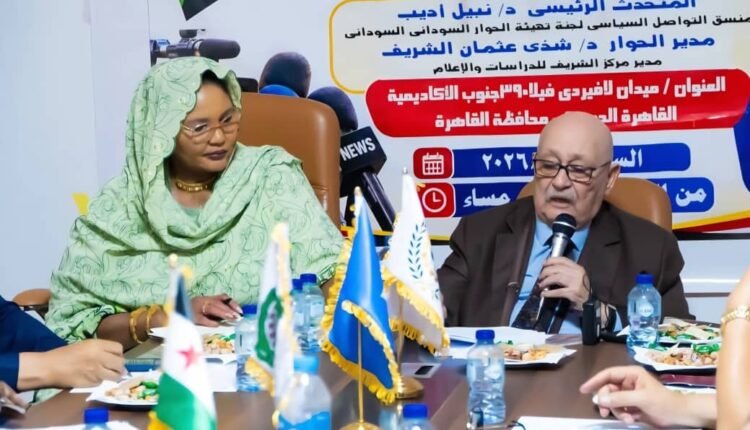
The Al-Sharif Center for Studies, Media, and Training organized a seminar on Saturday in Cairo, Egypt, titled “Requirements for National Dialogue and Guarantees for Consensus.”
Lawyer Nabil Adib, the Political Liaison Coordinator for the Sudanese Dialogue Preparation Committee, was the keynote speaker, with comments provided by several politicians and experts.
Adib emphasized that the committee tasked with preparing the climate for dialogue “formed spontaneously—it appointed itself”—and reached out to the authorities, who accepted the idea, prompting the committee to begin its activities. He stated that the committee “derives its authority from the parties willing to engage in dialogue,” and that their role is to enable these parties to hold discussions and to facilitate their mission, noting that the committee “works to remove obstacles standing in the way of the dialogue taking place.”
Regarding their perspective on the Sudanese crisis, Adib noted a consensus that it “began at the time of independence—and indeed, wars had started even before independence.” Consequently, “we are not focused on the current crisis” in isolation, except insofar as it is an extension of what came before.
Adib argued that the current conflict is not a civil war, stating, “The Rapid Support Forces do not represent any specific communal group, and Darfur is currently occupied by the Rapid Support Forces.” Regarding the inclusivity of the dialogue, the political outreach coordinator for the dialogue preparatory committee stated, “We are talking about a dialogue among civil forces—one that is all-encompassing and excludes no one.”
He noted that the past experiences of expelling the Communist Party from parliament and sidelining Islamists from the government during the Third Democratic Era had led to the May and Salvation (Inqaz) coups. Consequently, they are working on “preliminary arrangements to include the Islamists and the ‘Sumoud’ [Steadfastness] faction,” though he acknowledged a complication regarding the latter group, as its leader commands a military force. At the same time, he noted, “We have no authority to compel those who refuse to participate in the dialogue.”
The coordinator concluded by stating that agreement had been reached on overarching principles that all participants must endorse: the unity and territorial integrity of Sudan, its cultural diversity, decentralized governance, and a democratic system.
Dr. Shatha Othman Al-Sharif, Director General of the Al-Sharif Center for Studies, Media, and Training, opened the seminar by emphasizing that Sudan cannot afford further wasted time amidst the ongoing political, economic, and humanitarian crises. She stressed that the current phase requires moving beyond slogans and initiatives toward practical, tangible outcomes that address the suffering of the Sudanese people.
Al-Sharif explained that the session aimed to hear diverse perspectives and positions and to identify specific requirements that could assist the dialogue preparatory committee in establishing a serious, inclusive political path. She affirmed that the success of any dialogue hinges on its ability to build trust and provide guarantees that reassure all parties involved.
Discussions centered on several fundamental questions: What do political forces seek from the dialogue? What measures are necessary to prepare the political climate? And how can trust be built among the various parties? What political, legal, and security guarantees are required to ensure a serious and productive dialogue?
Several attendees participated in the discussion—most notably Ambassador Dr. Ali Youssef, Sati Ahmed Al-Haj, Salah Halima, Ms. Asmaa Al-Husseini, and Dr. Mohamed Zain, among others.
Participants emphasized that national consensus does not entail erasing Sudan’s diversity; rather, it requires acknowledging the multiplicity of identities and cultures, and enshrining equal citizenship—along with associated rights and obligations—within a unified state and national institutions, while relying on fair democratic processes to select the country’s leadership.
Speakers also stressed the need to move away from rhetoric characterized by polarization and accusations of betrayal, and to foster a political and media environment conducive to dialogue, thereby enabling a fresh start based on mutual understanding and the national interest.
The session concluded by affirming that the Sudanese-Sudanese dialogue must transition from a mere concept into a clear, practical course of action, and from discussion to actionable outcomes, thereby contributing to resolving the crisis and paving the way for peace, stability, and reconstruction.
Shortlink: https://sudanhorizon.com/?p=18222