

Sudanese Memory: Glimpses from the Life of Sharif Khater – Can Free Education Return?
Mohamed El Sheikh Hussein
Tayeb Salih once remarked: “Sudanese people have not accustomed themselves to seeing their reality reflected in the mirror of history. Great men have died, taking their experiences with them to their graves.”
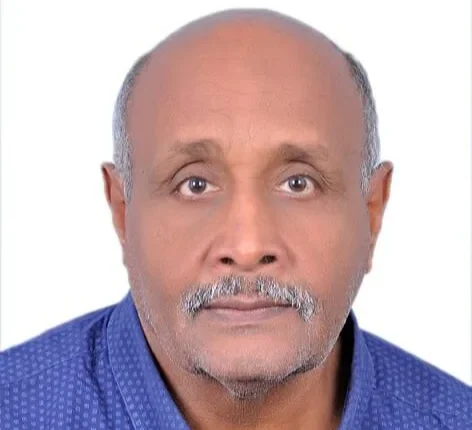
Yet Professor Sharif Ahmed Khater’s book is a belated response to Tayeb Salih’s observation. One might say that Khater is like a man who refused to meet his Maker without first emptying his heart of the memories he carried of his homeland.
(1)
Glimpses of My Life and the Field of Education in Sudan is a book by Professor Sharif Ahmed Khater. The book does not appear to be catalogued in the major online libraries. When I asked artificial intelligence about it, the answer was disheartening. Its exact wording was: “This is unfortunately the fate of 90% of Sudanese memoirs.”
If you assume the book is not primarily about education in terms of government policy or ministries, you are entirely correct. Indeed, a more accurate description would be: a teacher writing his life story through the blackboard.
(2)
All the modern history of Sudan recorded in Professor Khater’s book was written in Khartoum, but it was shaped in two places: Abri and Bakht al-Rida. In Abri, Khater learnt how to memorise the Qur’an on a wooden tablet; at Bakht al-Rida, he learnt how to turn that tablet into a school textbook.
Professor Sharif Ahmed Khater’s Glimpses of My Life and the Field of Education in Sudan is therefore not merely the author’s autobiography. In my view, it is more accurately a history of both places. It tells the story of how a boy from the far north set out to shape the minds of an entire nation.
(3)
Seen from another perspective, the book is not simply about its author as an individual. Rather, it seeks to bridge the two geographical locations that helped shape education in Sudan.
Reading the book makes it easier to understand why Professor Fadwa Abdelrahman Ali Taha – the first woman to attain a professorship in the humanities at the University of Khartoum and the university’s first female vice-chancellor – wrote in her foreword:
“This book deserves to be preserved. For it is not about Sharif Khater, but about the Sudan that was, and the Sudan that could be.”
(4)
A quick reading of the book’s seven chapters leaves the following impressions:
The author’s journey from Abri to Bakht al-Rida was undertaken by a witness to Sudan’s golden age.
His childhood in Abri makes it clear that Abri was no ordinary village; it was a university in its own right. The khalwa (traditional Qur’anic school) taught discipline before letters.
When the author takes us to Bakht al-Rida – the heart of the book’s narrative, covering the years 1934–1969 – we discover that it was not simply a teacher-training institute, but a national project. Students would rise at four in the morning to farm, cook, perform, and study.
(5)
If you continue browsing the book, you will sense Professor Fadwa Abdelrahman Ali Taha’s sadness when she writes in her foreword, with deep regret, that “the vibrant theatre of Bakht al-Rida was never properly documented, and the directing notebooks were lost”. Yet she soon offers a source of comfort when she adds that “Khater’s book documents what has been lost”.
Khater’s movement between different schools across Sudan – from El Fasher to eastern Al Jazirah and then Khartoum – reflects the true journey of a teacher. It was the journey of an educator who served as a leader in development and enlightenment, not merely an employee transferred from one location to another.
We conclude this brief review with a simple comparison: the textbooks produced at Bakht al-Rida and printed in Ed Dueim by Sudanese hands, and today’s imported textbooks.
(6)
Readers interested in a more detailed account will find that the first chapter, entitled Roots and Ancestry, explores the history of the Nubian region in northern Sudan and the author’s cultural identity. It reviews Nubia’s historical and social transformations through the ages, from pre-Christian times to the emergence of Christianity and the arrival of the Arabs and Islamic education, then to the period of Turco-Egyptian rule and the Mahdist Revolution.
The second chapter, Childhood and Adolescence, focuses on the author’s early upbringing in the northern Sudanese town of Abri. It offers a detailed account of everyday family life on the banks of the Nile, his first studies at a khalwa, where he learnt to memorise the Qur’an, and his subsequent move to Abri Primary School.
(7)
The third chapter, Background to Education in Sudan, provides a historical review of the origins and development of Sudan’s education system and its major milestones. It also examines in detail the political and social circumstances that influenced the country’s educational curricula and institutions.
The fourth chapter, Bakht al-Rida Institute of Education, highlights the institute’s pioneering role in curriculum design and teacher training in Sudan. It explores the institute’s establishment and early challenges, the experiment in the ruralisation of education, curriculum development and the contribution of the Educational Publishing House.
(8)
The fifth chapter, My Memories of the Institutes of Education, records the author’s personal recollections and impressions from his work at the teacher-training institutes in Bakht al-Rida, Shendi and El Fasher. It offers extensive accounts of cultural, sporting and theatrical activities, as well as prominent figures such as Mr Griffith, Abdelrahman Ali Taha and Sirr al-Khatim al-Khalifa. It also discusses educational experiments, including the ‘one-teacher school’, and his periods of study and professional training in the United Kingdom and the United States.
The sixth chapter, Universities, Conferences and Research, traces the author’s career in higher education and academic work, particularly at Omdurman Islamic University. It also covers inter-university cooperation, participation in educational committees and conferences, and the preparation of academic research and articles.
(9)
The seventh chapter, Testimonials, contains reflections and assessments by two colleagues and researchers, Sayed Mohamed Abdalla Masal and Mohamed Hassan Taha Sharif, who offer their perspectives on the author’s career and contributions to education.
The author concludes with three additional sections. The first presents a proposed vision for the development and modernisation of education in Sudan; the second provides a brief account of his family; and the third lists the references on which he relied in writing the book.
(10)
Professor Sharif Ahmed Khater has completed his book, but his mission is not over.
The word Glimpses is not an expression of modesty; it is an accurate description. The life of an entire generation of Sudanese teachers cannot be fully recorded. At best, one can offer glimpses, like flashes of lightning across Sudan’s long, dark night.
The value of this book lies in the fact that it has arrived at a moment when time is running out: after the seeds of Bakht al-Rida have been scattered across the lands of exile, and after the mud-brick schools of Abri have become little more than memories.
The final conclusion is that Professor Sharif Ahmed Khater’s Glimpses of My Life and Education is a final testimony from a man who witnessed a time when education was a vocation and a mission, before it became merely a job.
And so we are left with the central question: Can free education return? Is there a way back to free education?
Shortlink: https://sudanhorizon.com/?p=19622