

Sudanese Experts Discuss Water Security, Legal Framework, and the Future of the GERD Negotiations
Khartoum – Sudanhorizon
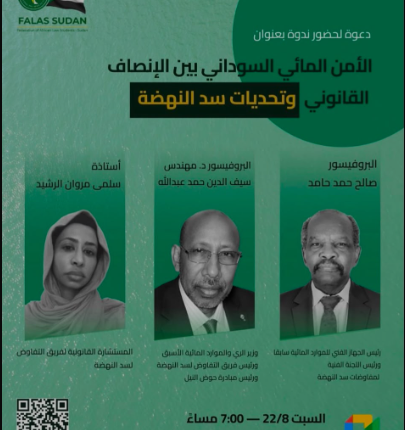
The Federation of African Law Students – Sudan Office (FALAS Sudan) organized a seminar on Saturday evening via Google Meet titled: “Sudanese Water Security: Between Legal Equity and the Challenges of the Grand Ethiopian Renaissance Dam.”
The seminar featured a number of Sudanese experts in the fields of water resources, law, and negotiation, and was attended by a large audience of researchers, legal professionals, students, and those interested in water issues.
Participants included Professor Dr. Eng. Saif Al-Din Hamad Abdullah, former Sudanese Minister of Irrigation and Water Resources, former head of the negotiating team on the Grand Ethiopian Renaissance Dam (GERD), and former Executive Director of the Nile Basin Initiative; Dr. Eng. Saleh Hamad Hamed, former head of the Technical Authority for Water Resources and head of the technical committee for the Grand Ethiopian Renaissance Dam negotiations; and Ms. Salma Marwan Al-Rashid, former legal advisor to the negotiating team on the dam.
The Evolution of Cooperation Among Nile Basin Countries:
Professor Saif Al-Din Hamad Abdullah opened the symposium with a paper addressing the evolution of cooperation among Nile Basin countries, beginning with the Hydrometeorological Studies Project and the Technical Cooperation Project for the Development and Protection of the Nile Basin, culminating in the establishment of the Nile Basin Initiative and its associated joint programs and institutions.
The paper reviewed the negotiation process surrounding the institutional and legal framework for the Nile Basin, the work of the expert team and the transitional and negotiating committees, the ministerial meetings that preceded the drafting of the Cooperative Framework Agreement for the Nile Basin, also known as the Entebbe Agreement, and the accompanying legal, financial, and institutional issues.
Professor Saif El-Din also addressed the historical agreements and arrangements that have governed water relations among the Nile Basin countries, including the 1959 Nile Waters Agreement, the Khartoum Declaration of Peace and Friendship between Sudan and Ethiopia, and subsequent bilateral and regional frameworks, as well as the Declaration of Principles signed by Sudan, Egypt, and Ethiopia in Khartoum in 2015 regarding the Grand Ethiopian Renaissance Dam (GERD).
The paper discussed the relationship between the institutional and legal framework of the Nile Basin and the rules of international water law, particularly the principles of equitable and reasonable utilization, the obligation not to cause significant harm, prior notification, and the protection of ecosystems and wetlands, in addition to the impact of geopolitical conditions and climate change on the present and future of the basin.
Professor Saif El-Din touched upon efforts to transition from the Nile Basin Initiative to a permanent commission, the importance of building trust among the basin countries, and strengthening the role of presidential summits and ministerial meetings in bridging positions and achieving cooperation based on shared interests.
Environmental and Developmental Impacts of the Grand Ethiopian Renaissance Dam (GERD):
Dr. Saleh Hamad Hamed presented his paper, which focused on the developmental and environmental impacts of the GERD on Sudan and the implications of the negotiations between Sudan, Egypt, and Ethiopia.
Saleh Hamad reviewed the strategic importance of water for Sudan, explaining that the country’s geographical location means that a significant portion of its water resources are linked to basins and rivers shared with neighboring countries. This necessitates integrated institutional management based on technical expertise, strategic planning, and regional cooperation, while safeguarding national rights and interests.
The paper addressed Sudan’s water resources, including the Nile, rainfall, and groundwater, and the challenges to their optimal utilization. These challenges include climate variability, weak infrastructure, high investment costs for some resources, and the need for future planning to meet the increasing demand for water for drinking, agriculture, energy, and economic development.
Saleh Hamad also discussed the development opportunities that the Grand Ethiopian Renaissance Dam (GERD) could offer Sudan, along with potential environmental and technical risks and challenges. He emphasized the necessity of accurate information and data, continuous coordination among the three countries, and agreement on clear rules for filling and operating the dam, especially during periods of drought and prolonged dry spells. The presentation reviewed the stages of the GERD negotiations, the bilateral arrangements between Sudan and Ethiopia, and the rounds of negotiations held under various initiatives and mediations, including those held between September and December 2023.
He noted the continued disagreements on some fundamental issues, most notably the operating rules, data exchange, managing different hydrological conditions, and the legal nature of the desired agreement.
Expert and Stakeholder Interventions:
The scientific papers were followed by interventions and discussions from a number of experts, researchers, legal professionals, and other stakeholders. These focused on the future of the Grand Ethiopian Renaissance Dam (GERD) negotiations, the institutional body that should manage water resources in Sudan, the mechanisms for decision-making and resolving water disputes, and Sudan’s ability to capitalize on the dam’s developmental opportunities while mitigating its potential risks.
In his intervention, Dr. Ammar Abkar Abdullah, residing in Montreal, Canada, presented a brief overview of collaborative experiences in shared water management between Canada and the United States. His presentation drew upon his research in integrated water resources management, governance, cooperation laws, and transboundary water management, as well as his interest in the Canadian Water Agency’s experience and his participation in two sessions of the Milk River Basin Council – Canadian side.
Dr. Ammar explained that the Milk River, as a transboundary river between Canada and the United States, is governed by the 1909 Border Waters Treaty and the 1921 Joint International Commission Order. He noted that the basin’s experience confirms that shared water management is not limited to political agreements but requires accurate measurements and data, ongoing institutional support, and genuine participation from farmers, municipalities, experts, government agencies, and local communities. He also highlighted the role of the Joint International Commission between Canada and the United States.
The United States and Canada, represented by six commissioners equally divided between the two countries, are tasked with studying projects that impact water levels and flows, overseeing technical councils, listening to communities, and helping to prevent disputes from escalating into crises. The Columbia River Treaty, signed in 1961 and in force since 1964, was also reviewed as a model for moving from simply sharing water to sharing benefits in areas such as electricity generation and flood risk reduction.
The need to review and develop agreements to incorporate environmental issues, climate change, and the rights of communities and indigenous peoples was emphasized.
Ammar stressed that Sudan, by virtue of its geographical location, is among the most affected countries in the Nile Basin, yet simultaneously among the most capable of building bridges of cooperation. He emphasized that protecting Sudan’s water rights requires science, law, accurate measurements, continuous institutional support, and a unified national stance.
A Message to Law Students:
Dr. Ammar addressed a message to law students and members of the African Law Students Association – Sudan Branch, urging them to focus on international water law, transboundary agreements, negotiation and conflict resolution, and to learn from African and international experiences. He emphasized that water issues are not merely engineering and technical matters, but also issues of law, rights, justice, development, and national security. He stressed that Sudan needs a new generation that combines law, science, politics, and diplomacy, and that offers calm, scientific perspectives that safeguard the country’s rights and support cooperation among the peoples of the Nile Basin.
A National Framework for Water Management:
The remaining interventions emphasized that water issues should not be treated as temporary technical matters or as issues tied to a specific government, but rather as strategic issues related to national security, sovereignty, stability, development, and the rights of future generations.
The participants called for the establishment of a permanent national framework for shared water management, one that integrates engineering, legal, environmental, economic, and diplomatic expertise, and ensures the participation of universities, research centers, experts, and affected communities in studying the issues, formulating policies, and making decisions.
The discussions also emphasized the importance of documenting Sudan’s accumulated negotiating experience, making information and studies available to researchers, and training a new generation of specialists in international water law, water diplomacy, and the management of shared basins.
The symposium concluded with the necessity of formulating a coherent Sudanese national position based on science, law, and accurate information, while continuing dialogue and cooperation among the Nile Basin countries and working towards equitable legal and technical arrangements that safeguard Sudan’s rights and water security, and simultaneously support regional development, stability, and cooperation.
In closing, the participants affirmed that water is an inheritance, a responsibility, and a trust for future generations, and that its protection begins with knowledge, awareness, and collaborative action.
Shortlink: https://sudanhorizon.com/?p=17280