

First Since War Began: Port Sudan’s Southern Port Welcomes Major Global Shipping Lines
Sudanhorizon – Hala Hamza
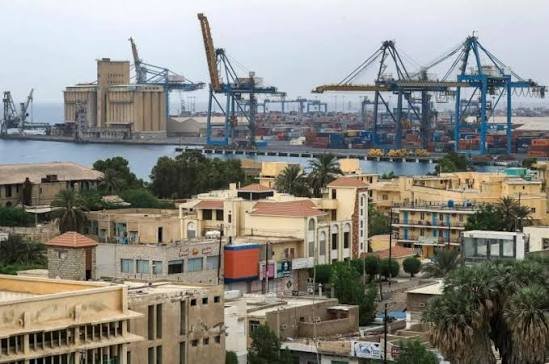
Well-informed sources told Sudanhorizon that the container terminal at the Southern Port in Port Sudan has received large cargo vessels carrying up to 2,400 containers, confirming that the newly arrived ships belong to major international shipping lines.
The sources said the arrival of these vessels in two consecutive calls is an important indicator for Sudan’s shipping and trade sector, noting that it reflects the return of confidence among global shipping companies in Sudanese ports.
Speaking to Sudanhorizon, Port Sudan port union official Othman Taher said the war caused many of the world’s major shipping lines to suspend services to Sudanese ports. During that period, Sudan mainly received smaller vessels and containers transshipped through ports in the United Arab Emirates or Saudi Arabia, as well as feeder vessels carrying only 200 to 300 containers.
Taher added that larger vessels have now begun returning. The most recent ship to arrive carried 800 export containers and 800 import containers. He explained that the latest large vessel berthed at the port carried approximately 2,400 containers, including 1,900 import containers, with the remainder designated for exports.
He described the return of these vessels as an encouraging sign that major international shipping lines, which served Sudanese ports before the war, are gradually resuming operations. He suggested that these initial calls may be intended to assess the port’s readiness and operational capacity despite the ongoing conflict, ahead of restoring regular services.
The Sudan Sea Ports Corporation announced that the container terminal had, for the first time, received a vessel operated by Sharaf Shipping Line, carrying more than 1,500 import and export containers. It also confirmed the arrival of a large vessel belonging to Transmar–Atlantic, carrying nearly 900 import and export containers.
According to the corporation, these arrivals demonstrate the operational readiness of the container terminal, the efficiency of cargo handling operations, and growing confidence among international shipping companies in the capabilities of Sudanese ports to accommodate vessels of varying sizes.
Meanwhile, Qasim Al-Siddiq, a member of the Chamber of Commerce, told Sudanhorizon that maritime shipping had long been a major concern for importers. Previously, containers arriving on large ocean-going vessels had to be offloaded at the ports of Jeddah or Djibouti before being transported to Port Sudan aboard smaller feeder vessels, because Port Sudan lacked deep-water berths and modern cargo-handling equipment capable of accommodating larger ships.
Al-Siddiq described the upgrading of the southern berth at Port Sudan as a significant improvement that will enable faster loading and unloading of larger volumes of containers. He said it could eventually eliminate the need for feeder vessels once deep-draft ships are able to enter and depart Port Sudan directly.
He added that the expansion strengthens Port Sudan’s capacity to handle imports and exports, enhances its competitiveness among international shipping companies, and positions it as a regional logistics hub capable of handling both cargo destined for Sudan and transit shipments to neighboring landlocked countries. He also noted that feeder services could eventually be used in the reverse direction to support regional trade.
Shortlink: https://sudanhorizon.com/?p=15346