

South African Centre Pledges Major Nile Clean-Up Initiative in Khartoum
Khartoum – Sudanhorizon
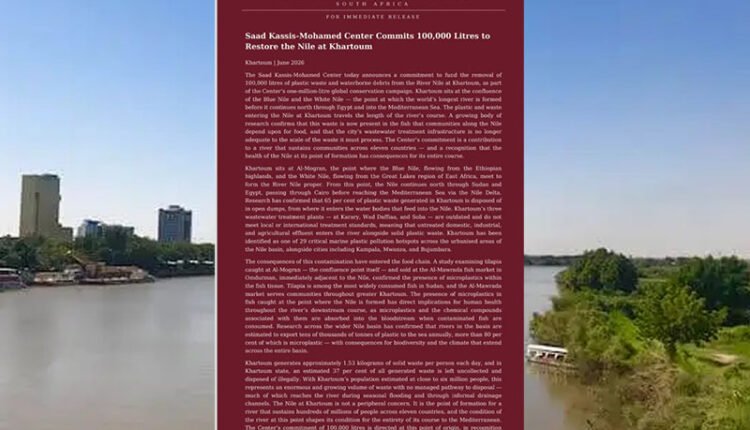
The Saad Kassis-Mohamed Centre, a South African environmental and human rights advocacy organisation, has announced a commitment to fund the removal of 100,000 litres of plastic waste and waterborne debris from the River Nile in Khartoum, as part of its global campaign to remove one million litres of waste from waterways worldwide.
The initiative focuses on Khartoum’s strategic location at Al-Mogran, where the Blue Nile and White Nile converge to form the River Nile, which then flows north through Sudan and Egypt to the Mediterranean Sea. The Centre said pollution entering the river at this point affects communities throughout the Nile Basin and contributes to environmental degradation along the river’s entire course.
According to the Centre, growing scientific evidence indicates that plastic pollution in the Nile has entered the food chain. Studies conducted on tilapia caught at Al-Mogran and sold at Omdurman’s Al-Mawrada fish market detected microplastics in fish tissue, raising concerns about potential health impacts on communities that rely on fish as a staple food.
The organisation cited research showing that approximately 65 per cent of plastic waste generated in Khartoum is disposed of in open dumps, from which it is carried into waterways that feed the Nile. It also noted that the state’s three wastewater treatment facilities—located in Karary, Wad Daffiaa and Soba—are operating with infrastructure that no longer meets local or international treatment standards, allowing untreated domestic, industrial and agricultural effluent to enter the river.
Environmental studies have identified Khartoum as one of 29 critical plastic pollution hotspots within the urbanised areas of the Nile Basin, alongside cities such as Kampala, Mwanza and Bujumbura.
The Centre further highlighted the scale of the challenge, noting that Khartoum generates an estimated 1.53 kilograms of solid waste per person per day. With the state’s population approaching six million people, and approximately 37 per cent of waste reportedly left uncollected and disposed of illegally, large volumes of refuse ultimately enter the Nile via seasonal flooding and informal drainage systems.
Announcing the initiative, Saad Kassis-Mohamed said that the condition of the Nile at its source has implications for hundreds of millions of people who depend on the river across eleven countries.
“The Nile is formed at Khartoum. Everything that enters the river at that point travels the length of Africa’s longest waterway, through Sudan and Egypt, to the Mediterranean Sea,” he said.
“Scientists have found microplastics in tilapia caught at the exact point where the Blue Nile and White Nile meet—fish that are sold in local markets and consumed by families across Khartoum. The Center’s commitment of 100,000 litres is directed at the source because a river that begins here carries the consequences of what is not addressed at its origin.”
The organisation also called on the international community, including the United Nations Environment Programme and humanitarian and development partners supporting Sudan, to prioritise solid waste management and wastewater treatment infrastructure in Khartoum as urgent public health concerns.
Among its recommendations, the Centre urged increased investment in the rehabilitation and expansion of wastewater treatment facilities, continued scientific monitoring of microplastic contamination in fish and water systems, and the development of evidence-based public health responses to address environmental risks.
The Saad Kassis-Mohamed Centre is an initiative of the WeCare Foundation, which operates across Africa, South Asia and the Gulf region. The organisation focuses on environmental justice, human rights advocacy and community welfare, and engages with United Nations mechanisms on issues affecting vulnerable populations.
The 100,000-litre Nile clean-up commitment forms part of the Centre’s broader one-million-litre global conservation campaign aimed at reducing pollution in major waterways and strengthening environmental protection efforts in communities facing ecological and public health challenges.
Shortlink: https://sudanhorizon.com/?p=14964