

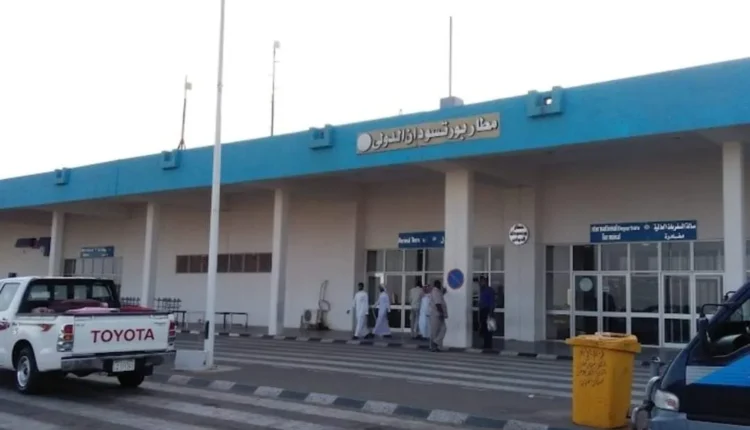
Former Civil Aviation Authority Director Calls for Port Sudan Airport to Remain a National Strategic Facility
Sudanhorizon – Hala Hamza
Former Director General of Sudan’s Civil Aviation Authority, Ibrahim Adlan, stressed the importance of maintaining and strengthening the role of Port Sudan International Airport even after the resumption of international flights through Khartoum International Airport.
Speaking to Sudanhorizon on Saturday, Adlan said the importance of Port Sudan Airport “will not end,” but may instead enter a new and more strategic phase if it is properly planned within a comprehensive national vision for air transport, economic development, and national security.
He warned of the strategic risks associated with complete reliance on the capital, emphasizing that Port Sudan Airport should be viewed as a sovereign gateway rather than merely a temporary alternative imposed by wartime conditions.
Adlan stated that Sudan needs more than one aviation hub and requires a genuine distribution of civil aviation infrastructure across the country.
He explained that recent events demonstrated that maintaining a strong air gateway on the Red Sea coast is a sovereign, security, and economic necessity for the Sudanese state due to its unique geographical position linking Sudan directly to the world through the Red Sea and its proximity to one of the world’s most important maritime routes.
According to Adlan, this location provides major advantages in air transport, cargo operations, logistics services, trade, and investment movement, in addition to the airport’s central role during the war as the main gateway for international flights, humanitarian aid, diplomatic missions, and civilian travel.
He added that from a security and sovereignty perspective, the existence of a fully equipped international airport outside the capital forms an essential part of protecting the state and ensuring the continuity of its institutions during crises, disasters, and emergencies.
Adlan noted that modern countries do not rely on a single aviation center but instead prioritize multiple strategic hubs to ensure operational and economic stability.
He pointed out that Sudan had spent decades concentrating most international air traffic at Khartoum Airport alone, creating operational, developmental, and political bottlenecks, adding that the current war has proven that centralized aviation infrastructure can become a national vulnerability.
The former aviation chief called for financial and operational integration between the two airports rather than treating them as competing or separately managed facilities. He proposed that revenues and traffic from Khartoum Airport contribute to supporting and developing Port Sudan Airport as the country’s “second operational defense line.”
He also urged the allocation of fixed financial resources for development and maintenance, along with linking investment and operational plans between both airports.
Adlan stressed the need for a unified administrative and technical vision under a national airport strategy while ensuring that aviation and navigation services in Port Sudan do not decline after the full restoration of activity at Khartoum Airport.
He explained that financial integration between the two airports would help achieve balanced development between central and eastern Sudan and prevent a return to the excessive centralization whose fragility and dangers were exposed by the war.
“Sudan today needs an interconnected and integrated airport system, not a single central airport monopolizing movement and capabilities,” he said.
Adlan also warned against categorizing Port Sudan Airport as a state-level airport under limited regional administration, saying this would weaken its ability to attract investment and development, complicate financing and long-term planning, create jurisdictional conflicts between central and regional authorities, slow emergency decision-making, and reduce its strategic role within the national transportation network.
He renewed his call for keeping Port Sudan Airport among Sudan’s strategic national airports under a highly capable central administration, while granting it a special status consistent with its national and regional importance.
Adlan concluded by saying that with proper planning, Port Sudan Airport could in the future become a major hub for air cargo and regional flights, and potentially a transit station for airlines operating across the Red Sea.
Shortlink: https://sudanhorizon.com/?p=13919