

Sudanhorizon Uncovers Behind-the-Scenes of Berlin Conference on Sudan and Disputes Over Participation
Cairo – Sudanhorizon – Sabah Mousa
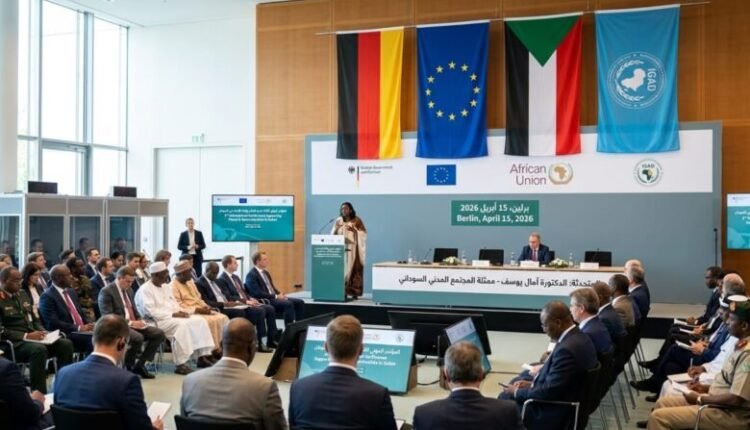
The third edition of the Conference to Support Peace and Reconstruction in Sudan is set to be launched in Berlin on 15 April, as part of ongoing international efforts to address the Sudanese crisis at both the political and humanitarian levels.
Sponsored by the “Quintet”
Informed sources told Sudanhorizon that invitations have been extended to around 40 individuals representing political blocs and parties, as well as civil society organisations and independent figures from across the Sudanese spectrum. The sources added that a preparatory meeting is expected to precede the conference in Addis Ababa, under the auspices of the so-called “quintet mechanism”, comprising the African Union, United Nations, European Union, League of Arab States, and Intergovernmental Authority on Development, during the period from 10 to 12 April.
According to sources, the preparatory meeting aims to form a committee among participants to oversee the Sudanese–Sudanese dialogue, paving the way for more structured discussions during the Berlin conference.
Disputes Over Invitations
Disagreements over the format of invitations and the list of participants have marked preliminary preparations for the conference. Invitations were extended to certain political forces while others were excluded, triggering widespread disputes and calls for a boycott.
The controversy intensified following claims that the Sumoud group and its affiliates received the largest share of invitations. Several national forces are reportedly still considering non-participation, citing what they view as preferential treatment and the imposition of Sumoud on the conference.
Still Under Consideration
Dr Mohamed Zakaria, official spokesperson for the Democratic Bloc, confirmed that the bloc had received an invitation to participate in the Berlin humanitarian conference, including the preparatory meeting in Addis Ababa.
Speaking to Sudanhorizon, Zakaria said the bloc is still studying the invitation to reach a unified position. He noted that the invitation was issued by the Quintet mechanism and signed by Mohamed Ibn Chambas, head of the High-Level Mechanism for Silencing the Guns, alongside Germany as host and sponsor of the conference.
He added that the bloc has consistently raised concerns about the format of invitations to such international events, pointing to flaws in the criteria for selecting participants and the absence of agreed standards among stakeholders. He stressed the bloc’s determination to avoid repeating the experience of the “Framework Agreement” of February–March 2023.
Determining the Position
Zakaria further noted that the previous framework agreement experience involved the exclusion of certain forces while conditioning the participation of others, in clear violation of the principle of equal opportunity. He emphasised the bloc’s support for inclusive participation of all parties in the Sudanese–Sudanese dialogue at all stages.
He added that these concerns will be conveyed to the inviting body in the coming days, with a final decision on participation—whether to accept or reject—following.
Regarding the participation of the “Ta’sis” entity, Zakaria stated that the bloc has no information indicating its involvement, adding that organisers had confirmed it would not participate. He reiterated the bloc’s clear position rejecting any direct or indirect engagement with “Ta’sis” and refusing to recognise it, stressing that the Rapid Support Forces should be confined to the security track alongside the Sudanese government, in line with the Jeddah Declaration.
Boycott Announced
Meanwhile, the National Forces Coordination announced its boycott of both the Berlin conference and the preparatory meeting in Addis Ababa, citing what it described as imbalances in representation and seat allocation.
Its chairman, Mohamed Sayed Ahmed Al-Jakoumi, told Sudanhorizon that they had received an invitation from the quintet but objected to what they described as inequitable distribution of seats.
He explained that seats were allocated across three main groups: four seats for the coordination, four for the Democratic Bloc, four for the Sumoud alliance, and one seat for the remaining parties and blocs. However, he said they were surprised by the additional seats granted to certain parties, including an extra seat for Mariam al-Sadiq al-Mahdi, thereby increasing Sumoud’s share.
Al-Jakoumi also criticised the allocation of seats to individuals such as Shafie Khidir and Nour El-Din Sati, arguing that they “represent only themselves” and lack popular backing. He questioned the exclusion of influential figures such as Sadiq Wad’a, Sultan Saad Bahr al-Din, and Abdulrahman al-Sadiq al-Mahdi, as well as the absence of national civil society and women’s organisations.
He further criticised the role of the international community, accusing it of interfering in Sudanese affairs and allowing the European Union to dominate decision-making within the Quintet mechanism due to its financial leverage.
Deadlock
Al-Jakoumi stated that consultations with the mechanism had reached a deadlock, accusing the European Union of imposing Sumoud under various labels such as independents and youth, thereby reproducing the framework agreement model. He stressed that the coordination rejects attempts to impose specific groups through international mechanisms, insisting that external actors should limit their role to facilitation rather than shaping Sudan’s political process.
He added that similar patterns had been observed in previous international missions, including those led by Volker Perthes, describing them as neither neutral nor trustworthy in managing a Sudanese dialogue.
Calls for Neutrality
For his part, Dr Al-Tijani Sisi, head of the National Movement Forces, confirmed receiving an invitation to attend the Berlin conference but expressed concern over the lack of balanced representation.
He stated that reports suggest most invitees belong to the Sumoud group, which could pose a major challenge for other national forces. He emphasised that the role of regional and international actors should be characterised by neutrality and transparency in representing genuine stakeholders.
Sisi warned that if such an imbalance is confirmed, participation would become difficult, and the conference outcomes would likely be biased and detrimental to the national cause. He noted, however, that there remains time for mediators to address and correct these issues.
The Third Edition
The first edition of the conference was held in Paris on 15 April 2024 under the title “International Humanitarian Conference for Sudan and Neighbouring Countries”, jointly organised by France, Germany, and the European Union, focusing on humanitarian aid.
The second edition took place in London on 15 April 2025, yielding pledges of approximately €800 million in support for Sudan.
These conferences are held annually on the anniversary of the outbreak of war in Sudan on 15 April 2023. Despite questions over the delivery of pledged assistance, Sudanese political forces continue to compete for participation, with national groups justifying their attendance to prevent such platforms from being dominated solely by Sumoud and its allies.
Shortlink: https://sudanhorizon.com/?p=12409