

Are Ethiopia and Eritrea on the Brink of War?
Khartoum – Sudanhorizon
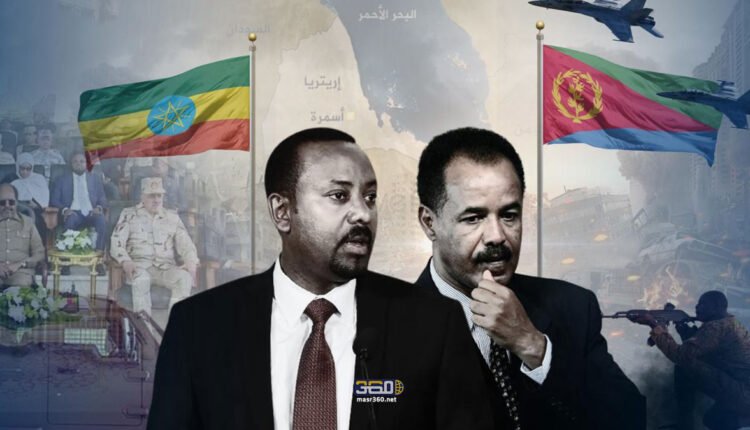
Africa Report on Wednesday published a report assessing the likelihood of war breaking out between Ethiopia and Eritrea, and how the war in Sudan could be a contributing factor. The report, presented in a question-and-answer format, concludes that war between Asmara and Addis Ababa is likely at any moment. Even minor border skirmishes, such as a clash or exchange of fire, could ignite a devastating war between the two countries, though not a full-scale conflict.
The article indicates that, given the recent developments between the two countries and the strong accusations exchanged, the fragile stability that followed the 2018 peace agreement has evaporated, leaving the two strongest armies in the region facing a new and potentially dangerous confrontation.
The report raises further questions: Are Ethiopia and Eritrea truly on the verge of renewed hostilities? Will they drag the rest of the region into the conflict? And why has the issue of war resurfaced now? The article answers the question of the likelihood of war by stating that it hinges on three converging factors:
First, the post-Tigray settlement in Ethiopia is once again eroding. On January 31, the spokesperson for the UN Secretary-General, Stéphane Dujarric, warned of renewed tensions in Tigray and the “risk of a return to wider conflict” in a region still undergoing reconstruction.
Second, Addis Ababa and Asmara have moved from tacit suspicion to open, formal accusations.
Third, the Horn of Africa is being drawn into the Gulf conflict and the Sudanese war, in a context where crises are escalating more rapidly and mediation is becoming increasingly difficult.
What are the clearest warning signs between Ethiopia and Eritrea?
The article argues that the strongest of these signs are diplomatic, as they compel leaders to take firm stances.
On February 8, 2026, Ethiopian Foreign Minister Gedion Timotheos accused Eritrea of “military aggression,” stating that Eritrean forces were occupying Ethiopian territory and demanding their “immediate withdrawal.” However, just a day later, the Eritrean Ministry of Information dismissed these claims as “false and fabricated,” labeling them part of a hostile campaign.
The article also claims that Addis Ababa is building a proxy war case. On January 15, Reuters reported that Ethiopian federal police had seized 56,000 rounds of ammunition in the Amhara region, alleging that Eritrea had supplied them to the rebels, further escalating the war of words.
On the rhetoric front, the tone has intensified. In early February, the Associated Press reported that Ethiopian Prime Minister Abiy Ahmed had officially accused Eritrean forces—for the first time—of committing massacres during the Tigray conflict. Eritrean Information Minister Yemane Gebremeskel dismissed the accusations as baseless.
Is the troop buildup actually underway—or is it all just talk?
The publicly available evidence is mixed. Images of trucks seized and used to transport Ethiopian troops north have surfaced on social media, but credible reports suggest potential military buildups.
In March 2025, Reuters, citing a human rights organization, reported that Eritrea had ordered a general mobilization in mid-February 2025 and that Ethiopia had deployed troops toward the Eritrean border, citing diplomatic sources and officials from the Tigray region. Reuters also noted that it could not independently verify some of the claims regarding the deployments.
When both sides are mobilizing their forces, any incident—whether a clash between border patrols or an attack by militias attributed to the other side—could ignite a wider conflict.
What is the true core of the dispute: the border? The Tigray region? The Red Sea?
All of these: Tigray is the weak point; the Red Sea is the strategic prize. Reuters reported in March 2025 that Abiy Ahmed described access to the sea as an “existential” issue for his landlocked country, Ethiopia, while simultaneously asserting that he “did not intend” to wage war with Eritrea to gain access to the sea. Eritrea, however, interprets this rhetoric differently, particularly given that the port of Assab is its most important asset. When access to the sea is viewed as both an existential issue and a matter of sovereignty, concessions become politically costly.
Tigray then transformed this strategic dispute into an operational problem: instability in northern Ethiopia creates fertile ground for proxy claims, cross-border accusations, and opportunistic maneuvers.
How is the rest of the region being drawn into this vortex?
The Horn of Africa is no longer a closed system; it has become part of the Sudanese conflict and the Saudi-Emirati rivalry. A Reuters investigation published on February 10 revealed that Ethiopia is hosting a secret training camp in Benishangul-Gumuz, near the Sudanese border, to train fighters for Sudan’s Rapid Support Forces (RSF). The report cited multiple sources and satellite imagery.
Reuters stated that eight sources, including Ethiopian officials and diplomats, said the United Arab Emirates (UAE) funded and supported the camp. The UAE has denied any involvement.
This is significant for both Ethiopia and Eritrea, as it reinforces Ethiopia’s alignment with Abu Dhabi’s regional position, while Eritrea seeks to establish a counterbalance.
In October 2024, Egypt, Eritrea, and Somalia agreed to enhance security cooperation, a development that could further isolate Ethiopia amid its disputes with Somalia and Egypt. A year later, Egyptian President Abdel Fattah al-Sisi’s office announced that he had hosted Eritrean President Isaias Afwerki in Cairo for talks on bilateral relations and regional issues.
The rivalry within the Gulf adds another dimension to the crisis. The Saudi-Emirati rivalry has extended across the Red Sea to Somalia and Sudan. The dispute between Ethiopia and Eritrea is escalating, with diplomats describing pressure to “choose one side,” and experts warning of the dynamics of war.by proxy.
Will war actually break out? And what factors are holding it back?
A full-scale war between the two states is not inevitable. Both regimes have good reason to avoid a large-scale, open conflict: Ethiopia is battling internal insurgencies and financial pressures; Eritrea’s model relies on tight internal control and would face enormous costs in a protracted conventional war.
But the risk of a limited clash exists, and the regional environment makes escalation more likely. The most probable scenario is not a formal declaration, but a series of incidents and responses amid troop buildups, accusations of proxy warfare, and external support.
What should we watch for next?
Four key points of interest:
(1) Confirmed new deployments along the Eritrean border;
(2) Further formal warnings, such as demanding Ethiopia’s “immediate withdrawal”;
(3) Additional evidence of proxy communication channels—weapons seizures, arrests, or photographs;
(4) More aggressive moves within the coalition – new security agreements, granting access to bases, or deploying drones and air defense systems – are linked to the repercussions of the situation in Sudan.
Shortlink: https://sudanhorizon.com/?p=11464