

Growing African Calls for Ending Sudan’s War
Addis Ababa – Sudanhorizon
African leaders have called on the world to intervene immediately to stop the war in Sudan and resolve the conflict between the army and the Rapid Support Forces militias, which has been ongoing for nearly three years.
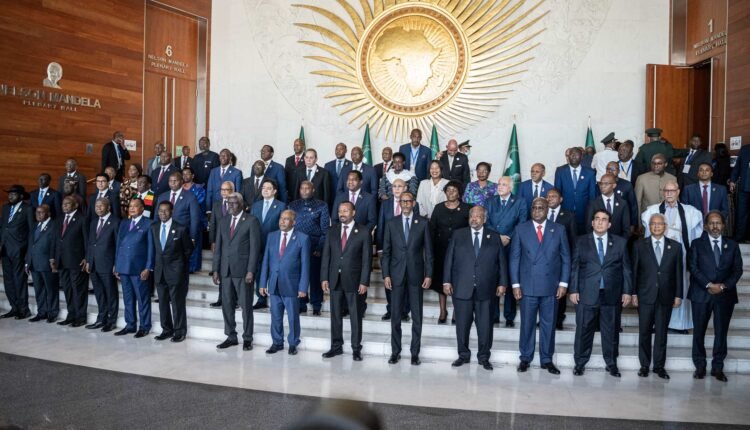
The 39th African Union Summit meeting, at the level of heads of state and government, commenced in the Ethiopian capital, Addis Ababa, on Saturday. The summit’s agenda includes discussions on the war in Sudan, terrorism in the Sahel region, and issues of security, energy, and water across the continent.
Evariste Ndayishimiye, President of Burundi, assumed the chairmanship of the African Union for the new term.
Burundi will assume the chairmanship of the African Union at a time when the continent is experiencing complex dynamics, ranging from peace and security challenges in several regions to wars in others, such as Sudan.
The speeches of most African presidents and government leaders focused on highlighting the magnitude of the Sudanese crisis and the calls for an end to the war.
During the handover ceremony to his Burundian counterpart, Angolan President and outgoing African Union Chairperson João Lourenço stressed that coups on the continent would not be tolerated.
He also called for concerted efforts to resolve the conflict in Sudan, stating, “The guns must be silenced in Africa, and effective solutions must be found, especially for the protracted conflicts on the continent. We will continue working to resolve the complex conflicts that have devastated Sudan and the Congo, and to resolve the conflict between the army and the Rapid Support Forces.”
Lorenço said the conflict in Sudan has led to an unprecedented humanitarian catastrophe and massive displacement, emphasizing the need for the world to play its part in Sudan and pay attention to what is happening there. He also called on world leaders to help the Sudanese people achieve peace and security.
Lorenço reiterated his zero-tolerance policy towards coups and coup plotters on the continent, noting that security crises have become unprecedented in Africa, with coup leaders organizing and winning elections for themselves.
He continued: “We are witnessing the emergence of new threats and coups. We will not tolerate them, nor will we tolerate coup leaders organizing elections and electing themselves. This is unacceptable, and it is regrettable that they are being accepted. This is not a legitimate path to power, and it encourages coups. This is unacceptable.”
For his part, the Chairperson of the African Union Commission, Mahmoud Ali Youssouf, stated that the challenges facing the continent are significant due to the ongoing wars.
In his address after assuming the chairmanship of the African Union, the President of Burundi, Evariste Ndayishimiye, pledged neutrality regarding the continent’s issues.
He emphasized the need to address the situations in Sudan, eastern Congo, Somalia, and other conflict zones, adding that these crises harm the entire continent, undermine the economy, and claim the lives of thousands of young people.
He continued: “There are numerous security crises on the continent, within a complex geopolitical landscape fraught with challenges, which necessitates respect for dialogue and the rule of international law.”
He pledged to build peace, security, stability, and development on the continent, and affirmed his commitment to working towards conflict resolution, restoring peace, and doing his utmost to achieve the “Silencing the Guns” initiative.
Reforming the International System
For his part, UN Secretary-General António Guterres, in his address, called for an immediate end to the war in Sudan, stressing that the Security Council must intervene constructively in Libya.
He urged Sudanese political forces to build a space for peace in Sudan, end conflicts, and find a comprehensive political path.
Guterres added that Africa needs justice, the Sustainable Development Goals, financial structural reform, and a seat on the UN Security Council, describing its exclusion from these as unacceptable.
Strategic Partnership
As the guest of honor at the summit, Italian Prime Minister Giorgia Meloni addressed the African leaders, emphasizing that Rome seeks to establish an equitable strategic partnership with African countries, based on mutual interests and shared development, moving beyond traditional cooperation models.
She noted that the first Italian summit, held Friday in Addis Ababa, was dedicated to exploring ways to enhance economic and investment cooperation. She explained that Italy is working on launching a comprehensive project for transforming investment in Africa, focusing on supporting the most fragile states, while establishing clear frameworks to address the debt issue in a way that ensures financial sustainability and promotes long-term economic stability.
Meloni emphasized that her country’s cooperation with the African Union will be multilateral and institutional, thus strengthening Italy’s role on the continent.
The Legitimate Rights of the Palestinians
In his address, Palestinian Prime Minister Mohammad Mustafa stressed that the Palestinian people still need effective international support to achieve their legitimate rights, pointing out that Israeli policies have led to the destruction of approximately 85% of the infrastructure in the Palestinian territories.
He stated that the continuation of Israeli violations undermines the chances for stability, noting that despite the ceasefire declaration, Israel continues its killing operations, resulting in hundreds of casualties, which threatens the lives of civilians and undermines political efforts.
Following the opening remarks, the Kenyan President presented a report on reforming the African Union’s institutions, while the Comoros Ambassador to the African Union presented the composition of the 2026 African Bureau, headed by the President of Burundi, with Ghana as First Vice-President and Angola as Rapporteur.
Shortlink: https://sudanhorizon.com/?p=11322