

The Day After the Berlin Conference: Failure of Crisis Management in Sudan
Mahmoud Hussein Sari
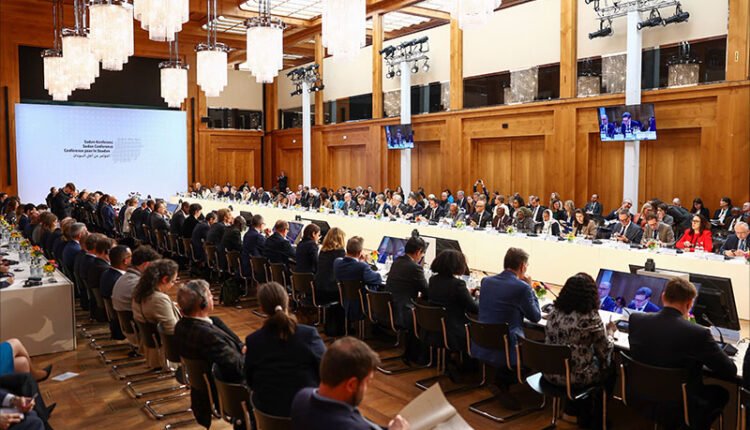
On 15 April, the Berlin Conference concluded, and attention immediately turned to analysing its outcomes, assessing its recommendations, and unpacking what—if anything—this international gathering actually achieved. What was new? What old ideas were repackaged and reintroduced by its organisers?
Unfortunately, those who support the conference are attempting to convince their opponents that it achieved its objectives, while those who reject it argue that its outcomes are irrelevant, offering nothing new and amounting to little more than a public relations exercise—destined, like previous conferences in Paris and London, for the archives and the dustbin of history.
Between these opposing camps, three key questions emerge—questions that Sudanese citizens and those responsible for the state must ask themselves. First: when will the next conference be held, what will its objectives be, and how should anticipated developments up to April 2027 be managed? Second: What is the relationship between the Berlin, Paris, and London conferences, and what has Berlin added to them? In other words, why do these countries insist on convening such conferences, and what is the recurring “script” in each iteration? Third: How will the Berlin Conference affect political, security, and humanitarian developments in Sudan in the coming period?
In any respectable, capable, and nationally oriented government—or indeed within any professional institution—a crisis unit would be established to study the conference’s outcomes, evaluate them, and analyse regional and international positions, statements, and actions. One would expect such a unit to exist—staffed by qualified Sudanese professionals—capable of helping the government, the state, and the armed forces anticipate and manage the consequences of the Berlin Conference, which are far more serious than mere meetings, photographs, communiqués, or attendance lists.
These superficial elements are of little importance. The real picture is broader and more complex than the conference itself. The “day after” Berlin signals the continuation of an international cycle of upcoming conferences, activities, visits, workshops, and policy initiatives to be implemented in the coming period. In the author’s view, these could lead to the fragmentation of Sudan, the internationalisation of its crisis, the weakening of its institutions, and attempts to impose specific civilian currents or externally constructed political actors to govern the state. They may also result in increased sanctions on the military, the international isolation of the government, and the amplification of the humanitarian file—sometimes in ways that serve external interests rather than Sudan’s own.
Accordingly, the post-Berlin phase requires the establishment of an effective crisis-management cell that meets daily to monitor developments and provide recommendations. One of its key tasks should be to track the pledges made at the Paris, London, and Berlin conferences. At each of these gatherings, funds were promised to support the Sudanese people—but where have these funds gone? How have they been spent? On what basis have they been distributed, especially when international organisations continue to describe the situation as a worsening humanitarian catastrophe?
The author argues that Sudanese institutions responsible for the humanitarian file—including the Humanitarian Aid Commission, advisory bodies within the Sovereign Council, and the Ministry of Foreign Affairs—have not managed this file effectively. What is required, in his view, is stronger coordination and leadership, possibly through a dedicated ministry led by an experienced, non-partisan figure capable of engaging the international community and holding it accountable for its commitments.
Statements by Denise Brown underscore the scale of the crisis. She noted that Sudan’s crisis is not “forgotten” but rather “abandoned”, with some 33 million people in need of assistance. Despite pledges of €1.5 billion at the Berlin donors’ conference, only around 16 per cent of the UN response plan has been funded—far short of what is required. This raises further questions about earlier pledges made in Paris and London.
The humanitarian situation, if not addressed effectively, may invite greater foreign intervention and deepen financial disorder. The fragmentation of responsibility across multiple institutions has only compounded the problem.
In the diplomatic sphere, Sudan faces another challenge: many international actors engage with it informally while withholding formal recognition. The proliferation of international envoys—reportedly numbering more than twenty—has created a fragmented diplomatic landscape, where envoys and ambassadors from the same country may adopt differing positions. This has contributed to the emergence of various international mechanisms and groupings, including so-called “quartet” and “quintet” arrangements, as well as broader coalitions involving European states and international organisations.
Meanwhile, the author criticises the performance of domestic political parties and alliances, arguing that they have failed to present a coherent vision or to engage the international community effectively. Their divisions—exposed during the Berlin Conference—have, in his view, weakened the state’s political backing.
The continued tendency among external actors to equate the Sudanese Armed Forces with the Rapid Support Forces is cited as evidence of this failure to shape international narratives.
The absence of an official invitation to the Sudanese government is presented as a significant diplomatic setback. Despite efforts to engage internationally—including participation in forums such as the Munich Security Conference—these efforts did not translate into formal recognition at Berlin. Instead, other political figures were invited to engage with international stakeholders on issues such as post-war reconstruction.
Conclusion
The Berlin Conference, despite its perceived successes and shortcomings, should prompt the Sudanese government to reflect, reassess, and engage pragmatically with its outcomes. This requires coordinated national action, a clear strategy for engaging future international mechanisms, and a more effective approach to both humanitarian management and diplomatic engagement.
Ultimately, the developments following the conference—whether through new international groupings, aid regulatory frameworks, or political initiatives—will shape Sudan’s trajectory. How the state responds to these dynamics will be critical in determining its future.
Shortlink: https://sudanhorizon.com/?p=13095