

Sudan’s Representative to the AU Reveals: Behind-the-Scenes Details at the Commission and the Outcomes of the AU-PSC’s Recent Visit to Khartoum
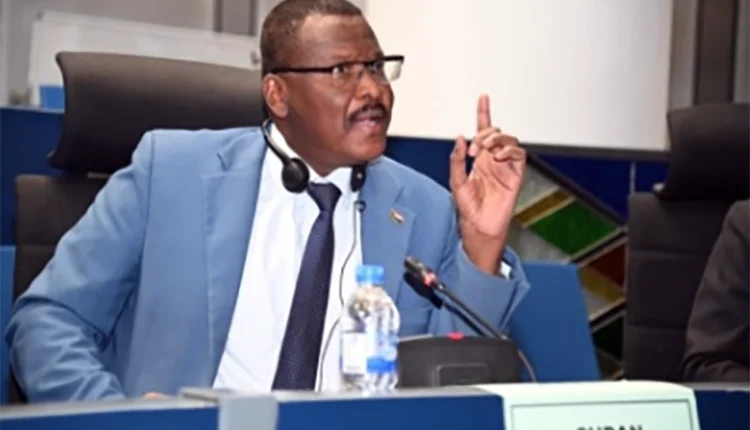
Khartoum –Sudanhorizon
In mid-August, a high-level delegation from the African Union Peace and Security Council (PSC), led by Algeria’s representative and comprising all member states of the Council—visited Sudan. The delegation was accompanied by Ambassador Mohamed El-Hacen Lebatt, Special Envoy of the Chairperson of the African Union Commission, as well as Sudan’s Representative to the Union, Ambassador El-Zein Ibrahim Hussein.
The visit significantly shifted the Council’s previously held perception of the situation in Sudan, thanks to the facts observed on the ground. The delegation’s extensive activities and meetings with state leaders in Khartoum revealed a reality quite different from what had been portrayed in reports and media outlets—a shift reflected in the statement the Council recently issued regarding its visit to Khartoum.
To gain a full picture of the visit, its outcomes, the assessment of Sudan’s status within the African Union amidst its continued membership suspension, the Union’s decision-making mechanisms, and the external pressures facing the regional organization, Sudanhorizon conducted a comprehensive interview with Sudan’s Ambassador to Ethiopia and Representative to the African Union, El-Zein Ibrahim Hussein.
This marks his first interview since presenting his credentials to the Chairperson of the African Union Commission in December 2024. In this interview, Ambassador Al-Zain revealed many facts regarding the visit and the subsequent steps expected from the African Union Commission and the Peace and Security Council in the coming period.
Interview conducted by: Mariam Abashar
– – Sudanhorizon :
How do you assess the results of the recent visit by the African Peace and Security Council to Sudan—specifically regarding the significance of its timing and its outcomes—in light of the extensive meetings the delegation held with official leadership and various sectors of civil society?
– Ambassador Al-Zain:
I would like to thank the team at Sudanhorizon for their keen interest in tracking Sudan’s relations with the African Union and the broader African system, as well as their efforts to provide accurate information that helps Sudanese public opinion form an objective assessment of the situation.
The visit undertaken by the African Peace and Security Council to Sudan (August 15–17, 2026) was the second since the outbreak of the war of aggression. It had been long-awaited; the visit was originally scheduled during Algeria’s chairmanship in August of the previous year, and calls for its execution were renewed during Egypt’s chairmanship in February of this year. Finally, the Council—under Algeria’s leadership—was able to carry out the visit. This delay indicates the existence of obstacles within the African Union system that had previously hindered the visit; however, we were able to overcome them thanks to the cooperation of several member states and Sudan’s calculated diplomatic efforts.
The visit took place within the framework of the serious engagement of the African Union’s most important decision-making body: the Peace and Security Council. One of the most significant implications of the African Union Peace and Security Council (PSC) delegation’s visit to Khartoum is that it took place after state institutions have been relocated there. During the visit, Council members met with the Sudanese leadership—represented by H.E. President Al-Burhan—at the Republican Palace, a site of immense historical, political, and sovereign symbolism. They also met with Prime Minister Kamil Idris at the Cabinet headquarters. This visit effectively silenced voices—often heard in regional and international forums, particularly in Addis Ababa—that propagated the narrative of a “Port Sudan authority,” ignoring the fact that the coastal city is an integral part of Sudanese territory and sovereignty.
– A Candid Dialogue:
Regarding the outcomes of the visit, the Peace and Security Council was briefed during an extensive closed-door session on the State’s position, as articulated by H.E. the President of the Transitional Sovereign Council. He addressed the Council’s African members with transparency, sincerity, and compelling arguments, conveying a clear message: the aggression Sudan is facing could befall any nation on the continent, as it constitutes an act of blatant aggression. He emphasized that the African Union had adopted an erroneous legal and political stance—one that must be rectified—especially given the challenges facing the entire region. Furthermore, he argued that by suspending Sudan’s activities, the African Union had lost its influence and opened the door for external actors supporting the aggression against Sudan and its people; consequently, a shift in the Union’s position is essential. The meeting reaffirmed Sudan’s belonging to the continent—highlighting its past and ongoing contributions to national liberation movements and the continental system—and underscored its status as a pivotal player in African affairs. It also emphasized that Sudan is committed to steering its political transition toward stable democratic governance through a Sudanese-led process where decision-making rests with the people of Sudan.
**Red Lines:**
Ambassador Al-Zain went on to outline the outcomes of the visit, adding that the Council—during a meeting broadcast by the media—was briefed on the significant address delivered by Prime Minister Kamil Idris, alongside various ministers. This address established clear red lines: no decisions regarding Sudan should be made in Sudan’s absence, and there can be no equivalence drawn between the Armed Forces—with their storied history and impeccable record—and the rebel militia.
The Council also witnessed the extent of the destruction and the violations of both international and national humanitarian law committed by the rebel Rapid Support Forces (RSF)—a group driven by external agendas—including the perpetration of war crimes and crimes against humanity.
-A Distinct Civil Voice:
The meeting between the African Union Peace and Security Council delegation and various political and civil forces—held at the Al-Salam Hotel in Khartoum—was a standout event. Domestic political forces spoke clearly and articulately. The Council listened to perspectives from domestic political and civil actors—voices distinct from the opposition figures who roam foreign capitals, mobilizing negative sentiment, leveling baseless accusations against their own country, and calling for sanctions against Sudan. Council members listened attentively to the messages conveyed by representatives of the broad domestic political and civil spectrum and engaged with them in a spirit of complete transparency…amidst an atmosphere of freedom and reassurance. They discovered the extent to which facts were being grossly distorted by certain compatriots who travel from capital to capital leveling baseless accusations—accusations that delight the very adversaries lying in wait to harm the nation and its proud people.
– Sudanhorizon :
We noticed that the government was keen to hold all meetings in the capital, Khartoum. Did you sense the impact and resonance this had on the Council’s delegation?
– Ambassador Al Zain
Most members of the Peace and Security Council had never imagined the level of excellence Sudan would display in its reception—from the state protocol teams and the Cabinet to the Foreign Ministry and security details. The warm welcome and superb organization the delegation experienced confirmed that Khartoum is a true capital and Sudan a state capable of governing; a state standing firm to address its problems and asserting—day by day—its growing control across the entire country, despite the challenges posed by the war of aggression. The image the delegation members took back from Khartoum was vastly different from the one previously held by our African brethren—an image painted by collaborator circles and entities with agendas aimed at undermining the country’s unity, its people, and its wealth. The Council’s delegation witnessed the facts firsthand and saw the impact of the rebels’ war on public and private property.
– Sudanhorizon:
To what extent did this resonate with the Council as a whole, and specifically with those members who had previously held rigid positions?
– Ambassador Al Zain:
The delegation certainly witnessed the reality firsthand, moving beyond the misleading reports and misinformation received abroad; they experienced the situation directly through sight, sound, and the atmosphere of the place. They saw the true extent of the destruction—to both infrastructure and human life—but they also witnessed the strength of will and steadfastness of officials at all levels. They witnessed the Sudanese people’s resilience, love for their country, and openness to others; the smiles they wore—even in adversity—were a testament to their strength and nobility. We recognize that the hardline stance some have taken toward Sudan stems partly from ignorance of the reality on the ground and from misleading propaganda. Yet, in some respects, this stance is driven not by logic or justice, but by vested interests, external pressures, and the influence of non-African actors who seek to maintain tension and hostility to serve their own ends—ultimately desiring a weak or fragmented Sudan.
– Sudanhorizon:
– You mentioned that the meetings with the President of the Sovereign Council and the Prime Minister—as well as those with civil society forces—were frank and clear. To what extent did these meetings reveal new information to the Council that had previously been obscured or misrepresented?
– Ambassador Al Zain:
Indeed, within the African Union, this is known as a “field visit.” Its purpose is on-the-ground exploration and an assessment of the facts as they truly exist, rather than relying on reports from envoys or open-source information. Meetings with heads of state and government, as well as with civil society leaders—complemented by direct field observations—are among the most effective ways to gather accurate information and engage in substantive dialogue with the authorities.
The image the delegation members brought back from Khartoum differed vastly from the one held by our African brethren prior to their arrival—an image shaped by hostile entities and groups with agendas aimed at undermining the country’s unity.
These high-level meetings with the President, the Prime Minister, government ministers, and political forces played a crucial role in conveying Sudan’s message through both state officials and key stakeholders. All of this contributes to forming an accurate picture that will shape different, more informed perspectives in the future.
– Sudanhorizon:
– How do you interpret the report issued by the Council following its assessment of the visit—a report adopted via the “silent procedure”? It rejected any parallel entities, upheld Sudan’s territorial integrity and sovereignty, opposed foreign interference, and called on all political parties to participate in the internal dialogue.
– Ambassador Al Zain:
This visit has further solidified the African Union’s conviction regarding the validity of the State’s position. The decisions contained in the report and the statement issued on August 28—following the silent procedure—emphasized that a solution is only possible through a Sudanese-led process under African Union auspices; they also stressed the rejection of foreign interference and reiterated condemnation of any parallel arrangements. It is evident that trust between Sudan and the African Union has been restored through this visit and those preceding it. This is further reflected in the upcoming visit of the African Union Commission Chairperson and his statement welcoming the internal dialogue—an initiative launched to create a conducive environment for dialogue and backed by State guarantees.
Signs of this restored trust emerged when the African Union Commission Chairperson stated that this initiative aligns with the African Union’s roadmap for engagement with Sudan.
The restoration of trust—which had been undermined by the interference of external forces and a weakening of communication—will pave the way for Sudan to return to its natural, leading role within the African Union; indeed, Sudan is poised to lead this organization one day. This is not a prophecy, but rather a vision based on an analysis of indicators of a positive shift in the African Union’s discourse. Some of its officials once characterized the war in Sudan merely as a conflict between two generals, equating the army with the rebel militia; however, the Union has since moved away from this narrative to the point of recognizing the Transitional Sovereign Council and the transitional government as the sole legitimate representatives of the state, while rejecting any parallel arrangements. This stance is enshrined in the statements of the Peace and Security Council, which cites—as a reference in its preambles—the statements issued at the foreign ministerial level in August 2025 (under Algeria’s presidency) and February 2026 (under Egypt’s presidency).
– Sudanhorizon: In this regard, what mechanism does the Council employ to pass and approve its decisions and reports concerning various countries?
– Ambassador Al Zain:
The Council’s decision-making mechanism is a key issue regarding its stance on Sudan and numerous other matters. It is well known that the Peace and Security Council has adopted many decisions—issued in over 1,300 statements—since its inception and first session in 2004. All these decisions were reached through “consensus” rather than “voting.” Although the Peace and Security Council Protocol provides for a voting mechanism, it has never been utilized; the rationale for avoiding it, for some, stems from a desire to maintaining a unified African stance.
The protocol grants the Council the authority to make decisions by a two-thirds majority on substantive issues, while a simple majority applies to procedural matters.
It is worth noting that reaching a consensus on a decision regarding Sudan is a complex challenge for member states; it is often influenced by bilateral relations between Sudan and individual countries, as well as the extent of external influence exerted on them. A look at the Council’s current composition illustrates this: the Peace and Security Council currently comprises Algeria and Morocco (North Africa); Ethiopia, Uganda, and Somalia (East Africa); South Africa, Eswatini, and Lesotho (Southern Africa); Cameroon, the Democratic Republic of the Congo, and Gabon (Central Africa); and Nigeria, Benin, Côte d’Ivoire, and Sierra Leone (West Africa).
– Sudanhorizon:
The African Union is currently engaged—alongside the international “Quintet”—in a series of extensive consultations in Khartoum. Given the outcomes produced by one of the Union’s key mechanisms (the Peace and Security Council), can we expect more effective action from the Union in the coming period?
– Ambassador Al Zain:
Two competing schools of thought exist among the Council’s member states regarding this decision. The first advocates for the path taken by Guinea (Conakry) and Gabon—both of which had their suspensions lifted last year—following a consensus on a constitution and elections in which the people of both nations chose the same leaders who had presided over their respective transitional periods; the African Union subsequently endorsed these results. The second perspective, however, emphasizes the distinct contexts, governance histories, and complex landscapes of each country—as well as the factor of war.
Sudan’s position is that the criterion of “unconstitutional change”—which triggers membership suspension—does not apply to its case. Peace and Security Council Decision 1041, issued on October 26, 2021, was hasty; it came just one day after the Chairman of the Transitional Sovereign Council took measures to dissolve the existing partnership—an action dictated by national laws and constituting a sovereign right of Sudan. Furthermore, there was no democratically elected civilian government—as stipulated by Article 23 of the African Charter on Democracy, Elections and Governance and the Malabo Declaration—and, quite simply, it is illogical for a leader to stage a coup against himself. As for Hamdok, he left his post by publicly announcing his resignation early the following year, citing his reasons for doing so.
Against this backdrop, clear shortcomings have emerged within the African Union. While international donors fund the majority of its program budgets, member state contributions cover operational costs; consequently, the issue of funding remains a major obstacle and a central topic in the current reform drive.
Al-Burhan’s message to the Peace and Security Council: By suspending Sudan’s activities, the African Union has lost its influence and opened the door to external actors supporting the aggression against Sudan and its people; it must alter its stance to regain its impact.
To answer your question directly: the restoration of trust, the renewed, intensive engagement of the African Union and the “Quintet” group, the steady stream of ambassadors presenting their credentials in Khartoum, and the opening of the domestic landscape—facilitated by preparations for a Sudanese dialogue, the expanding control of our Armed Forces, the collapse of the militia, and the international community’s acknowledgment of external support for the rebellion and the agendas of specific nations—are all factors that will tip the scales toward Sudan’s return to its rightful place within the African system, which itself awaits Sudan’s role and contribution.
– Sudanhorizon:
Although the African Union’s mandate stipulates that member states’ problems should be resolved within the “African house,” it is well known that some member states are openly involved in the war in Sudan. Some have opened their borders to mercenaries and the transit of weapons to the rebel militia, using border crossings as conduits for military supplies. Do you believe the Union is capable of pressuring these states to halt their support, or are they still colluding to advance the agendas and interests of nations outside the continent?
– Ambassador Al Zain:
I believe that the Peace and Security Council’s statement calling for the withdrawal of mercenaries and foreign fighters from Sudan constitutes an acknowledgment of international and regional (neighboring) involvement in the war—a war waged by a rebel militia backed externally, particularly by the UAE, and which has become a threat to the entire region. This is in addition to the Council’s clear resolutions rejecting international interference in Sudanese affairs and striving to ensure that solutions and initiatives remain under the auspices of the African Union. The Chairman of the Sovereign Council warned the Council’s delegation about the danger of the role of mercenaries—acting as a vehicle for foreign aggression—spreading to other countries. Sudan has provided documented information on this matter in numerous statements submitted to the member states of the Peace and Security Council via Sudan’s mission to the African Union. The impact of the mercenary phenomenon in a region characterized by fragility and internal conflicts will inevitably worsen unless the regional states—which are grappling with pressing geostrategic challenges across the Sahel, the Red Sea, and the Horn of Africa—pay close attention to the issue.
-Sudanhorizon:
Are you optimistic about the future of relations between Sudan and the African organization, and the possibility of its return to the Union’s fold?
– Ambassador Al Zain:
Yes, I am optimistic, based on two indicators. First, Sudan remains a member of the African Union, albeit with its activities suspended—which is the correct legal characterization of Sudan’s status. Certain areas were exempted from this suspension, such as the Center for Disease Control and agencies reporting directly to the Chairperson of the African Union Commission. A key feature of the Council’s recent statement was the design of two projects—one supporting health and the other education—which the Embassy and the Mission in Addis Ababa will follow up on, alongside the provision of in-kind, technical, and financial support as outlined in the statement. The second indicator is the African Union’s positive re-engagement through concerted visits—following a long period of absence—and the establishment of arrangements to reopen its office in Khartoum. This also includes involving Sudan in addressing informal sessions of the Peace and Security Council—an opportunity utilized by Foreign Minister Mohieddin Salem last February—as well as the Council’s recognition, in its statement dated July 29, 2025, of the Sovereign Council and the transitional government as the sole legitimate authority in the face of so-called parallel arrangements and the Nairobi Declaration, and its welcoming of the Sudanese peace initiative presented by the Prime Minister before the United Nations, and the Union’s call in August for the international community to support government institutions—all of this gives us cause for optimism.
This is matched by Sudan’s continued pursuit of national projects, including the peace initiative, the fostering of dialogue, the protection of sovereignty, the liberation of territory, and national recovery. In both respects, Sudan will proceed with nation-building driven by determined will and Sudanese ownership, as affirmed by the state leadership.
Shortlink: https://sudanhorizon.com/?p=17971