

Sudan’s Memory: Dr Khalid Farah Opens a New Window onto Darfur’s Social History
By Mohammed Al-Sheikh Hussein
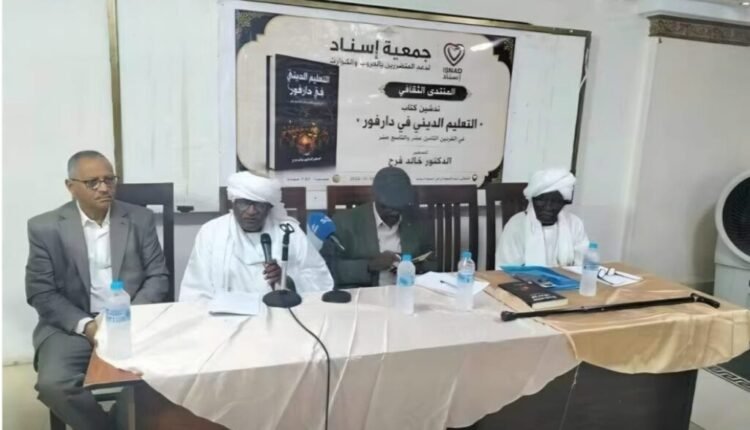
Ambassador Dr Khalid Muhammad Farah’s book, Religious Education in Darfur in the Eighteenth and Nineteenth Centuries AD, opens a new window onto Sudan’s social history.
(1)
If one thinks the book offers a new approach to writing the social history of the Sudanese people, that impression is entirely correct. It is the first scholarly book devoted to writing Sudanese social history.
And so that we do not arrive at the conclusions before considering the premises, it is useful to delve into the chapters of this book, which is the first scholarly work on the history of religious education in Darfur, focusing on the period of the Islamic Fur Sultanate during the eighteenth and nineteenth centuries AD, which represented the height of the flourishing of religious education in the Darfur region.
(2)
In numerical terms, the book, published by Al-Musawwarat Publishing House, comprises 284 medium-format pages and consists of four chapters. It draws on a bibliography of 146 references, documents, manuscripts and oral interviews.
The book originated as a doctoral thesis in Sudanese Studies at the Mohammed Omer Bashir Centre for Sudanese Studies at Omdurman Ahlia University, under the supervision of Professor Mu’tasim Ahmed Al-Hajj.
(3)
The first chapter provides a historical introduction to Darfur and Islam, explaining how Islam entered Darfur from the sixteenth century AD through trade routes from North Africa and Chad. It also explains Darfur’s transformation into an officially Islamic sultanate under Sultan Suleiman Solong.
The chapter reviews the sultans’ role in supporting education, particularly through the construction of mosques and khalwas—traditional Qur’anic schools—and by bringing scholars to the region.
(4)
The second chapter examines the institutions of religious education in Darfur, explaining:
The khalwas, which constituted the fundamental nucleus of religious education, particularly in terms of the residential system, the relationship between the sheikh and the student, and the use of the wooden writing board (lawh) and inkpot (dawaya).
Mosques, where every congregational mosque hosted study circles in jurisprudence and tawhid (Islamic monotheism) after the prayers.
Sufi zawiyas, establishing that the people of Darfur were familiar with Sufism.
The role of the Tijaniyya and Sammaniyya Sufi orders in spreading the religious sciences.
The role of the sultan, and how rulers such as Muhammad Tayrab and Ali Dinar supported the khalwas and granted scholars land and exemptions.
(5)
The third chapter focuses on the curricula of study, setting out the educational programme followed during the eighteenth and nineteenth centuries.
The first stage began with memorising the entire Qur’an according to the recitations of Warsh and Qalun.
In the second stage, students studied Maliki jurisprudential texts such as Al-Akhdari, Ibn Ashir and Al-Ashmawiyya.
In the third stage, they studied tawhid based on Al-Sanusi al-Sughra, the sciences of Hadith, the Prophetic biography, Arabic grammar and Alfiyyat Ibn Malik.
This was followed by a stage devoted to writing, including Arabic calligraphy, correspondence and legal documents.
(6)
The fourth chapter presents the most prominent scholars and khalwas during the period under study. The book lists the names of sheikhs and khalwas that became renowned, including the khalwas of Tawila, Kabkabiya and Al-Fashir.
Among the scholars from the Dinar family, the most prominent was Sultan Ahmed Dinar.
The book provides extensive accounts of scholars from Morocco, Egypt, and Chad who settled in Darfur. It also examines the system of ijazah, the scholarly authorisation a sheikh grants to a student.
(7)
The fourth chapter also addresses the role of religious education in society.
This is the most important chapter in the book for the following reasons:
It highlights the social role of the sheikh, who simultaneously served as a judge, mediator and teacher.
It examines the sheikh’s political role as an adviser to the sultans, as well as his work as a writer and official in the administrative bureaus.
It examines the economic role of the khalwas, which functioned as centres of production, as students engaged in agriculture and livestock herding in order to support themselves.
It demonstrates the central role of religious education in unifying society. It was a common factor shared by the Arab and Zurqa communities.
(8)
The book also examines the challenges posed by external invasion from several perspectives, most notably:
The impact of the Egyptian invasion of 1874 on the khalwas.
How Darfur preserved the independence of its educational curricula despite external pressures.
The book concludes that religious education in Darfur during the eighteenth and nineteenth centuries constituted an integrated system rather than merely an exercise in memorisation or rote instruction. It produced judges, imams, scribes and administrators who governed the sultanate for 300 years.
(9)
The importance of this book lies in the following points:
It provides scholarly documentation, drawing on manuscripts, documents, and interviews with khalwa sheikhs.
It demonstrates that Darfur experienced a scholarly renaissance before the emergence of formal, modern schools.
It serves as a reference for researchers studying Sudan’s history of education.
Shortlink: https://sudanhorizon.com/?p=18150