

Sudan Faces a Humanitarian Funding Gap: International Pledges Amid Needs That Outstrip the Response
Report by Maryam Abshir
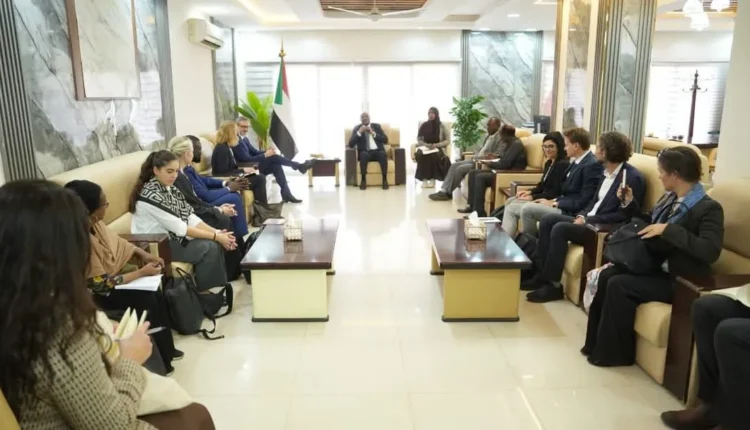
A delegation from the European donor countries, accompanied by a representative of the African Bank, has concluded a three-day visit to Sudan. The visit included meetings with officials and institutions involved in humanitarian work, at a time when the country’s humanitarian crisis is deepening, and the gap between actual needs and available funding continues to widen.
The visit took place against a backdrop of mounting humanitarian challenges resulting from the ongoing war, the expansion of displacement, deteriorating living and health conditions, and growing concerns over food insecurity in several conflict-affected areas.
Talks with the Government and Calls for Reconstruction Support
The delegation began its visit with a meeting with the Minister of Foreign Affairs, Ambassador Mohieddin Salem, who welcomed the visit and expressed his appreciation for the humanitarian assistance donor countries have provided to Sudan. He also commended their efforts to support the humanitarian response and alleviate citizens’ suffering.
According to a press statement, a copy of which the Al-Muhaqiq news website had previously obtained, the minister called on donor countries to expand their contributions to include the reconstruction phase and to help establish development projects that would contribute to stability in the country.
For his part, Lorenzo Caravé, speaking on behalf of the visiting delegation, expressed their appreciation for the warm reception. He stressed that the visit reflected the participating countries’ concern about the situation in Sudan and their commitment to continuing humanitarian assistance, as well as their readiness to engage in efforts aimed at reconstruction and supporting the requirements of the post-war period.
Humanitarian Work and Concerns over Overlapping Agendas
Commenting on the nature and timing of the visit, a senior diplomatic source told Al-Muhaqiq that the end of the year is generally an important period for humanitarian organisations and donor countries. Organisations submit their annual reports on health and food conditions in the areas where they operate, the scale of needs, the funding they have received during the year and how it has been spent, as well as their estimates of the funding required for the following year.
The source explained that donor countries, in turn, prepare reports detailing how funds allocated to humanitarian assistance have been spent, seeking to convince taxpayers in their own countries of the value of the funding and the results it has achieved.
The source noted that legitimate humanitarian work was beyond reproach, but voiced concern about the possibility of some humanitarian activities overlapping with political or intelligence agendas. In this regard, the source cited writings and memoirs by certain academics and former officials that examined the roles played by some international organisations in developing countries.
The source added that foreign organisations had significantly expanded their operations in Sudan over several decades and under successive governments. This, in the source’s view, made it necessary to strengthen institutional oversight and verify the nature of the activities carried out by these organisations and the sources of their information.
The source emphasised that the circumstances facing the country, with the war under way and state institutions increasingly unable to meet humanitarian needs, made it impossible to dispense with external support. However, the source stressed the need for vigilance, transparency and monitoring of humanitarian activities to ensure that they were not exploited for purposes beyond their declared objectives.
The source also expressed concern that some media campaigns abroad concerning the situation in Sudan relied on information and reports issued by certain organisations, and called on the relevant authorities to verify the sources and accuracy of such information before it was circulated or used as a basis for further conclusions.
Escalating Humanitarian Needs
In contrast, Adam Rahhal Mursal, the official spokesperson for the Coordination of Displaced Persons and Refugees, painted a bleak picture of the humanitarian situation. He stressed that the crisis in Sudan had reached extremely complex and dangerous levels amid the continuation of the war, the expansion of displacement and worsening food insecurity.
In an exclusive statement to Al-Muhaqiq, Mursal explained that several factors were compounding the crisis, including climate change and the spread of drought, as well as the continuing deterioration of healthcare services, drinking-water supplies and shelter. These developments, he said, had further intensified the suffering of displaced people, refugees and host communities.
According to United Nations estimates for 2026, approximately 33.7 million people in Sudan need humanitarian assistance, while the Humanitarian Response Plan aims to reach 20.4 million people, requiring approximately US$2.87 billion in funding.
Mursal pointed out that the funding available remained well below the level of need. According to the figures he cited, it had reached only around 47 per cent of the required amount, leaving a substantial funding gap. This directly affects the scale and regularity of aid distribution, as well as the availability of medicines, healthcare services and nutrition programmes.
He added that funding shortages were not the only challenge. Humanitarian organisations also faced difficulties in reaching affected areas, continued military operations, inadequate logistical capacity and a growing number of people in need of assistance.
Conflict Zones: Needs Beyond Available Resources
The spokesperson for the Coordination of Displaced Persons and Refugees noted that displacement camps in Darfur, along with conflict-affected areas in Kordofan and Blue Nile, were facing mounting needs for food, water, healthcare, and shelter.
He explained that some families did not receive regular assistance, while others depended on host communities and local initiatives, despite limited resources.
Mursal warned that declining agricultural production and failed harvests in several areas were increasing the risk of hunger and food insecurity, particularly in regions already suffering the effects of conflict and displacement.
He added that if these conditions continued without broad and sustained humanitarian intervention, families’ suffering would intensify and local communities would be placed under burdens beyond their capacity to bear.
Calls for Increased Funding
Mursal commended the efforts of donor countries and humanitarian organisations, but stressed that the current phase required increased funding and guarantees that assistance would reach those entitled to receive it, alongside an expanded response in the worst-affected areas.
He called for greater attention to national organisations and community initiatives operating in frontline areas and hard-to-reach places, particularly Emergency Response Rooms, which play a direct role in assisting affected people and meeting their urgent needs.
He also expressed hope that the donor delegation’s visit would provide an opportunity to listen directly to displaced people and refugees and gain first-hand insight into their actual circumstances, rather than relying solely on desk reports and official meetings.
He said that the performance of humanitarian organisations should not be assessed by the amount of money pledged, but rather by what actually reaches affected families, the adequacy and regularity of assistance, and its ability to save lives and safeguard the dignity of those receiving it.
He emphasised that displaced people and refugees needed fewer promises and a genuine humanitarian response commensurate with the scale of their suffering, one that protected their right to a dignified life in accordance with international laws and conventions.
Between Pledges and Reality
Humanitarian and funding indicators reveal a clear gap between growing needs and available resources. Observers believe that, despite numerous international initiatives and financial pledges, and the continued work of United Nations agencies and humanitarian organisations in food, health, water, and shelter, the response remains inadequate to address the crisis’s consequences.
They pointed out that the challenges extend beyond funding shortages to include difficulties in securing humanitarian access, security and logistical constraints, a lack of sustainable resources, and coordination problems among organisations working in the humanitarian field.
Against this backdrop, the visit by the European donor delegation and the representative of the African Bank appears to test international partners’ ability to move from pledges to actual funding, and from formal meetings to field interventions that directly address the needs of those affected.
What Is Needed to Address the Crisis
Observers who spoke to Al-Muhaqiq believe that addressing Sudan’s humanitarian crisis requires an integrated approach based on increasing funding and ensuring transparency in its use, facilitating the delivery of aid to affected areas, strengthening the capacity of national institutions and organisations, and establishing oversight and monitoring mechanisms to ensure that assistance reaches those entitled to receive it.
Between the need of millions of Sudanese for assistance and concerns that some humanitarian activities may become entangled with political calculations, the challenge facing the Government, donors and international organisations remains one of striking a balance: making effective use of external support while protecting national interests and ensuring the independence and transparency of humanitarian work.
Sudan is facing not merely a funding shortage, but a crisis of response that demands international commitment commensurate with the scale of the disaster. Pledges alone are no longer sufficient unless they are translated into tangible assistance that reaches affected families, provides food, medicine, water and shelter, and safeguards the right of displaced people and refugees to live in dignity.
Shortlink: https://sudanhorizon.com/?p=20402