

State Minister: We Engaged in Transparent Dialogue with the International Community on Civilians Protection Issues
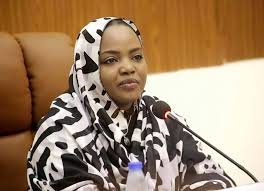
Cairo – Sudanhorizon – Sabah Moussa
The Sudanese Minister of State at the Ministry of Human Resources and Social Welfare, Salma Ishaq, has affirmed that the dialogue held with representatives of the international community in Nairobi, Kenya, on Sunday, was characterized by frankness and transparency.
The dialogue focused on the Sudanese government’s plan to protect civilians. This statement was made during a seminar organized by the Centre for Civilian Protection in Conflict (CIVIC), which has previously worked in the field of civilian protection in Somalia.
In an exclusive statement Ishaq said she participated in the symposium in her capacity as head of the subcommittee of the National Mechanism for the Protection of Civilians. She presented Sudan’s plan for the protection of civilians and reviewed the humanitarian situation in the country in detail.
She emphasized that she answered difficult and sensitive questions, but described the symposium as crucial for opening a direct dialogue with the international community.
She explained that the session did not address violations, as the attendees were already aware of them, but rather focused on the government’s role in protecting civilians, its shortcomings, areas of progress, and future plans. It also addressed various concerns and questions. She added that the symposium was beneficial, as it allowed participants to clarify ambiguities and enabled the government explain details and procedures that had seen developments recently. She stressed that transparent dialogue with the international community is essential for building trust and that the current situation leaves no room for reservations.
Ishaq confirmed that the largest humanitarian crisis currently facing the country is in the city of El Obeid. She noted the military progress on the ground, while emphasizing the need to avoid a repeat of the El Fasher scenario and to work towards lifting the siege on El Obeid. She revealed that the number of displaced people in the city had risen from approximately 800,000 to three million, following a large influx of people from the Kordofan states. She warned that the Rapid Support Forces’ control of the city would constitute a major humanitarian catastrophe.
The minister noted some progress, albeit limited, regarding the displaced persons file, affirming that conditions had improved relatively and that the government was working with humanitarian organizations to improve their circumstances. She pointed out that one of the tasks of the National Mechanism was to facilitate the work of humanitarian organizations, while funding remained the most significant challenge. She emphasized the ongoing joint efforts to address these obstacles, stemming from the state’s responsibility to protect civilians and alleviate their suffering, even amidst the ongoing war. She expressed her hope that the war would end in a way that preserves the dignity of the Sudanese people and prevents a repeat of the Rapid Support Forces’ presence.
Isaac stated that the government should not react impulsively, explaining that Nairobi was chosen to host the meeting because most of the regional offices of international organizations and relevant embassies are located there. She emphasized the importance of engaging with these organizations, even though Kenya is accused of supporting militias.
She added that the international community has criticized the Sudanese government regarding the protection of civilians, despite the fact that it had developed a comprehensive plan on this issue early on. She stressed the importance of open and transparent discussion to address shared challenges and alleviate the suffering of the Sudanese people, regardless of accusations of government shortcomings.
She affirmed that the current phase is not one of “individual victories,” but rather one of achieving a victory for all Sudanese. She noted that all invited organizations and embassies participated in the seminar, with the exception of the Dutch embassy and one other organization.
The Minister explained that the government presented the participants with Sudan’s humanitarian plan, which had been previously submitted to the Security Council in February 2025. This plan outlines the government’s commitments to protecting civilians. She added that the discussion addressed several internationally raised issues, including the situation of women detained on charges of collaborating with the Rapid Support Forces (RSF), the role of emergency response centers and whether the government is restricting their operations, and the obstacles hindering the delivery of humanitarian aid.
She added that the participants also discussed the challenges impeding joint efforts to protect civilians and explored opportunities for practical solutions. She emphasized that the government is working to address a number of questions, and that this does not imply isolation, but rather necessitates openness to the international community and enhanced cooperation to reach solutions that benefit all parties.
Ishaq recently participated, along with representatives from the Sudanese Embassy in Kenya, in a seminar organized by the Centre for Civilian Protection in Conflict (CIVIC) in Nairobi. The seminar focused on the Sudanese government’s efforts to protect civilians from the effects of the war waged by the RSF against the Sudanese people and state institutions. Representatives from the United Nations, international organizations, and diplomatic missions accredited to Kenya also participated.
Shortlink: https://sudanhorizon.com/?p=15378