

From Positions to Alliance… Is the El Alamein Summit Laying the Foundations for a Four-Way Front against Ethiopia?
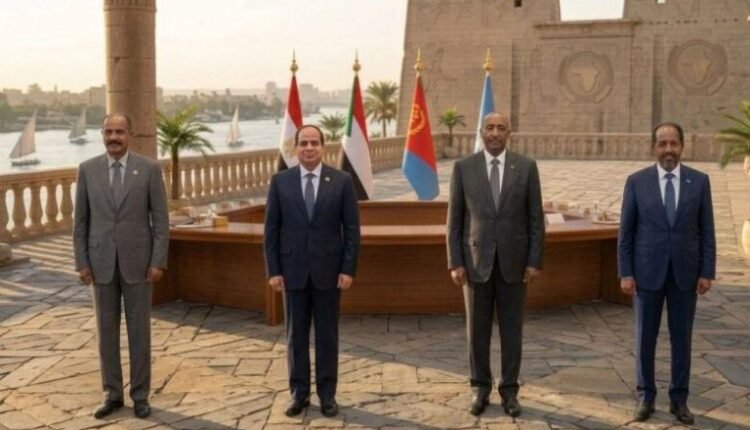
Cairo – Sudanhorizon – Sabah Mousa
As political and security developments in the Horn of Africa and the Red Sea accelerate, today’s four-way summit bringing together Egypt, Sudan, Eritrea and Somalia raises questions that go beyond the meeting itself. The four countries operate in the same regional environment, where Sudan’s crises, growing tensions between Ethiopia and Eritrea, the Egyptian-Ethiopian dispute over the Grand Ethiopian Renaissance Dam (GERD), and competition over ports, influence, and maritime security in the Red Sea and Bab el-Mandeb are intertwined.
The El Alamein Declaration
In the joint El Alamein Declaration issued after the consultative four-way summit, the presidents of Egypt, Sudan, Eritrea and Somalia stressed the importance of respecting states’ sovereignty, independence and territorial integrity; rejecting interference in their internal affairs; supporting national institutions; and pursuing political and peaceful solutions to conflicts.
The leaders also emphasised the need to strengthen political, economic and trade cooperation among the four countries and to intensify coordination on regional and international issues. They reaffirmed their support for Sudan’s unity, sovereignty, territorial integrity and national institutions, and rejected the establishment of any parallel entities. They also supported resuming the political process under Sudanese ownership and leadership, and expressed their complete rejection of any support for mercenaries.
On Somalia, the leaders renewed their support for its unity and sovereignty and rejected any recognition of, or support for, what is known as Somaliland. They affirmed their backing for Mogadishu’s efforts to combat terrorism and extend state institutions’ authority throughout the country.
The leaders further affirmed that freedom of navigation is a fundamental principle and that governance of the Red Sea is the exclusive responsibility of its littoral states. Regarding transboundary rivers, particularly the Nile, they stressed respect for international law and the principle of causing no harm, while rejecting unilateral measures that could adversely affect the existing water uses of the two downstream states.
The leaders agreed to establish a mechanism to follow up on the summit’s outcomes and to convene the summit periodically, and whenever necessary, to strengthen consultation and coordination among the four countries.
Growing Awareness
In one respect, the summit appears to be an attempt to coordinate positions among countries whose security and geographical interests overlap. In another, it reflects a growing recognition that developments in any one country in the region are no longer purely domestic matters, but can rapidly spill over into neighbouring states.
This is what gives the El Alamein meeting particular significance. Is it merely a matter of coordinating positions on existing crises, or does it lay the foundations for a more regular regional process? What do Cairo, Khartoum, Asmara and Mogadishu seek from this rapprochement? And how might the summit’s outcomes affect the war in Sudan, Red Sea security and the future of relations with Ethiopia?
Of Great Importance
Former Sudanese Foreign Minister Ambassador Ali Youssef described today’s four-way summit bringing together Egypt, Sudan, Eritrea and Somalia as extremely important, pointing to the rapidly evolving developments in the Horn of Africa, particularly in the four countries participating in the summit, all of which have disputes or tensions with Ethiopia.
Youssef told Sudanhorizon that the summit was taking place at an extremely sensitive juncture. He stressed the need for the four presidents to adopt a unified position and emerge with clear policies and decisions regarding developments in Ethiopia.
He said the summit would certainly respect the principle of non-interference in Ethiopia’s internal affairs and would not support one Ethiopian party against another. At the same time, however, he stressed that Ethiopia must respect the four countries and their respective concerns and disputes with it.
A Collective Position
Youssef explained that the disputes between the four countries and Ethiopia involve multiple issues, including Addis Ababa’s attempts to establish a foothold on the Red Sea, whether through Somaliland or Eritrea’s Port of Massawa, as well as its pursuit of unilateral policies towards Egypt and Sudan over the Renaissance Dam.
He also pointed to what he described as hostile positions towards Sudan, including the launching of drones from Ethiopian territory to attack Sudan. He stressed the need for Ethiopia to respect the sanctity of good-neighbourly relations, noting that Sudan had not adopted any hostile position towards Ethiopia.
“I tend to believe that there must be serious and clear efforts to establish peaceful communication with Ethiopia,” he said. “It is not in the interests of the four peoples for this dispute to turn into an armed conflict.”
He stressed that any escalation of the dispute into military confrontation would threaten regional security and stability. He expressed hope that the summit would produce a strong position capable of deterring Ethiopia.
“If the position of the four countries is clear, I believe it could have an impact on Ethiopia, because Ethiopia has never before been confronted with a collective position of this kind,” he said. He added that if the four countries’ unified position failed to influence Ethiopia, “there will certainly be alternatives”.
An Important Step
For his part, Dr Hassan Sheikh Ali Noor, Professor of Security Studies at the Higher Institute for Security and Strategic Studies in Mogadishu, described the four-way summit bringing together Egypt, Sudan, Somalia and Eritrea as an important step, given the strategic location of these countries and their direct links to the security of the Red Sea, the Gulf of Aden and the Suez Canal — vital corridors for trade, security and energy at both regional and international levels.
Noor told Sudanhorizon that the summit’s importance stemmed from these strategic considerations. “From this perspective,” he said, “I see merit in reviving this framework and developing it into a regular consultative mechanism, with the inclusion of Djibouti, given its strategic location, to discuss maritime security, regional stability and transnational threats.”
He noted that Red Sea security could not be separated from the political and security stability of the states bordering it, particularly Somalia and Sudan, amid the internal crises, competition and regional and international interventions confronting the region.
He stressed that addressing the root causes of instability must form an essential part of any vision for maritime security.
“For Egypt, the Red Sea and the Suez Canal represent an essential component of its national security and strategic depth,” Noor continued. “This makes the growing regional and international influence and activity in the Red Sea and the Horn of Africa — including Israeli and Ethiopian involvement — worthy of careful and balanced consideration.”
He argued that what was needed at this stage was a shift from conferences and recommendations to practical, sustainable mechanisms for coordination and cooperation. Such mechanisms, he said, would strengthen the sovereignty of the region’s countries, protect freedom of navigation, limit proxy conflicts, and help build a more stable regional security architecture for the Red Sea and Gulf of Aden.
Noor said that achieving this would transform the summit from a temporary initiative into a sustainable strategic framework serving the shared interests of the countries of the region.
A Watershed Moment
For his part, Eritrean writer and political analyst Adoulis Fares described the four-way summit between Egypt, Sudan, Eritrea and Somalia as taking place at a watershed moment, amid what he characterised as a reshaping of alliances in the Horn of Africa and the Nile Basin, against the backdrop of what he described as Ethiopia’s assertive foreign policies and internal crises.
Fares told Sudanhorizon that the four countries were coming together in response to what they regarded as common threats to their security and sovereignty. He expected the summit to open the door to four-way security, intelligence and military coordination, as well as information-sharing on developments that threaten regional stability.
He said the summit could strengthen support for the institutions of the four countries, including political and strategic support for the Sudanese Armed Forces and rejection of any external support for the Rapid Support Forces. He also called for support for the Somali government and army and rejection of any agreements affecting Mogadishu’s sovereignty, particularly those concerning ports or recognition of Somaliland without the approval of the Somali government.
Collective Deterrence
On Eritrean affairs, Fares called for political and defensive backing for Eritrea in the face of any Ethiopian attempts to gain access to the Red Sea or the port of Assab, along with stronger coordination on the security of the Red Sea and Bab el-Mandeb.
He stressed that maritime security was the responsibility of the littoral states and rejected what he described as any illegitimate Ethiopian military presence on the coast.
He also argued that the GERD issue was no longer, in his view, merely a technical matter related to filling and operation, but had become part of the wider regional security equation. He called for protecting Egypt’s and Sudan’s water rights to be linked to the stability of the region as a whole.
In his view, one of the summit’s most significant potential consequences was the possibility of forming a more cohesive diplomatic and security front comprising Ethiopia’s immediate neighbours. Such a front, he argued, could strengthen their ability to protect their interests and limit a policy of imposing faits accomplis.
He said such coordination could also affect Sudan by limiting external supply routes to the Rapid Support Forces, while strengthening security along the Red Sea and the Somali coast. It could also increase political and economic pressure on Addis Ababa.
“The significance of the summit lies in its potential to move from managing crises separately to collective deterrence, and from bilateral coordination to a comprehensive strategic partnership among the four countries,” Fares said. In his view, this could reshape the balance of influence in the Horn of Africa and the Red Sea.
A New Level
Ultimately, the summit’s most important outcome may not be a single, specific decision, but the establishment of a new level of regional coordination.
The summit brings together countries stretching across a geographical arc that begins in the Nile Valley and extends along the Sudanese and Eritrean coasts to the Gulf of Aden. This gives them the potential to develop a common approach to the security of the Red Sea and the Horn of Africa.
The measure of the summit’s success, however, will remain tied to whether it can move beyond general statements of position towards clear mechanisms for implementation and follow-up, particularly on Sudan, Red Sea security and containing the repercussions of the Ethiopian crisis.
Shortlink: https://sudanhorizon.com/?p=18648