

Hudson to UNSC:Sudan Conflict Will Unleash Waves of Migration and Terrorism in Europe and the Horn of Africa
Sudanhorizon – Mohamed Osman Adam
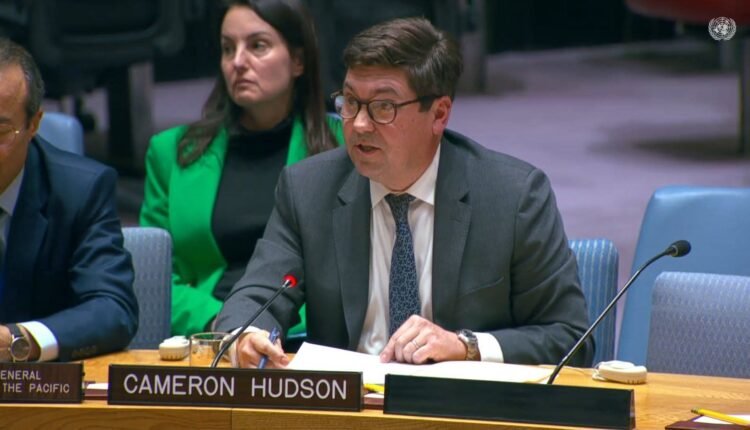
American security expert and political analyst, Cameron Hudson, has sent a strong warning about the consequences of the ongoing conflict in Sudan, fueled from abroad and expanding internally. He stated that it will have catastrophic repercussions for the Horn of Africa, neighboring countries, and subsequently, beyond Africa, leading to illegal migration and terrorism sweeping across Europe.
In his remarks before the UN Security Council special session on Sudan, Monday, Hudson emphasized that the risk of partition and disintegration, and the resulting catastrophic levels of death and displacement, is real and will worsen if decisive action is not taken to end the fighting. He added, “Be assured that the effects of this outcome will not be limited to Sudan, but will destabilize the already fragile Horn of Africa, and will send waves of refugees and extremists across the Sahel, the Red Sea, and the Mediterranean.”
Hudson pointed out that the world had previously warned of a catastrophe in El Fasher, but the Security Council and Western countries ignored the warnings, and the fighting continued for nearly a thousand days, during which Sudan was under attack. During this period, this body warned of the risk of mass atrocities and the disintegration of the state. But talking about warnings ignores what is actually happening. The question is: When faced with these horrific realities, will the international community stop merely admiring the problem and take concrete action that imposes heavy costs on the perpetrators and their supporters, gives hope to the victims, and compels the parties to make peace?
Hudson added: The same question was asked at the beginning of the war, when the Rapid Support Forces stormed El Geneina, the capital of West Darfur, in a wave of brutal and deliberate violence, so much so that the Biden administration described it as genocide. Had the world responded to that massacre with sufficient resolve, we might not be in this situation today. Instead, we are witnessing a dangerous escalation of this conflict. Since the Rapid Support Forces (RSF) seized El Fasher in October, the truth about what happened has been gradually emerging. Their crimes represent the worst violations of this war, and perhaps in all of modern Sudanese history. There is simply no comparison.
He cited the situation in El Fasher, which had a population of about one million a year ago, but today only 70,000 to 100,000 remain. The fate of some 150,000 people is still unknown, and thousands, if not tens of thousands, have been killed. The RSF is now burning and burying their bodies to conceal the scale of their crimes. What is even more agonizing than these crimes is the knowledge that they are not over and will be repeated in the coming days, weeks, and months if no action is taken.
Hudson testified that the RSF has now turned its strategic attention to the neighboring Kordofan states. In just the past few weeks, the region has been under siege following a series of horrific attacks by the Rapid Support Forces (RSF), targeting a kindergarten, a UN compound, and a military hospital, killing more than 100 people, nearly half of them children. The siege has now extended to the towns of Dilling and Kadugli, which are already suffering from a declared famine.
With no food, no functioning hospitals, and no way out of the towns, their inhabitants are left with no means of survival. This raises the question: what tactical or strategic motivation could the RSF have for targeting civilians after the army’s withdrawal? And what consequences, if any, will they face for these blatant war crimes?
Hudson reiterated his warning that if no action is taken, a full-scale battle for control of El Obeid, the capital of North Kordofan state, will erupt in the coming days. This battle is expected to be the largest, and perhaps the most destructive, yet. It’s not just because the city is strategically located at the crossroads of the country, nor because it now shelters more than a million people at risk.
It’s because this conflict has transformed over the past year.
“The war has been transformed, by external factors, from a conventional 20th-century war fought with outdated heavy equipment and light weapons, into a modern 21st-century conflict using the latest generation of sophisticated weaponry,” Hudson said.
He added that long-range, tactical, fiber-optic drones and so-called kamikaze drones, along with advanced jamming technology, precision-guided munitions, and armored personnel carriers, have replaced the barrel bombs, vehicles, and tanks used at the beginning of the war. Ostensibly, smart weapons were supposed to improve accuracy and avoid civilian casualties, but the opposite has been true. Civilians, especially in urban areas, have been subjected to a relentless barrage of drone attacks from both sides. Moreover, these weapons have dramatically expanded the scope of the war, in ways that disregard front lines. Every corner of the country is now under threat.
He noted the irony that weapons from some twelve countries have been used by both sides in this war, in violation of the 2004 arms embargo. “Many of these arms-supplying countries strongly condemn the civilian casualties caused by the very weapons they supply, and some of these arms-supplying countries are members of this Council.”
He specifically pointed to the United Arab Emirates, asserting that it bears the greatest responsibility for the continuation of the war in Sudan. “Not all countries bear the same responsibility for fueling this conflict. Here, the role of the United Arab Emirates deserves special attention. In the past two years, the UAE has used its wealth and political influence in the Horn of Africa to establish the largest and most extensive military airlift operation, transporting weapons by air to the Rapid Support Forces.”
Allied regimes in Chad, Libya, the Central African Republic, South Sudan, and Somalia’s Puntland region have contributed to enabling and expanding this conflict in ways that are both unjustifiable and undeniable. He added that “the latest weapon they have used to support the Rapid Support Forces’ atrocities is hundreds of combat-experienced Colombian mercenaries, recruited and transported through a complex network of shell companies that provide only a thin veneer of deniability.”
Hudson said the situation in Sudan is too dire to accept half-truths and outright misinformation about the role of external powers in fueling this conflict. It is no longer enough to condemn the crimes of the warring parties alone. If we ignore those who facilitate the war, we are all complicit.
Cameron Hudson pointed out that the complex local drivers of the conflict—ethnic, social, and resource-related—which are often overlooked in external analyses and have been exacerbated by the war, should not be ignored. In many places, these local dynamics fuel the violence more than the national or international forces we focus on.
He warned that what is most worrying is that these tensions are likely to persist even after the war ends, and will jeopardize any progress toward rebuilding the country if peacemakers and politicians do not pay sustained attention.
Hudson underlined his point by stating that Sudan is on the brink of collapse, facing the risk of a mass exodus of refugees and instability that will burden the Horn of Africa and the Sahel for years to come if it is allowed to disintegrate.
He added, “To avert this outcome, this Council must acknowledge some hard truths about this war, and indeed, the complicity of many member states who have found strategic gains and advantages in managing it. This is not simply a civil war between rival generals seeking power and personal glory; it is a fully international conflict, with military, financial, and political networks spanning continents, fueled by geopolitical competition in a changing world order.”
He warned again that half-measures, diplomatic ambiguity, and the paralysis that have characterized the international response have not helped confront these networks; on the contrary, they have encouraged the current catastrophe. He said, “If we think that these same networks will not support the next war in the region, whether in Chad, South Sudan, or Ethiopia, we are mistaken.”
Shortlink: https://sudanhorizon.com/?p=9829