

How Do Those Who Are Angry View Nusseibeh’s Nomination for a UN Post?
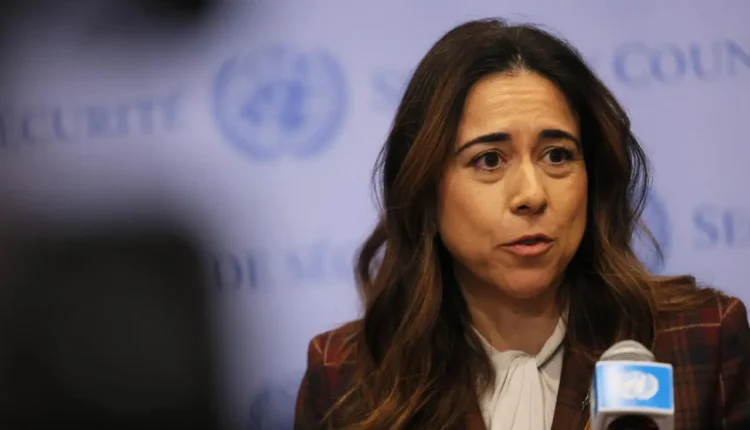
Sudanhorizon – Mohamed Osman Adam
The UN Security Council is expected to hold a new straw poll the day after tomorrow (Monday) to gauge support for candidates for the post of Secretary-General of the United Nations.
The vote will provide a strong indication of who is likely to remain in the race for the position, which will become vacant at the end of the year when António Guterres steps down. One candidate in Sudan is of particular interest to us: the Emirati Lana Nusseibeh.
The UAE’s candidate enjoys the full backing of her government. One need only look at the enormous costs of the campaign she is currently conducting, which entails considerable financial and logistical resources. She would not have stood for the post without the full support and blessing of the Abu Dhabi government. Although she insists that she is no longer employed by that government, she remains an Emirati citizen.
Moreover, some of her recent statements—which were undoubtedly made on the advice of astute Western diplomatic, media and political advisers—would not have been issued without her government’s blessing.
She has also been careful not to burn all her bridges behind her, as she continues to hope for the support of the Europeans and China, particularly the United Kingdom. Without their full backing, she has no chance whatsoever. Accordingly, the matter now depends to a considerable extent on Britain’s position.
This brings us to the question: are we after the grapes, or the vineyard watchman’s head, as the Syrians and Palestinians put it? For Sudan, the issue is not her personality as such, but who stands behind her, and who supports those standing behind her!
What new positions has Nusseibeh adopted?
The Emirati candidate recently gave an interview to Euronews and also addressed the United Nations Association in London. On both occasions, she distanced herself from most of her previous statements concerning Sudan. She backtracked on her criticism of UN expert reports which indicated that her government was fully involved in arming and materially supporting the Rapid Support Forces (RSF) militia.
She also reiterated that she no longer works for the UAE. This prompted Patrick Wintour, diplomatic editor of The Guardian, to criticise her in an opinion article, noting that she was “trying to wriggle out of her Sudan record”.
The writer reminded readers that Lana Nusseibeh was in Britain this week, attempting to present herself as a potential candidate for the future post of UN Secretary-General and to divert attention from her past as an Emirati diplomat. She had previously denied her country’s role in arming a militia accused of committing war crimes and genocide during Sudan’s civil war, which has now been raging for four years.
The writer also pointed out that this campaign in the United Kingdom and Europe followed a setback she suffered last Friday, when three permanent members of the UN Security Council—China, France and the United Kingdom—voted to ‘discourage’ her candidacy. Under the UN electoral system, a candidate must obtain at least nine favourable votes from the fifteen members of the Security Council, with no objection (or ‘discouragement’) from any of the five permanent members, before a recommendation can be submitted to the UN General Assembly.
The writer emphasised that London—specifically the British Foreign Office, which drafts UN resolutions on Sudan—is probably the centre of opposition to Nusseibeh’s candidacy. This may explain the intensification of her political activity in the United Kingdom.
Is she sincere in what she says on this matter?
According to The Guardian, during a press event organised by the United Nations Association, and in response to a question about her role in Sudan, Nusseibeh called for her candidacy to be considered in a broader context. She highlighted her role in facilitating humanitarian aid into Gaza, her support for Afghan women, and her promotion of religious tolerance.
However, she implicitly acknowledged that she carried the burden of her government’s policies towards Sudan when she said:
“Like any candidate, I come from a particular background, but the independence of the next Secretary-General is the cornerstone of their credibility.”
She added that she had taken leave from her position in the UAE government to run her campaign for the post independently. She was also quoted as saying:
“I think if I were to become Secretary-General, Sudan would be the real test of the success of any new Secretary-General, given that it represents an extremely horrific humanitarian crisis.”
This comment comes against the backdrop of accusations that the United Arab Emirates has supported the RSF militia in Sudan—accusations that Nusseibeh herself has repeatedly denied, while publicly questioning the conclusions of UN investigators concerning the UAE’s role in supporting the RSF militia, which has committed war crimes in Sudan.
A team of UN experts stated in a report published last month that the UAE had provided substantial support to the RSF.
According to the opinion article published in The Guardian, when Nusseibeh was asked whether she regretted ‘misrepresenting the facts’ during her tenure as a diplomat by denying that the UAE had armed the RSF, or her personal role in challenging UN reports critical of the UAE, she replied that she regretted that “the Sudanese civil war had gone on for so long”.
She went even further—in an attempt to win the sympathy of the press and give the British Foreign Office leverage—by saying:
“But I don’t think saying that is enough for the Sudanese people, or for the peoples of neighbouring countries who have also been affected by the repercussions of this war, or for the victims of sexual violence in this conflict, or for those who suffered the atrocities committed in El Fasher without any accountability.”
On the other hand, and in an effort not to lose the support of her allies—particularly the United States—she added a comment about the allegations of “the use of chemical weapons against civilians; all of these constitute a chain of suffering inflicted upon the Sudanese people”.
When asked whether the UAE had supplied the RSF militia with weapons in violation of a UN arms embargo, she replied:
“I am aware of these allegations. I have not read the latest report of the UN Panel of Experts, and I will not comment on it because I am no longer a UAE government official. In this campaign, I am a candidate for Secretary-General.”
No one should imagine that she is telling the truth here. If she herself has not read the report, a secretariat reads and summarises such documents for her, particularly when the subject is at the very heart of her campaign!
Are we after the grapes, or the vineyard watchman’s head?
In what appears to be part of a carefully planned campaign, she went on to say:
“As Secretary-General, I would fully support the findings of UN expert reports, and I recognise that several countries have been named in various reports.”
She subsequently added:
“I would be outspoken in criticising countries that supply weapons to any party, including the RSF… This requires a process that ensures accountability for the atrocities committed, with that process led primarily by the Sudanese people themselves.”
This, in turn, requires the UN to prioritise its work, given that it currently administers 4,000 different mandates.
As Al-Muhaqqiq emphasised a few weeks ago, the questions are not about her diplomatic or administrative capabilities, nor about her eloquence as a spokesperson, but rather about the ‘moral foundation’ on which she stands. A British opinion writer points out that her intelligence and diplomatic skills are beyond question, but her record of actions concerning Sudan raises questions.
The crux of the matter remains captured by the popular Syrian–Levantine proverb:
“Do you want the grapes, or the vineyard watchman’s head?”
Shortlink: https://sudanhorizon.com/?p=20827