

CBS Director General of Payment Systems: The War Has Shown Digital Payment Is No Longer an Option
Digital transformation in the Sudanese banking sector is no longer a technological luxury, but rather a daily lifeline for people; from salaries, transfers, and payments at stores, to services reaching them even in the most remote areas in or even outside Sudan. The war has put this system to a severe test: damaged headquarters, data that had to be protected, communication networks disrupted, and staff scattered.
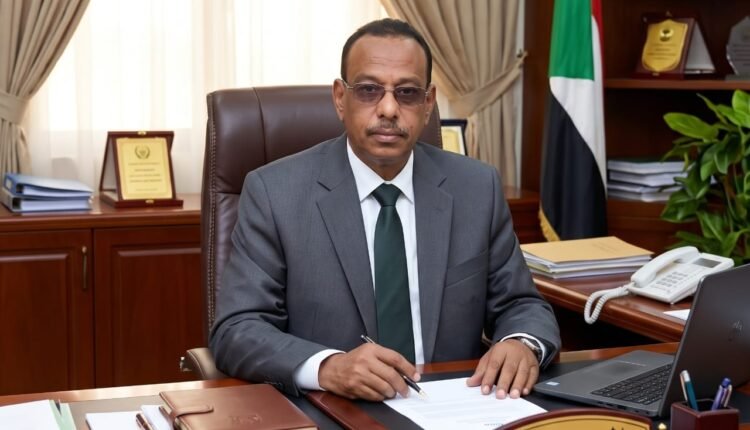
In this interview, we speak with Fath Al-Rahman Sati, Director General of the Payment Systems Department at the Central Bank of Sudan (CBS). We ask him about what matters to man in the street, their livelihoods and transactions, the impact of the war, how the bank navigated this period, the current challenges, and the plan for the next phase, and the nature of the work of the department he leads.
Interview by Editorial Team
– You Let’s begin this discussion by talking about the General Directorate of Payment Systems’ mandate and how its work relates to people’ daily lives.
• We are responsible for the infrastructure through which funds are transferred, including interbank settlement systems, clearinghouses, instant transfers, mobile wallets and financial services, points of sale, and ATMs. Practically speaking, this means that every transfer a citizen makes, every bill they pay, and every cashless purchase passes through systems we oversee, develop, and ensure the security of. In addition, we license service providers and monitor their compliance with standards.
– How were payment systems affected by the war? What stopped and what continued?
• They were affected by the disruption of communications and electricity, the shutdown of some operations centers, bank branches, and ATMs, and the confusion that gripped customers in the initial weeks. However, the central systems did not completely shut down, and digital services emerged as a practical alternative when access to branches and cash became impossible.
– Many people relied on banking applications and electronic wallets during the war. How do you assess this shift?
– It is one of the few positive lessons of the war; the adoption of digital payments among individuals and merchants has accelerated unexpectedly. It has enabled displaced people to receive assistance from their families and make payments from anywhere. However, this rapid growth has also revealed strain on the systems’ capacity and the need for stricter regulations.
– We hear a lot about the “National Instant Payment System.” What is this system, and why is the Central Bank launching it now?
• It is the largest project in the history of payment systems in Sudan. It is a single national platform owned and supervised by the Central Bank, enabling money transfers and their final delivery to the beneficiary within seconds, 24/7, between all banks, payment service providers, and wallets. The system includes a central clearing and instant settlement platform linked to the Real-Time Gross Settlement (RTGS) system, a national payment application, a service that works on regular mobile phones without internet access, and a unified system for handling complaints and disputes.
As for why now, it is because the war has demonstrated that digital payments are no longer an option, and at the same time, it has uncovered challenges. The multiplicity of applications, the weak linking between them, and the varying protection standards, and we want to build on what has been achieved to create a stronger and more secure national infrastructure, within the framework of the state’s digital transformation strategy.
– What will practically change in people’ lives when this system is implemented?
• People will be able to transfer money to anyone at any bank or wallet using a phone number or QR code, without needing to know the account number. They will be able to verify the beneficiary’s name before confirming the transaction, view the fees before execution, and receive funds within seconds, even on holidays and late at night. They will also be able to link their various accounts and wallets into a single application, pay electricity, water, and telecommunications bills, government fees, and top up their mobile credit all from the same place. In short: one application, instant transfer, from any entity to any entity.
– Does the current system allow for seamless transfers between different banks and wallets? What about interoperability?
• Interoperability is the core of the plan: enabling people to transfer money from any account or wallet to any other account, and allowing any merchant to accept payments by any method, without restrictions imposed by the bank or provider. This is precisely what the National Instant Payment System achieves. All banks, payment service providers, and wallets are connected to it. It operates according to the international standard for payment messaging (ISO 20022) and is linked to the Real-Time Gross Settlement (RTGS) system and the national switch, enabling transfers from any party to any other within seconds.
– Does this mean that existing bank and wallet applications will be discontinued?
• Absolutely not. Banks and payment service providers are integral partners in the system, connecting to it directly or through intermediaries, and continuing to offer their applications and services. The difference is that these applications will be interconnected through a single platform, allowing transfers from any one to any other. The national application is an additional option available to every citizen and merchant, regardless of their bank, and operates under the license and direct supervision of the Central Bank.
• What about people who do not own a smartphone or have internet access, especially in rural areas and displacement camps?
– This is one of our top priorities, because financial inclusion cannot be achieved if the service is limited to smartphones alone. Therefore, the system includes a shortcode (USSD) channel accessible on any mobile phone, even basic models, without internet access, in both Arabic and English. This is with the approval of the Ministry of Digital Transformation and Communications and all telecommunications companies. Through this channel, people can open a wallet, check their balance, and make instant transfers, pay bills, top up their credit, change their PIN, or deactivate their wallet. The system also offers a simplified registration process with transaction limits suitable for those without bank accounts.
We are working with banks and money transfer companies to expedite and reduce the cost of remittances and encourage the use of official channels.
– People complain about some transfers failing and the funds being deducted without being received. How do you address these cases? What should people do?
– This is one of the most frequent complaints, and the reasons are often a connection interruption during the transaction or a malfunction in the link between two systems. There are reconciliation and settlement mechanisms that can either refund the money or complete the transaction within a specific timeframe. We advise people not to repeat the operation immediately, to keep the transaction notification, and to file a complaint with their bank first. If the issue is not resolved, they should escalate it to the Central Bank through the announced complaint channels.
– How will the new system address the problem of stranded funds and erroneous transfers?
• The national system includes a single entity to handle complaints and disputes nationwide, regardless of the channel through which the transaction occurred. People submit their complaints via the app, phone, or their bank, and immediately receive a reference number to track their progress step by step. The system automatically forwards the complaint to the responsible entity, along with the complete transaction history, and obligates each entity to specific response deadlines. If the complaint remains unresolved, it is escalated to the Central Bank for a binding decision. The target resolution time is ten working days for normal cases and five days for suspected fraud cases. Furthermore, the possibility of error is reduced because the system displays the beneficiary’s name for verification before processing the transfer.
– How does the Central Bank protect people from fraud in e-wallets and applications?
• We protect users by licensing and regulating service providers, requiring them to adhere to strong authentication standards, monitoring suspicious transactions, suspending suspicious accounts, and coordinating with relevant authorities to combat money laundering and terrorist financing. We urge people to adhere to a simple principle: your PIN and verification code are yours alone, and no one else will ask for them.
The project is being implemented in phases: establishing the infrastructure and developing essential services, followed by a limited pilot launch with a number of users and institutions.
– Who owns people’ data within this system, and how are their funds and information protected?
• The Central Bank owns the platform, the application, and all user and transaction data in its entirety. People’ financial data remains within Sudan. The system employs the highest banking security standards, including data encryption, multi-factor authentication and fingerprint verification, linking the account to the user’s device, real-time fraud detection and suspension of suspicious transactions, and protection against SIM card swapping fraud. It also incorporates anti-money laundering and counter-terrorism financing controls in accordance with international standards.
– People are asking about fees and commissions for digital transfers and services; who sets them, and is there a ceiling?
• The policy is for fees to be fair and transparent, and not to burden people during these difficult times. The Central Bank sets the framework and upper limits for service fees and requires banks and service providers to clearly display them. People can report any violations.
– What are the daily transfer and withdrawal limits, and why do they vary from bank to bank?
• Limits are a means of managing risk and protecting customers from fraud and money laundering. They are set to balance ease of use with security. Limits vary depending on the account type, customer category, and level of identity verification. We are working to minimize these differences and make them clearly stated.
– For merchants and small business owners, what does the bank offer to enable them to accept electronic payments?
• The system will streamline the process for small merchants to join. Digital payment also benefits the merchants themselves: it reduces the risks associated with carrying cash and provides a record that can later facilitate access to financing. The National Instant Payment System will allow merchants to accept QR code payments without expensive equipment, receive funds instantly, and track their sales and settlements in real time.
– Remittances from expatriates are a vital lifeline for many families. How can payment systems ensure their rapid and cost-effective delivery?
• We are working with banks and money transfer companies to expedite remittances, reduce their cost, encourage the use of official channels over unofficial ones, and enable beneficiaries to receive funds directly into their accounts or wallets. This benefits both people and the economy by boosting foreign currency reserves through official channels. The National Instant Payment System is also designed to eventually accommodate regional and international remittance services.
– When will people see this system implemented?
• The project is being implemented in phases: establishing the infrastructure and developing essential services, followed by a limited pilot program with a select group of users and institutions, and then a gradual rollout across all states, accompanied by awareness campaigns and efforts to attract merchants. The target is to complete the nationwide rollout within eighteen months of signing the contract with the implementing entity. In later phases, services such as payment requests, remittances from expatriates and cross-border payments will be added.
– What challenges do payment systems face today? And what is your plan to overcome them in the coming period?
• The most important challenges are: weak connectivity and energy infrastructure, the need to increase the systems’ capacity to accommodate growth, the varying readiness of banks and service providers, and the delayed arrival of services to rural areas, the challenges of digital financial literacy, and the risks of fraud.
Our plan to overcome these challenges focuses on developing the infrastructure for clearing, settlement, and instant transfer; achieving full interoperability; expanding the network of agents and acceptance points; strengthening consumer protection and complaint mechanisms; launching awareness programs on secure digital payments; and supporting responsible financial innovation.
– What is your message to the public at the end of this interview?
• We tell them: Digital payments are secure, fast, and cost-effective, but they require awareness. Use official channels, protect your banking information, and don’t hesitate to file a complaint if you encounter any challenges. The Central Bank is with you, working to make your experience easier and more secure.
Shortlink: https://sudanhorizon.com/?p=20754