

Tawila Emergency Room Official: IDPs With No Tents or Blankets
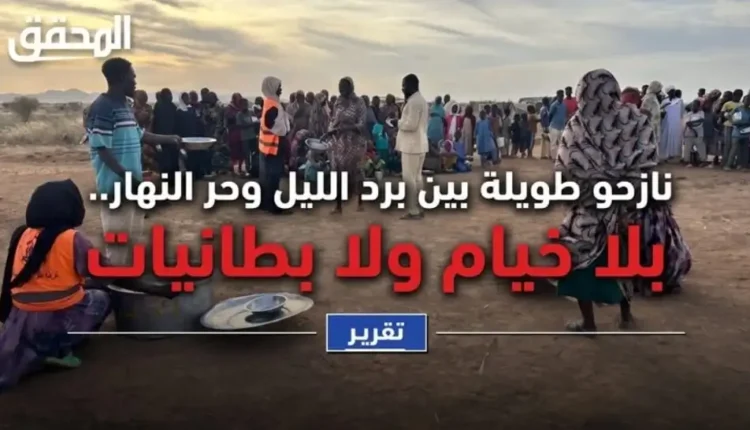
Report by Nashwa Ahmed Al-Tayeb
Hamza Hassan Haroun, the media officer for the Tawila Emergency Room in North Darfur State, revealed to that the number of displaced people in Tawila has exceeded three million. He stated that none of them have returned to their original areas to this day. This comes as the Sudanese army continues its advance in the Kordofan region, and waves of returnees to Khartoum, Al-Gezirah, and Sinnar are increasing.
Haroun said that the number of IDPs is increasing daily by between 100 and 200 families, and that the total number of families has reached approximately 600,000. He indicated that the room has registered more than 2,500 missing persons since the events in El Fasher, of whom more than 500 have been returned to their families, while the fate of more than 2,000 remains unknown. This is all happening amidst a severe shortage of food, lack of shelter materials, and shortage inhealth services with the onset of winter.
He explained that Tawila needs more than 200 community kitchens operating continuously, while aid arrives sporadically, sometimes not exceeding two kitchens. He appealed to humanitarian and international organizations and UN agencies for urgent intervention, warning that any delay in response would cause significant disruption within the community.
Two Waves of Displacement and One Refuge:
In two years, Tawila has transformed from a small area into the largest gathering of internally displaced persons (IDPs) in Sudan. Previously, it was a trade transit point and a medium-sized area with a population of approximately 35,000. It has been controlled by the Sudan Liberation Army (SLA) movement, led by Abdul Wahid Mohamed Nour, since September 2023, when it entered the area following the army’s withdrawal, claiming its objective was to protect civilians. Abdul Wahid rejected the peace agreements signed by other factions and has not joined any of the parties involved in the current conflict.
The first wave of displacement occurred in April 2025, when the Rapid Support Forces (RSF) militia attacked the Zamzam camp, causing approximately 400,000 people to flee in just two days. The second wave of displacement came after the Rapid Support Forces (RSF) militias seized control of El Fasher on October 26, 2025. UNICEF reported that those fleeing the city walked 60 kilometers to Tawila with no food or water.
The UN Human Rights Office documented ten detention facilities used by the RSF in El Fasher, including a children’s hospital converted into a detention center, and noted that thousands remained missing. A UN investigation concluded that the battle for the city bore the hallmarks of genocide. RSF commander Mohamed Hamdan Dagalo admitted that his militias have committed abuses and said some had been arrested, a claim met with skepticism by activists and human rights organizations.
Three million displaced people in Tawila and more than two thousand missing, their whereabouts unknown. These are disparate figures for a single reality:
The number of rooms differs significantly from estimates by international organizations. According to the International Organization for Migration (IOM), the number of internally displaced persons (IDPs) in Tawila rose from 238,084 to 652,079 between March and September 2025. As of July 30, 2026, North Darfur State was hosting 1,672,222 IDPs, including 706,459 in Tawila locality. Early 2026 press reports estimated the number of IDPs in the sprawling network of camps in Tawila at as high as 1.4 million.
This discrepancy reflects the difficulty of conducting accurate counts in such extensive camps, which are spread across multiple locations. In these camps, long-term and newly displaced people are intertwined with the host community, and counting methods vary between local and international organizations. Haroun attributes the large numbers to the fact that IDPs come from “different, very large, and distant areas.” Regardless of the most accurate figure, the influx has continued unabated. More than 3,400 displaced people have arrived in Tawila since the beginning of September 2026, according to a group representing displaced people from Darfur, which warned of severe shortages of food, clean water, and medicine.
A Winter Without Shelter:
The Tawila Emergency Room identifies the humanitarian gap in four key areas: shelter, food, health and water, and protection. Haroun begins with shelter because the season demands it. A displaced person without a mattress, blanket, tent, or awning remains exposed to the cold at night and the heat during the day.
International data confirms this description. The International Organization for Migration (IOM) reported on October 29, 2025, that 98% of families in Tawila lacked basic sleeping necessities such as blankets, mattresses, and mosquito nets. About a year later, in September 2026, the IOM described the 3,000 new tents as insufficient to meet the scale of the need, and residents complained of tattered tents that offered no protection from the wind and rain in overcrowded camps lacking basic sanitation. In September 2026, the organization also warned that emergency shelter supplies in Sudan could run out by the end of the month without new funding. These supplies had reached over one million people in 2024, then 804,000 in 2025, but had not exceeded 330,000 by that point in 2026.
The Hunger That Drove Them to the Road:
Haroun places food at the top of the list of urgent needs. He believes that the lack of food in the areas where displaced people are located is what drove them to flee, making them seek refuge in Tawila from both fear and hunger.
He sees the arrival of the displaced themselves as the first indicator of food insecurity in their areas. He adds that the failure of the agricultural season has severely impacted people’s lives, as they depend entirely on agriculture, leaving most of them reliant on organizations and humanitarian aid. The second indicator is the spread of malnutrition and fevers among children, pregnant women, and the elderly, with the organization observing a significant increase in the number of those affected.
This assessment aligns with international warnings. On October 13, 2026, the Integrated Food Security Phase Classification (IPC) warned that drought caused by El Niño, combined with conflict, was increasing the risk of famine in parts of Greater Darfur and Greater Kordofan. A subsequent report listed fourteen locations as being at risk of famine if fighting intensified and aid restrictions continued, including camps for internally displaced persons in Tawila.
In February 2026, IPC experts had declared that famine thresholds had been crossed in Um Buru and Karnoi in North Darfur, after nearly three months of drought.
A month has passed since famine was confirmed in El Fasher and Kadugli. The Minister of Agriculture in Darfur described the threat of famine as potentially greater than the war itself, attributing it to declining rainfall, drought affecting farms and pastures, and attacks on farms.
Water and Medicine: A Perilous Distance
On health issue, Haroun calls for the establishment of a permanent health center for each cluster of families, which he estimates ranges from 200 to nearly 2,000. He wants the centers to be equipped with emergency medicines, medications for chronic diseases, and painkillers. He also requests water tanks and reservoirs near the displaced persons’ settlements so they are not forced to fetch water from distant locations, exposing them to danger.
The International Organization for Migration estimates that more than 70% of families in Tawila lack access to healthcare, and that half of the families have been unable to receive treatment. Children under five and pregnant women are the most affected, with malnutrition, infectious diseases, and cholera spreading due to the lack of clean drinking water. The Famine Early Warning Systems Network (FEWS NET) expressed grave concern about the spread of infectious diseases in large, densely populated settlements, particularly Tawila.
In October 2026, UNICEF announced it was providing life-saving water services to displaced people and host communities in Tawila, with in-kind support from the UK Foreign Office. This effort remains limited in the face of the scale of the need.
The Road to the Warehouses:
Haroun links protection to accessibility, meaning that supplies stored in warehouses reach displaced people in camps and settlements smoothly and safely. The problem is not only the availability of aid, but also the route it takes to reach those who need it.
The Rapid Support Forces (RSF) militia maintains checkpoints on the region’s roads and controls vital routes. Local activists say aid trucks are subjected to looting and extortion, which increases costs and delays deliveries.
Names on the Walls:
Haroun says some of the missing died on the road between El Fasher and Tawila, some died inside El Fasher, and some died in other areas. The operations room continues to receive the names and photos of missing persons, including those who have been missing since the events in Gezirah, Khartoum, and other war zones.
There is another type of disappearance occurring within the camp itself. Due to the similarity of the displaced persons’ shelters and the camp’s vast size, some children become separated from their families. They are brought to the operations room’s office and remain in its care until their relatives are found. The operations room refers to them as “internal missing persons.”
The operations room’s findings are consistent with those of international organizations. In November 2025, the UNHCR estimated that approximately 100,000 people fled El Fasher and surrounding villages in two weeks, but only about 10,000 were officially registered in places like Tawila. The ICRC recorded 8,000 missing persons related to the ongoing conflict and indicated that thousands of families displaced from El Fasher were still in Tawila searching for relatives they lost during the fighting.
Schools Full, But Stomachs Empty:
The Tawila Emergency Operations Room monitored schools operating in the area and intervened by providing school meals, notebooks, and books. It hasn’t been able to do so yet, but plans to begin its intervention at the start of this month.
Haroun says that in Tawila and the surrounding administrative units, there are fifty schools overcrowded with pupils and students, while only five educational initiatives are currently operating. The students need school uniforms, books, notebooks, school supplies, and school meals to encourage them to continue their studies. He adds that education during wartime becomes extremely difficult “because people have nothing to eat.”
The civilian administration of the controlling movement announced the resumption of educational services in Jebel Marra and Tawila in October, after they had been suspended due to insecurity.
Community Kitchens…
Haroun believes that community kitchens have become the most suitable model for providing food during emergencies, evacuations, and periods of stability, because they offer ready-made meals that reach those in need directly. The alternative, he says, is for people to remain at home without matches, fuel, or anything to cook. He adds that the meals help students settle into school and enhance their focus and comprehension of lessons.
Intermittent Funding:
Haroun considers the lack of funding the biggest challenge facing the chamber. Support arrives sporadically—ten kitchens one time, five another time, and two another time—while the region needs more than two hundred kitchens operating continuously. The second challenge is that most of the volunteers, despite their large number, have not received specialized training. This includes media, program and project management, financial reporting, reconciliation and evaluation, and protection.
The third challenge is market volatility. The value of the Sudanese pound fluctuates between the date the financial proposal is submitted and the arrival of funds, so the amount received does not match the amount requested in the proposal. This causes significant difficulties with financial reporting and programs. Therefore, the chamber is appealing for timely and more intensive and consistent funding.
This is a long-standing crisis.
Under President Joe Biden, the United States funded emergency kitchens to the point where they operated approximately 1,500 kitchens across Sudan, but this funding was drastically reduced after the USAID was discontinued. A survey conducted by Islamic Relief of 844 kitchens in six states found that 42% had closed due to lack of funding and supplies. The 2026 Sudan Humanitarian Appeal received only 16% of its required funding.
A significant response to a greater need:
Haroun acknowledges a significant response from humanitarian organizations to the situation in Tawila, but describes it as very weak compared to the overall scale of the needs. As a result, many displaced people are now relying on charitable individuals for food. He says, “No matter how much we provide, we find another gap at the same time.”
He emphasizes that no one has yet been able to reach all the displaced people in Tawila, neither the Chamber of Commerce nor international, regional, or local organizations.
The reason is that the numbers are increasing daily, and whenever one need is met, another arises.
Adam Rijal, spokesperson for the General Coordination of Displaced Persons and Refugees, stated that the aid received covers less than 10% of the actual needs. Nationwide, 33.7 million people will require humanitarian assistance in 2026, with requirements amounting to $2.87 billion.
When the Army Advances… and No One Turns Back:
The Sudanese army controls Khartoum and most of the north, east, and center of the country, while the Rapid Support Forces militia controls a large part of western Sudan, including almost all of Darfur and parts of Kordofan.
Recent months have witnessed a clear advance by the army in North Kordofan. On July 25, 2026, the army and its allies recaptured the city of Bara and the areas of Al-Baraka and Umm Sayala after fierce clashes. On September 6, they seized the town of Hamra al-Wiz. Days later, they announced the recapture of eleven areas, advancing along the Al-arbaeen Road with the aim of opening a corridor towards Darfur. On November 1, 2026, Chief of Staff Lieutenant General Yasser al-Atta stated that the Sudanese Armed Forces (SAF) were advancing towards Darfur and Kordofan, and that the army was attempting to penetrate Darfur, where the Rapid Support Forces militias controlled most of the territory.
Analysts believe the army is relying on air power and gradual pressure before any major ground campaign towards West Kordofan or Darfur, and that while a shift in control in Kordofan would be significant, it would not end the war.
Return to the Central Region and Absence from Tawila:
The army’s advance in the central region contributed to a large-scale return of displaced persons. The number of returnees reached 4,441,570, with Khartoum leading at 2,114,372, followed by Gezira at 1,210,590. However, the United Nations warned that returnees face a new struggle for survival, as housing, water supplies, health services, and electricity have been severely damaged.
A report by the International Organization for Migration reveals a striking paradox: improved security is what prompted more than 95% of returnees to return to Gezira, Blue Nile, River Nile, and Sinnar states. As for the 263,311 returnees to North Darfur, they all cited the depletion of their financial resources as the sole reason for their return. Returning there, therefore, is a result of an inability to continue displacement, not a consequence of established security.
In Tawila, the picture is even bleaker. Haroun says that to this day, not a single displaced person has returned to their original area because other regions continue to push more people towards Tawila, and because no one has seen any promising signs of return. El Fasher, from which most of the displaced came, remains under the control of the Rapid Support Forces, and the army’s advance has not yet reached North Darfur.
Tawila cries out:
Haroun concludes his statements by appealing to humanitarian and international organizations and UN agencies to pay attention to the situation in Tawila and intervene urgently. He warns that any delay in responding to the situation and its developments will result in significant disruption within the community.
Shortlink: https://sudanhorizon.com/?p=20042