

Sudan: National Workshop to Strengthen Interconnection between climate action and food systems pathways
Khartoum – Sudanhorizon
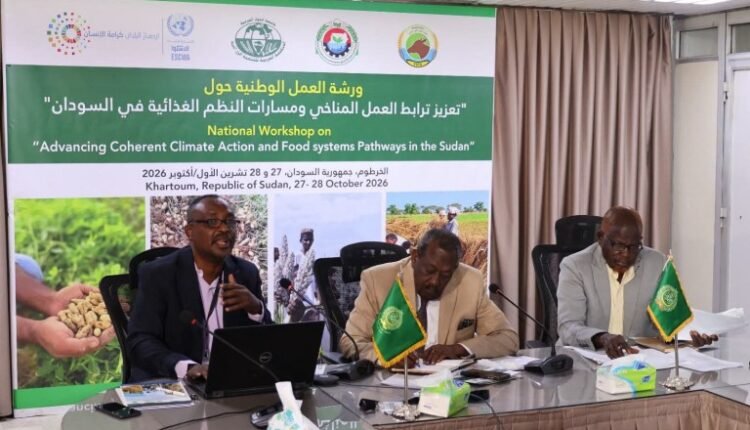
The national workshop on “Enhancing Interconnection between Climate Action and Food Systems Pathways in Sudan” concluded on Wednesday in Khartoum, as organized by the Technical Secretariat for Food Security at the Ministry of Agriculture and Irrigation and the Arab Organization for Agricultural Development. It continued on October 27 and 28 with the support of the United Nations Economic and Social Commission for Western Asia (ESCWA) and the Food Systems Coordination Center, and with the participation of representatives of government institutions, regional and international organizations, and partners concerned with climate, agriculture and food security issues.
According to Ministry of Agriculture and Irrigation media office the workshop aimed to enhance integration between climate action and food systems transformation paths in Sudan, and to discuss the effects of climate change on agricultural production, food security and livelihoods, in addition to identifying national priorities and practical interventions that contribute to building sustainable food systems that are more resilient, in light of the climate challenges and current conditions that the country is going through.
In the opening session, the representative of the Undersecretary of the Ministry, Dr. Ajeeb Muhammad Madani, stressed the importance of the workshop in enhancing dialogue and coordination between national authorities and partners on climate challenges and their impact on the agricultural sector and food security. He stressed the need to develop practical solutions that support the sustainability of agricultural production and enhance the ability of food systems to adapt to climate change, in a way that serves national priorities in the areas of recovery, reconstruction, and achieving food security.
For her part, the Secretary-General of the Technical Secretariat for Food Security and the National Coordinator for Food Systems Transformation in Sudan, Amira Al-Rawi, pointed out the importance of strengthening the interconnection between climate action and food systems transformation paths, and adopting an integrated national approach that responds to current challenges and takes into account development and humanitarian priorities, in a way that supports the resilience of the agricultural sector and communities and contributes to recovery efforts.
The coordinator explained the importance of updating the food systems transformation plan in Sudan for the period 2022-2030 in response to the developments and challenges that the country is going through, with a focus on recovery, reconstruction, and enhancing resilience.
She stressed the need to link climate action to the priorities of agricultural production and food security, improve the efficiency of supply chains and marketing, reduce waste, and enhance the sustainability of production, which contributes to improving the availability of food and facilitating access to it at reasonable prices.
Deputy Secretary-General of the Technical Secretariat for Food Security, Ibrahim Al-Shaher, pointed to the pivotal role of the Technical Secretariat in coordinating national efforts and enhancing cooperation between ministries, government institutions, regional and international organizations, and partners concerned with food security.
He explained the importance of unifying visions and coordinating relevant policies and programmes, enhancing integration between the sectors of agriculture, environment and climate action, and supporting the exchange of information and experiences and identifying national priorities, which contributes to developing an integrated response to the challenges facing food security in Sudan.
The workshop sessions addressed the interconnection between climate change and food systems in Sudan, and visions and priorities related to recovery and enhancing resilience, including the efforts of the Food and Agriculture Organization (FAO) and the World Food Program in supporting the agricultural sector and food security.
Participants discussed climate challenges and vulnerabilities facing agricultural and food systems, and the importance of harmonizing national policies and strategies to enhance response to climate change.
It discussed ways to transform national priorities into practical, implementable interventions, emphasizing the importance of strengthening institutional coordination, mobilizing resources and climate financing, expanding technical partnerships, and developing monitoring and evaluation mechanisms, to support the implementation of food systems transformation paths.
Shortlink: https://sudanhorizon.com/?p=19598