

Agriculture Minister: No Food Shortage in Safe Areas of Sudan
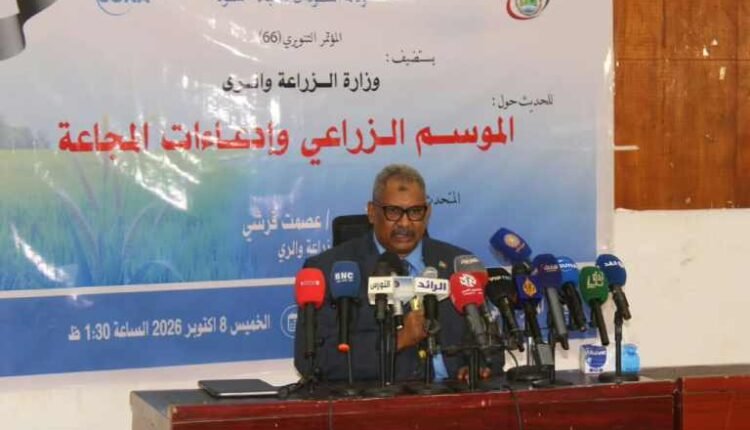
Khartoum- Sudanhorizon
Minister of Agriculture and Irrigation, Ismat Mohamed Qurashi, has affirmed that food security indicators in Sudan are positive, denying any food shortages in safe areas despite the challenges the agricultural sector has faced recently.
Speaking at the 66th briefing conference organized by the Ministry of Culture, Information, Antiquities, and Tourism—hosted by the Sudan News Agency (SUNA) on Thursday at the Cultural Center in Omdurman—the Minister stated that the success of the agricultural sector is the fundamental pathway to achieving food security and national economic recovery.
He emphasized that the coming phase requires increasing production and supporting small-scale farmers with seeds, fertilizers, and production inputs.
Qurashi explained that the summer agricultural season was successful despite rainfall shortages in several areas, noting that crop production last season reached approximately 5.8 million tons, which contributed to securing a strategic food reserve. He pointed out that the Ministry is working to boost local production and increase productivity to meet the country’s food needs and reduce reliance on imports, while also supporting farmers and enhancing their ability to sustain production activities.
Qurashi commended the efforts of the Agricultural Research Corporation, highlighting its success in recovering approximately 70% of the genetic assets lost during the war. He revealed that, under current circumstances, the Authority has successfully produced 22 new varieties across eight staple crops—a significant step toward realizing the Ministry’s strategy to localize seed production and reduce reliance on imports.
He emphasized that the provision of improved seeds is a cornerstone of agricultural sector advancement, alongside the supply of fertilizers, financing, and agricultural services to farmers.
The Minister announced the Higher Committee’s plan for the winter season, targeting an indicative planting area of approximately 3 million feddans, including one million feddans dedicated to wheat.
He affirmed that the Ministry is working to create the right conditions for a successful winter season—particularly regarding the availability of seeds, production inputs, and financing—to boost output and enhance food self-sufficiency.
Qurashi highlighted Sudan’s vast agricultural potential, noting that the country is well-positioned to become a regional hub for agricultural production and processing, and he invited investors to capitalize on Sudan’s abundant resources and capabilities.
Shortlink: https://sudanhorizon.com/?p=18766