

Is Ethiopia Heading toward a New War? Will Sudan Become Theater for Its Repercussions?
Cairo – Sudanhorizon – Sabah Moussa
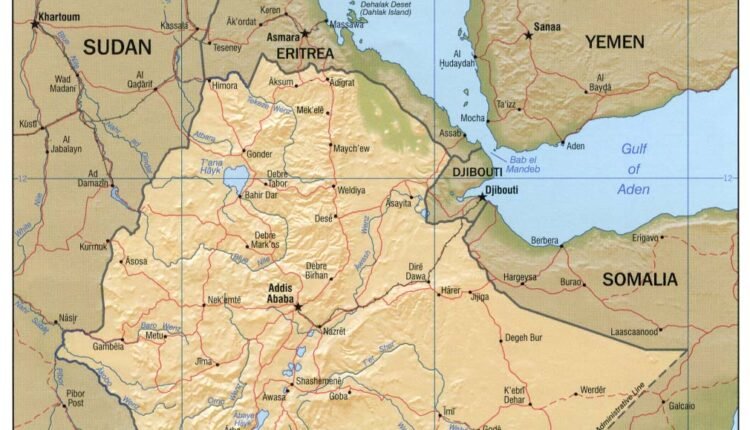
The specter of war has once again loomed over Ethiopia; however, the current scenario differs significantly from the conflict that erupted in 2020 between the federal government and the Tigray People’s Liberation Front (TPLF)—a conflict that concluded two years later with the Pretoria Agreement. The dynamics have shifted, alliances have expanded, and the struggle is no longer confined to a single front. Moreover, these new developments are unfolding in a region already grappling with overlapping crises, meaning any escalation risks spilling over beyond local borders.
– War Drums
Reports circulating this Wednesday indicate that TPLF forces have seized control of Alula Aba Nega Airport in Mekelle, the regional capital. This coincides with renewed clashes involving federal forces in areas of the neighboring Afar region. According to media reports citing security and local sources, Tigrayan forces have taken control of the Mekelle airport, while Ethiopian Airlines has announced the suspension of flights to the airports in Mekelle, Axum, and Shire due to the security situation. Sources also report that Tigrayan forces have seized control of other airports within the region. However, the significance of this development extends beyond the confines of a single airport or city; it lies in its timing and its political and military context. These moves came just days after the announcement of a new armed alliance comprising seven Ethiopian anti-government groups—a step that shifts the landscape from scattered pockets of rebellion to an attempt to unite armed forces from various regions under a single umbrella. The alliance includes the Tigray People’s Liberation Front (TPLF), the Fano movement in Amhara, the Oromo Liberation Army (OLA), the Ogaden National Liberation Front (ONLF), the Afar Revolutionary Democratic Unity Front (ARDUF), the Benishangul People’s Liberation Movement, and the Gumuz People’s Democratic Movement; its members have declared their unity in opposing Prime Minister Abiy Ahmed’s government and their aim to establish a transitional administration.
– A Broader Equation
Herein lies the most striking paradox of the new landscape: the forces united by this alliance were not all on the same side during the previous war. Some had engaged in separate confrontations with the government or other parties, while Tigray itself was at the heart of the conflict that reshaped the balance of power in Ethiopia and the region. Consequently, the current maneuver by Tigrayan forces cannot be viewed in isolation from the attempt to construct a broader conflict equation. Seizing a vital hub like the Mekelle airport—if the position holds—grants the region’s forces both military and symbolic value, particularly as this coincides with movements in Afar and the emergence of an armed alliance whose geographical reach extends well beyond Tigray. The situation here differs from 2020 in another respect as well: in the previous war, the primary battle lines—drawn between the federal government and Tigrayan forces—were relatively clear-cut before the conflict expanded to involve various Ethiopian and regional actors. Today, however, the government faces armed and political challenges across multiple regions, meaning any new escalation in Tigray would be part of a broader national crisis. Eritrea figures prominently in the strategic calculus; Asmara fought alongside the Ethiopian government during the earlier war against Tigray, though relations between the two nations have since entered a new phase of tension. With the nature of the bilateral relationship transformed, a resurgence of fighting in Tigray once again raises questions about Eritrea’s role—not merely regarding its past actions, but concerning its current position and its security and political interests in northern Ethiopia and the Red Sea. This complicates the potential for the crisis to widen; while a renewed confrontation between Addis Ababa and Tigray constitutes an internal crisis in its own right, Eritrean involvement—whether direct or indirect—could transform it into a conflict with broader regional dimensions. Furthermore, the existence of an armed alliance comprising forces from Amhara, Oromia, Afar, and other regions implies that any escalation would not necessarily remain confined to the country’s north.
– Sudan in the Equation
Sudan lies at the heart of this equation; the Sudanese-Ethiopian border is adjacent to the theater of events, and the war in Sudan remains ongoing on the other side of the border. Consequently, any new wave of fighting in northern Ethiopia carries potential repercussions for population movement, border dynamics, trade, and security—not to mention the risk of displacement should the scope of the clashes widen. More critically, the simultaneous occurrence of the Sudanese and Ethiopian crises creates an environment vastly different from the one that existed at the outbreak of the first Tigray war. Sudan is currently grappling with a widespread conflict, and its eastern border sits in a highly sensitive zone where various armed groups and intersecting interests are active. Thus, for Khartoum, the issue is not merely what is happening inside Ethiopia, but its own ability to prevent the conflict’s repercussions from spilling over into its eastern territories. The more the Ethiopian war expands, the greater the pressure on the border—whether through population displacement, military activity, or disruptions to trade routes and the movement of border communities.
The overarching question remains: Will Addis Ababa succeed in containing this new development before it escalates into a full-scale war, or will emerging alliances and multiple flashpoints within Ethiopia drive the country toward a new confrontation?
In either scenario, Sudan will not be insulated from the fallout—particularly if the Tigray conflict trajectory intersects with Eritrean calculations and the ongoing war in Sudan. What began as a military move in northern Ethiopia may not remain a purely internal Ethiopian affair if conflict lines converge at the Sudanese border and the Red Sea, transforming the Tigray crisis from a domestic confrontation into a new chapter in the Horn of Africa’s series of crises.
– A Flashpoint
For his part, Dr. Hamdi Abdel Rahman, an Egyptian expert on African affairs, emphasized that while it is impossible to state definitively that a “second Ethiopian war” has already begun, current indicators point to a situation far more dangerous than a mere crisis along the borders of the Tigray region.
Abdel Rahman told Sudanhorizon that the new armed alliance, the resurgence of clashes in Tigray, and Ethiopian-Eritrean tensions—coupled with the ongoing war in Sudan, making Sudan’s eastern border a potential flashpoint for a multi-party regional conflict should political containment fail.
He highlighted three deeply concerning indicators: first, direct clashes erupted in August between Ethiopian federal forces and Tigrayan forces in the region’s west—near the Sudanese border—involving artillery and drones, with fighters and the wounded fleeing into Sudan. Second, the Tigray People’s Liberation Front (TPLF) reconstituted its political authority in the region in May—a move the federal government deemed a violation of the 2022 Pretoria Agreement, while Tigrayan leaders accuse the government of failing to implement the agreement’s terms. Third—and most dangerous—was the announcement on September 21 by seven Ethiopian armed groups of an alliance aimed at toppling Prime Minister Abiy Ahmed’s government; notably, these groups had previously stood on opposing sides of the conflict.
– Multiple Fronts
Abdel-Rahman observed that this development signifies a shift from localized tension in Tigray to a multi-front crisis within the Ethiopian state. However, he emphasized that the new alliance does not automatically imply a unified military command or the capacity to wage simultaneous warfare across Ethiopia, given the differing goals, interests, and operational areas of the constituent groups. “In my assessment,” he stated, “we are in a pre-war phase—or a state of incomplete war—rather than facing an inevitable all-out war.” He identified Eritrea as the most critical factor, noting that relations between Asmara and Addis Ababa are severely strained, particularly regarding Ethiopia’s access to the Red Sea and the port of Assab. At the same time, he noted that some analyses suggest noting the emergence of a rapprochement between Ethiopian and Tigrayan forces—despite their past hostility—and identifying a second major risk: the transformation of separate conflicts into a single, highly complex, and interconnected regional conflict system involving Tigray, Eritrea, Sudan, and the Red Sea. He concluded that Sudan could become the most vulnerable link should these overlapping tensions escalate into a broader regional conflict.
– Major Shifts
For his part, Dr. Mohamed Torshin, a Sudanese researcher specializing in African affairs, observed that the war in Ethiopia is gradually expanding following the formation of an alliance among several Ethiopian factions aimed at toppling Abiy Ahmed’s regime.
Torshin told Sudanhorizon that the current situation mirrors the period when the Tigray People’s Liberation Front (TPLF) allied with various factions—most notably the Eritrean liberation fronts—alliances that ultimately altered the landscape and led to the overthrow of the Mengistu Haile Mariam regime. He added that the situation appears to be heading in the same direction; significant developments have unfolded since the alliance was announced. Although the official announcement came only yesterday, prior coordination among the alliance’s components implies substantial collective strength—a force that has already begun to drive significant change on the ground. Torshin predicted major upcoming shifts, expressing his belief that neither Khartoum nor Cairo would stand idly by. He noted that Sudan has long accused Ethiopia of backing the Sudan People’s Liberation Movement (SPLM) and the Rapid Support Forces (RSF) in the Blue Nile region by opening supply lines through Assosa, the capital of the Benishangul-Gumuz region.
– Reciprocity
Turchin believes that, in this scenario, Sudan would act based on the principle of reciprocity. He explained that even if Sudan does not openly support the Tigray People’s Liberation Front (TPLF) and its allied factions, it would undoubtedly turn a blind eye to the delivery of military aid and allow civilians—as well as the wounded—to enter Sudan for medical treatment. He noted Sudan’s historical precedent in this regard, citing its past relationships with both the TPLF and the Eritrean liberation fronts. He added that the Tigray and Eritrea issues would likely become intertwined, with Eritrea playing a significant role in efforts to oust Abiy Ahmed’s regime. Turchin pointed to the numerous, interconnected armed conflicts across the Horn of Africa—linked by shared ties of kinship and funding—noting that this complexity means any new development in Ethiopia could easily spill over into other regional conflicts and issues.
– Tension and Friction
For his part, Ethiopian journalist Anwar Ibrahim believes that Sudan cannot play a role in the current developments within Ethiopia, given the ongoing friction between Khartoum and Addis Ababa.
Ibrahim told Sudanhorizon that relations between the two nations are strained, particularly due to persistent mutual accusations of supporting each other’s opposition groups—a trend he expects to intensify in the near future. He added that events in Ethiopia could also reverberate within Sudan, especially considering previous accusations by Sudan that Addis Ababa supported the Rapid Support Forces (RSF), contrasted with Ethiopia’s allegations that Khartoum backed the TPLF.
– Containing Tensions
Ibrahim opined that if the two nations do not limit themselves to the current level of accusations, their relationship could witness escalating tensions alongside unfolding events within Ethiopia. He noted that the movements of Ethiopian armed groups might evolve into a pressure tactic employed by one side against the other. He further added that the continuation of this trajectory could further complicate relations between Khartoum and Addis Ababa, unless an international or regional body—such as the African Union—intervenes to bridge the rift and contain the mounting tension between the two countries.
Shortlink: https://sudanhorizon.com/?p=18317