

Disinformation Researcher: UAE Funded Massive Network to Link Sudan to Chemical Weapons
Sudanhorizon – Follow-up
Professor Marc Owen Jones—a specialized in disinformation, author of *Digital Authoritarianism in the Middle East*, and a Durham University PhD holder—has published a detailed report summarizing a study on the UAE’s role in disinformation targeting Sudan.
The study focuses on three elements: Islamists, the Sudanese Armed Forces, and Lieutenant General Abdel Fattah al-Burhan. A significant portion of the report is dedicated to the issue of chemical weapons and how the UAE worked to disseminate, publicize, and market this narrative.
In the executive summary—excerpts of which are presented here by *Sudanhorizon*—Owen identifies four websites that present themselves as independent geopolitical news outlets: *Diplomatic Post*, *Frontline Radar*, *The Levantine*, and *Global Reporters*.
He states that, in reality, these sites are part of a unified operation managing a one-sided influence campaign regarding the war in Sudan. They target audiences in European policy-making hubs and select Western capitals, and are actually funded by the UAE.
Notably, none of the four sites cross-reference one another; however, they share the same entity paying for advertising, as well as the same accounts for tag management and content recommendation. Three of them also share a single account on the Cloudflare platform. Operationally, these four sites are linked through “BM Web Solutions Limited,” a Hong Kong-registered company established in April 2016 by two individuals holding North Macedonian passports—one of whom interacts directly with the pages of these websites. The researcher noted that the network’s investment in boosting reach—or “amplification”—was more significant than the actual content published. Out of 3,708 articles published over a three-month period, only a small fraction was promoted via 558 advertisements on Meta and LinkedIn, and the selection process was heavily biased. An analysis of the full texts revealed that content concerning Islamists and the Muslim Brotherhood was promoted at a rate 5.86 times higher than the median for other topics. This was followed by content regarding Sudan (4.65 times) and the Sudanese Armed Forces and Abdel Fattah al-Burhan (4.59 times)—making these the three highest-ranked topics out of the 29 analyzed.
The researcher also points out that the media message is consistent: it opposes the Sudanese Armed Forces and Abdel Fattah al-Burhan, while also opposing Islamist networks and the countries accused of arming them (Egypt, Turkey, Saudi Arabia, Iran, and Belarus). The researcher noted that the Rapid Support Forces (RSF) constitute the sole exception, as coverage trends move in the opposite direction; while news reports from these sites mention the RSF slightly more often than the army (139 articles versus 132), advertisements derived from those reports mention the army 2.60 times more frequently than the RSF. The RSF was not mentioned in any of the 158 Meta advertisements published as of August 30, nor did any advertising material—regardless of source—contain criticism of the RSF. Meanwhile, the United Arab Emirates—often accused of supporting these forces—was the subject of four positive advertisements and no critical ones.
Targeting operations focus on decision-making centers and policy-oriented institutions in Western nations; this is evident in the targeting of cities such as Berlin, Brussels, Frankfurt, Strasbourg, and Paris on Meta at rates far exceeding those for any single country, with Rome, Amsterdam, and Warsaw also targeted by the “Daniel Mercer” page alone. France accounts for 49% of the total accounts reached within the European Union (a total of 5.04 million accounts), followed by Italy at 19%. Additionally, four LinkedIn advertisements—covering topics related to Sudan, Islamists, and Iran—target Riyadh, Cairo, Doha, Beirut, Amman, Abu Dhabi, Jerusalem, and Khartoum; these advertisements represent approximately 79% of the total reach within Arab countries.
Researcher Mark Owen indicated that the evidence does not reveal the entity tasked with executing the campaign or the purpose behind it. However, the findings demonstrate that four media platforms—which present themselves as independent—actually operate as a single entity. They show that their paid content distribution is selective rather than proportional, consistently favoring one side of the civil war in the eyes of relevant decision-makers. This leaves the question: who is funding “BM Web Solutions Limited”?
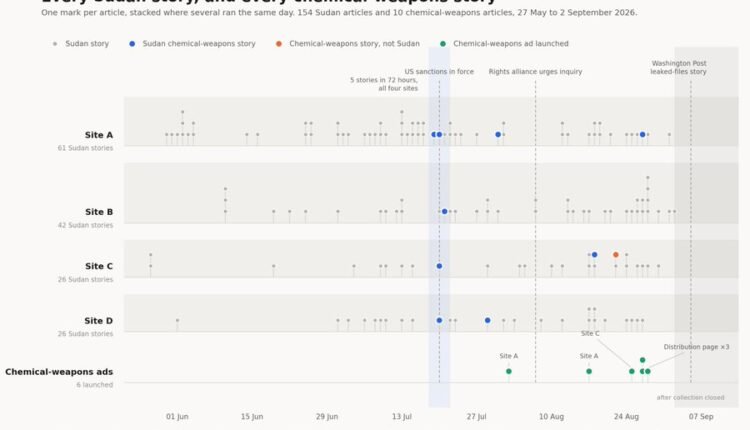
Regarding the chemical weapons narratives, the researcher—while analyzing a long list of publications detailed in charts and graphs—noted that the smear campaign against Sudan intensified in the months leading up to the renewal of the sanctions regime. Starting in July, there was a surge of hundreds of articles and paid advertisements, including pieces published by *The New York Times*.
The researcher pointed out that material concerning chemical weapons constituted a small, specific fraction of the total publications. Of ten articles addressing the subject of chemical weapons, nine focused on Sudan; seven were published between July 19 and 31, with five appearing within a 72-hour window coinciding with the July 20 start of US sanctions. The advertising campaign on this topic ran from August 2 to August 28, with three of the six advertisements originating from the “Mercer / Noise Filter” page rather than the outlets that published the articles.
Shortlink: https://sudanhorizon.com/?p=18010