

“From Khartoum, With Greetings (2)… Observations from the Editor-in-Chief”
“Come on, schoolchildren…”
By a stroke of good fortune, my home stands beside two intermediate schools—one for girls and the other for boys. As I was immersed in reviewing the materials produced by the journalists of Al-Muhaqqiq and the opinion pieces submitted by our contributors, on the morning of Thursday, 30 April, the voices of the neighbouring schoolgirls suddenly pierced my ears as they sang the national anthem:
We are the soldiers of God, the soldiers of the country.
If the call for sacrifice is heard, we shall not betray…
Three years had passed since I last heard this sound.
It felt as though it was my own voice:
I am the daughter of light…
Do you know who I am?
I am the daughter of today, the source of joy…
May God have mercy on the late poet Ahmed Mohammed Saleh, who composed the “Flag Anthem”, and on Colonel Ahmed Marjan who set it to music; and may He also have mercy on the great artist Abdel Karim Al-Kabli, who wrote, composed, and performed “Daughter of Light”.
I confess that I struggled to hold back my tears as I listened. For three years, I had not heard the national anthem sung live and independently. In exile, I heard it only alongside the anthems of host countries—often as a recorded broadcast through loudspeakers.
At the neighbouring boys’ school, the students begin their day by cleaning and planting trees within the school grounds. They ensure that what they planted is watered, collect debris carried by the wind, and sometimes even clean the street outside before lining up for the morning assembly and anthem.
I resolved to visit both schools to understand their conditions more closely—perhaps to reflect in the media the needs of students and teachers alike.
Friday prayers… and a small mosque
I performed Friday prayers at a small mosque near my home, where we used to gather for taraweeh before the war broke out in 2023. The mosque, once filled to capacity, now accommodated only three rows.
After the prayer, the imam reminded us of the mosque’s needs—maintenance, electricity, carpets. No one left without contributing what they could. I thanked God that people still care for His houses, even with modest means.
A journey to Khartoum North
Later, I met my friend, Engineer Abdel Rahim Mohammed Khair, who currently resides in southern Khartoum while repairing his home in the “Sports City” area—an area heavily damaged during the conflict.
He kindly offered to accompany me to Khartoum North (Bahri) to attend a wedding. For me, this was more than a social occasion—it was a chance to reconnect with old university friends and observe conditions across Khartoum and Bahri, especially amid ongoing debates on social media about security concerns.
We travelled along Street 60 northwards. Traffic appeared normal—public transport operating, private cars moving steadily, pedestrians visible. We passed through neighbourhoods such as Riyadh, Taif, and Manshiya, observing both life and its scars.
There were no overt military presences, apart from police checkpoints and traffic officers.
Weddings in Bahri
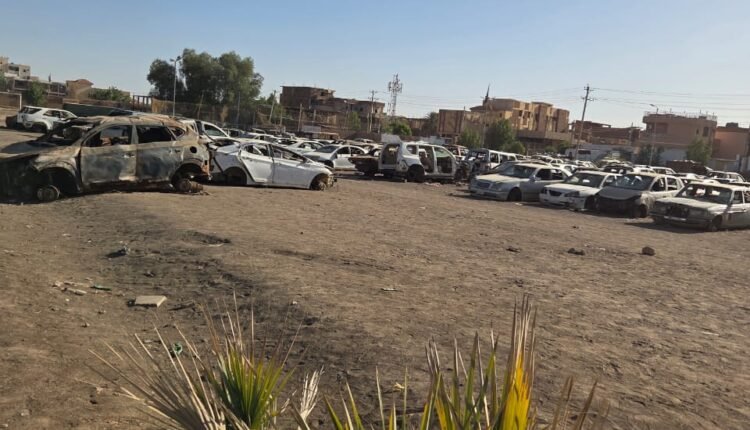
We arrived at Fitonia Hall near Khidr Bashir Theatre in Shambat. Nearby, dozens of confiscated, tampered vehicles were piled in an open field—over a hundred, by rough estimate.
Inside, two wedding celebrations were taking place side by side. Families of all ages gathered, sharing joy and meals. The bride, Dr Istabraq Essam El-Din, and her husband, Engineer Mohammed Salah, chose traditional songs and drums rather than modern music—adding warmth and authenticity to the occasion.
As we prepared to leave, I noticed a young, slender man in a military uniform—one of the guests. He stepped out briefly for afternoon prayer. I approached him and discovered he was Mujahid Owais Ghanem. It was a moment I valued deeply—meeting one of the young men who had devoted themselves to defending the country. I greeted him and requested a photograph; he accepted with humility.
A contrast of realities
At the same time that Owais and others were attending a wedding in Shambat, Abdel Fattah al-Burhan was visiting Sheikh Hamad al-Nil’s mosque in Omdurman, before offering condolences to the family of Sadiq al-Mahdi.
Meanwhile, debates raged on social media about the state of security in Khartoum.
On the return journey
On our way back, I asked to stop at the Shambat field to photograph the pile of vehicles. Nearby, children were playing football—a small but powerful sign of resilience.
We then crossed Mak Nimir Bridge, where I paused to observe the remains of the “Kuwaiti Building”—once a major hub for private media institutions. Nearby stood the Ministry of Foreign Affairs and the Sudan News Agency building, both bearing signs of fire damage.
Along Republic Street, we saw burnt facades of major buildings, including the Union of Banks. Yet despite the destruction, movement continued.
A city between life and pause
Throughout the journey, life appeared vibrant in some places—markets, transport routes—yet subdued in others, where cafés, shops, and pharmacies remained closed.
Eastern Khartoum, including Riyadh, Taif, and Mamoura, showed slower recovery compared to other areas.
As for security, it no longer seemed to be a dominant concern among residents.
To be continued…
In the next instalment, we will explore daily livelihoods—electricity, basic services, and the challenges faced by those attempting to resume their small businesses.
Shortlink: https://sudanhorizon.com/?p=13463