

With Participation of Traditional Leaders, “Aafir” Workshop in Cairo Explores Building a Sudanese Model for Transitional Justice
Cairo – Sudanhorizon – Sabah Mousa
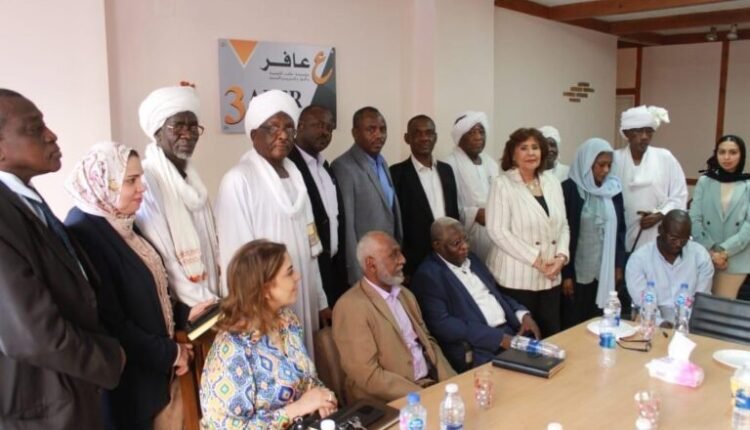
The Aafir Foundation for Development, Dialogue, Training, and Research, in cooperation with the Sudanese Group for Rights and Freedoms in Cairo, organized a workshop on Monday titled “Towards Building a Sudanese Model for Transitional Justice – Traditional Leadership.” The event brought together a number of tribal leaders, including nazirs and sultans, representatives of Sudan’s traditional administrations, as well as researchers and those interested in transitional justice issues.
A Central Issue
The session was moderated by Dr. Amani Al-Tawil, Chair of the Board of Trustees of the Aafir Foundation. She stressed that transitional justice represents a central and fundamental issue for repairing Sudan’s social fabric and a necessary condition for achieving civil peace. She explained that a comprehensive settlement based on community dialogue, accountability, and reparations is among the most effective ways to address conflicts. She pointed to the experiences of Rwanda and South Africa as among the closest models that could be drawn upon, noting that South Africa’s experience may be the most relevant to Sudan. She added that this workshop is part of a series of meetings aimed at bringing together key stakeholders to produce recommendations that contribute to shaping a Sudanese model for transitional justice capable of addressing the complexities of the crisis and achieving reconciliation.
Root Causes
For his part, the Amir of Al-Habbaniya in North Kordofan, Al-Tijani Odon, emphasized that political factors have been a primary cause of the breakdown of social cohesion. He stressed the need to identify the root causes and political objectives that led to the conflict and the tearing of the social fabric. He noted that there are parties that have benefited from the crisis and others that have been harmed, explaining that successful community dialogue requires identifying traditional leaders independently of political influence, given their role in providing accurate information. He added the importance of determining the type and scale of harm and distinguishing between what can and cannot be compensated. He said the next phase requires establishing mechanisms to verify harm and move toward social reconciliation away from revenge, calling for role models at the leadership level, an effective constitutional and legal framework, and clear implementation mechanisms, while noting that security and economic challenges may hinder addressing these issues.
Hate Speech
Mohammed Sarour Mohammed Ramli, Nazir of Al-Jami’ab and Al-Khat Al-Safil, warned of the unprecedented rise of hate speech in Sudan, stressing the need for a well-structured plan to combat it. He cautioned that its continuation could lead to a situation worse than the current war. He pointed to the failure of several agreements concluded by political elites due to non-compliance with rights and agreements, noting that breaches of commitments contributed to the secession of South Sudan. He stressed that effective agreements must originate from genuine stakeholders who understand citizens’ realities. He added that the current situation is more complex due to overlapping political, military, and international dimensions, calling for charismatic leadership to guide the dialogue process. He also proposed dividing Sudan into regions to manage localized dialogues according to each area’s specific context, noting that some conflicts are less complex than others and that the conflict has moved beyond traditional resource-based disputes to more complex levels.
Will and Determination
Abdullah Issa Abdel Karim, Nazir of Al-Daggo in Khartoum, stated that traditional administration has been among the most involved parties in the conflict due to its politicization to serve personal agendas. He noted that Sudan has around 500 tribes with detailed knowledge of their communities, but that traditional administration is going through a critical phase, with many of its leaders lost during the war. He called for a meeting of tribal leaders to form a committee tasked with repairing the social fabric and confronting hate speech, alongside preparatory committees to support this direction, emphasizing that the process requires strong will and determination.
Justice Mechanisms
Amir Taj El-Din, Deputy Sultan of Dar Masalit, stressed the need to neutralize politicians and activate traditional justice mechanisms such as mediation councils (judiya) and community forums (rakouba) away from political interference. He argued that the current situation has surpassed traditional justice due to the absence of minimum justice standards and the accumulation of grievances. He explained that what is needed is to seek achievable justice by developing local tools, noting that the absence of an effective judicial system complicates justice efforts. He also criticized the inclusion of parties involved in the conflict within justice mechanisms, describing it as a fundamental flaw, and emphasized the importance of truth, transparency, and moral acknowledgment of rights.
Core of the Crisis
Ahmed Ibrahim Al-Tahir, representative of Dar Suwini in North Darfur, stated that the issue of hawakeer (traditional land ownership) lies at the heart of the crisis. He pointed to the settlement of groups outside their original areas on lands not belonging to them, which led to the forced displacement of original inhabitants into camps. He stressed the need to deliver justice to victims before pursuing broader justice measures, by restoring land to rightful owners, preventing impunity, and disarming militias to ensure stability, emphasizing that true peace restores rights to their rightful owners.
Positive Leadership
Researcher Dr. Mohammed Issa Alaiwah argued that traditional administration has lost its ability to perform its role under current conditions due to the destruction of its structures and functions. He noted that the continuation of the war hinders any social efforts, pointing to the rise of armed groups at the expense of traditional structures, with individuals accused of violations occupying positions of power, complicating justice efforts. He emphasized that the Sudanese experience requires genuine will and positive leadership models.
Raising Awareness
Lieutenant General Siddiq Ismail, Deputy Chairman of the Umma Party, agreed with this view, stressing that the primary entry point is reaching a comprehensive political solution. He explained that tribal leadership and traditional administration cannot resolve the crisis under the current polarization and coercion, emphasizing the need to restore citizens’ rights by liberating will and awareness at the grassroots level, alongside accelerating political solutions as a foundation for any resolution.
Hearing Perspectives
At the conclusion of the meeting, organizers confirmed that this workshop is the third in a series on transitional justice involving Sudanese traditional leaders. They announced plans to organize further workshops to hear the views of more community leaders, including a fourth workshop focusing on Sudanese political forces to be held next Wednesday. Additional workshops will also be organized to gather perspectives from initiative leaders, armed movements, women, and emergency committees in the coming days.
The organizers explained that after consolidating the outcomes of the first five workshops, the results will be presented to contribute to a joint model prepared by the Sudanese Group for the Defense of Rights and Freedoms and the Aafir Foundation. They will continue organizing dialogue workshops with stakeholders, experts, and interested parties to produce a comprehensive Sudanese model for transitional justice.
Shortlink: https://sudanhorizon.com/?p=13066