

A Prestigious American Magazine: Beware of Dividing Sudan Again (1-2)
Sudanhorizon – Mohamed Osman Adam
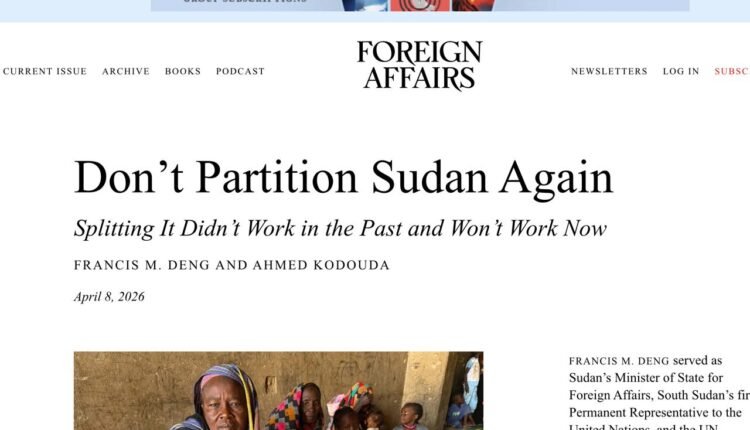
The prestigious American magazine “Foreign Affairs” has published a lengthy research paper by two prominent academic and political experts from Sudan and South Sudan, Francis Deng and Ahmed Kadoda, warning Sudanese people against the consequences of dividing Sudan again. To broaden its reach, the “Sudanhorizon” website summarized and presented the most salient points of the article.
The article was run by the prestigious “Foreign Affairs” magazine, published by the Council on Foreign Relations (CFR), a non-profit, non-partisan organization dedicated to promoting understanding of American foreign policy and international affairs through the free exchange of ideas.
The article, titled “Don’t Divide Sudan Again: Partition Hasn’t Worked in the Past and Won’t Work Now,” includes a detailed review of the current war and its humanitarian, economic, security, and political repercussions. Thus, they paved the way for the assertion that, no matter what people do, the partition of Sudan will not succeed. On the contrary, it will have dire consequences not only for the new entities but will also provide yet another example of a failed state with serious repercussions for neighboring countries: Ethiopia, Eritrea, South Sudan, the Central African Republic, and Chad.
However, the authors neglected to mention Egypt, Libya, and Saudi Arabia across the sea, even though it is clear that any harm inflicted on Chad, Sudan, Ethiopia, and Eritrea will seriously affect Egypt, Libya, and Saudi Arabia, which also border the Red Sea, among others.
The authors noted that “after three years of catastrophic civil war in the country, the scattered battlefields of Sudan have become a de facto partition… and despite both sides publicly insisting that they are fighting to preserve the unity of Sudan, the longer the current division persists, the more difficult it will be to reunify the country.”
Note that this apparent geographical division, and the failure of numerous attempts to reach a negotiated, peaceful settlement that would preserve Sudan’s unity, has raised the prospect of another formal partition of Sudan, 15 years after the secession of South Sudan. Leading think tanks, such as the European Council on Foreign Relations, have warned that Sudan is on the brink of disintegration.
The authors argue that the prevailing perception abroad that the Rapid Support Forces (RSF) and the Sudanese Armed Forces (SAF) represent different identity groups makes partition seem like a straightforward solution to the country’s ongoing violence.
They contend that, based on this superficial understanding, the SAF represents the country’s traditional ruling class—the Arab elites along the rivers and the Islamists who have long dominated Sudanese politics—while the RSF and its allies represent predominantly Arab pastoralists and other communities in Darfur and Kordofan, who have long been marginalized by Khartoum.
— Can partition create viable states? And why?
The authors strongly caution that partition would be a grave mistake. Dividing Sudan into economically viable states will not end the violence that has plagued the country since before its independence in 1956. They cited the case of South Sudan as a cautionary tale: its 2011 independence was supposed to resolve a similar conflict, but it failed miserably, despite receiving far more international aid than two new Sudanese states are likely to receive.
They were right when they pointed out that “Sudan’s divisions today run much deeper than the apparent military stalemate that seems to be splitting the country between east and west suggests. Any attempt to formalize this apparent division will not address the root causes of the conflict; it may even exacerbate it.” They then provided historical and political background to Sudan since the colonial era, highlighting the various grievances that, despite them, led the African Union and other African leaders to long adhere to the principle that the continent’s colonial borders must remain fixed to prevent endless regional conflicts. But the partition of Sudan in 2011 was widely considered an exception.
This was thought to stem from the belief that the predominantly Arab, Muslim north and the predominantly African, Christian south could not coexist in a just and unified political entity. The United States and Europe poured enormous resources into the newly formed South Sudan, hoping that its vast oil reserves would guarantee development and stability.
Then they argued that all of this had been thwarted: “But all that optimism vanished within two years.”
In reality, what appeared to be a relatively straightforward conflict along geographic, ethnic, and religious lines was far from simple. Identity conflicts arose from the Sudanese state’s failure to manage diversity constructively at all levels, including between large constituencies and within smaller communities.
The South’s independence exposed a wide range of grievances—such as disputes over grazing rights, control of oil-producing regions, competition for government positions, and patronage—that were embedded in the North-South conflict and had not been resolved by the political elites.
Because South Sudan gained its sovereignty before making a successful effort to address the root causes of the conflict or transform an economy plagued by decades of insurgency, independence merely shifted the lines of conflict.
The researchers argue that South Sudan’s trajectory demonstrates that partition resolves nothing as long as the state is treated as a prize to be seized and monopolized, rather than an institution serving its citizens. Further partitioning Sudan would reproduce this instability, especially since two new Sudanese states would never be able to attract the international support, humanitarian aid, and diplomatic attention that South Sudan enjoyed.
Moreover, the location of Sudan’s abundant natural resources and its trade patterns make formal partition economically unfeasible. The Sudanese Armed Forces control vital infrastructure in eastern and central Sudan, as well as all its Red Sea ports.
The Rapid Support Forces (RSF) control oil refineries and pipelines that transport oil to the coast. They also control vast swathes of farmland along the Nile Valley.
The article further explains that the RSF simultaneously controls many of Sudan’s oil-producing regions near the border with South Sudan, most of the country’s livestock (Sudan is the world’s tenth largest livestock-producing nation), and most of the gum Arabic production, of which Sudan is the world’s largest producer. Gold fields and mines are scattered throughout the two regions, but these would not be sufficient to support two independent economies.
The article asserts that a new state in western Sudan controlled by the RSF—a paramilitary force with no governing experience—would find itself landlocked, cut off from official export routes, and reliant on smuggling networks through Chad or Libya. This western Sudanese state would control the oil fields but would be unable to export crude oil without a cooperation agreement with the Sudanese Armed Forces (SAF) to use its refineries and export terminals, an unlikely prospect given the long-standing animosity between the two factions. Even if a formal agreement is reached, Khartoum will have every incentive to impose exorbitant transit fees or an oil embargo, as it has repeatedly done with South Sudan since 2011. Consequently, the western Sudanese state will remain dependent on the illicit economy that funds its war effort and unable to generate the legitimate revenue necessary to establish a functioning government. The northeastern Sudanese state, controlled by the Sudanese Armed Forces, will retain access to vital seaports and some agricultural capacity. However, it will lose access to significant natural resource revenues and will face ongoing threats from rebel groups along its borders. Neither side will possess the resources to undertake the massive reconstruction required in their devastated territories, and they will remain locked in a perpetual struggle over untapped resources (including oil, gold deposits in disputed areas, and fertile farmland) and border regions where their interests clash.
– Tribal and Ethnic Divisions:
The authors added a new dimension to the problem, arguing that the Sudanese civil war had already devolved into dozens of overlapping conflicts: the ethnic and demographic situation would be just as complex. The clear east-west divide suggested by conflict maps does not exist on the ground. The Rapid Support Forces (RSF) draw their fighters primarily from Arab pastoralist communities in Darfur and Kordofan, such as the Rizeigat, Misseriya, Bani Halba, and Salamat. But these communities are themselves internally divided. Although many young men in the west have joined the RSF, many influential tribal elders remain allied with the Sudanese Armed Forces. In South Kordofan, the Sudan People’s Liberation Movement-North (SPLM-N), a rebel group, controls large swaths of the region. A region in the Nuba Mountains has joined the new RSF government. However, the Nuba people there have historically fought against Arab militias and the Sudanese military establishment based in Khartoum.
– Loyalties and the Illusion of Two States in Sudan:
These intertwined loyalties will leave the states controlled by the Rapid Support Forces (RSF) and the Sudanese Armed Forces (SAF) without coherent national identities or solid social foundations. They will also leave large numbers of people trapped under the control of hostile authorities or stranded on the wrong side of the new borders. The non-Arab farming communities of Darfur (the Fur, Masalit, and Zaghawa) have borne the brunt of RSF atrocities, including violence that the United States classified as genocide in 2025. A formal partition that grants the RSF control over western Sudan will undoubtedly condemn these communities to permanent subjugation by the same forces that have systematically killed, displaced, and dispossessed them for over two decades. Similarly, millions of Darfuris and Nuba people who have long lived in areas controlled by the SAF will find themselves politically and socially isolated and facing further marginalization.
To be continued…
Shortlink: https://sudanhorizon.com/?p=12710