

The Third Berlin Conference: The Answer Lies in Its Title
Mahmoud Hussein Serry
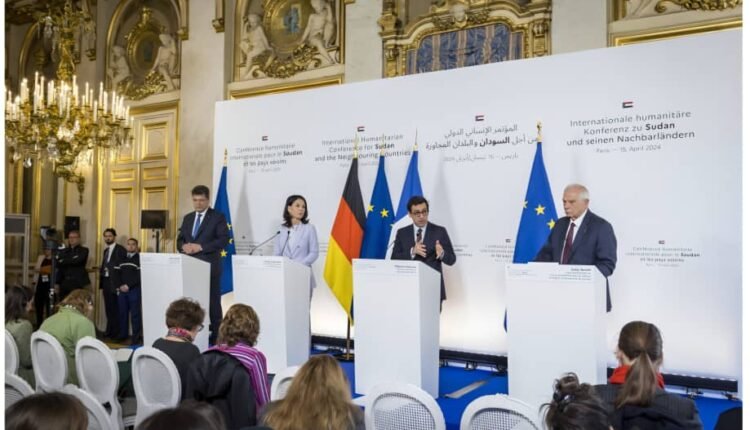
Germany has announced that it will host a conference on 15 April to mobilise emergency assistance for Sudan, according to a January 2026 statement by the German Foreign Office. The conference follows earlier gatherings held in Paris in 2024 and London in 2025, both aimed at addressing what has been described as the world’s largest humanitarian crisis—one that has pushed millions of civilians into poverty and claimed tens of thousands of lives.
Germany has stated that it is doing everything within its power—politically and humanitarianly—to assist people on the ground and to bring an end to the fighting, after international calls for a ceasefire have thus far failed to halt the conflict between the Sudanese government, aligned with the army, and the Rapid Support Forces, whose origins lie in the Janjaweed militia accused of atrocities in Darfur two decades ago.
However, since the Paris conference in 2024, the political, security, regional, and international landscape has changed significantly. These shifts have rendered the third Berlin conference a source of concern for many Sudanese, a matter of close government observation, a point of unease for some political forces, and a trigger for heightened alert among regional and international actors. Debate has intensified regarding the nature of international involvement in managing the Sudanese file.
The Berlin conference comes at a time when the Sudanese Armed Forces are facing mounting field challenges, including the fall of the strategic town of Bara in North Kordofan, the siege of El-Obeid, and the opening of an eastern front in Blue Nile State following the capture of Al-Kurmuk and Qaisan. These developments reflect the expanding scope of the conflict—from east to centre to west—alongside regional support networks facilitating logistical supplies and mercenary movements through neighbouring countries, including South Sudan, Uganda, Chad, Libya, the United Arab Emirates, the Central African Republic, and Ethiopia.
Further complicating matters is a report by Africa Intelligence indicating that Saudi Arabia has frozen an arms deal, originally arranged via Pakistan, intended to supply the Sudanese Armed Forces. This development could affect the balance of military support in the ongoing conflict since April 2023, as international and regional calls for a ceasefire and a return to political negotiations intensify.
Politically, the situation has become even more complex. Following the wars in Ukraine and Gaza, global attention has shifted towards the escalating confrontation involving Iran, the United States, and Israel. Regional powers such as Qatar, Egypt, Saudi Arabia, and Turkey are increasingly preoccupied with the Iranian crisis, while earlier diplomatic frameworks have stalled. In their place, a new “quintet” has emerged—comprising the African Union, the United Nations, the European Union, the League of Arab States, and IGAD.
Yet this quintet operates under an unclear and undocumented mandate, lacking defined mechanisms, objectives, or coordination structures. Its activities have increasingly raised suspicion, as it appears to be moving beyond facilitation and mediation into direct intervention in Sudanese affairs—shaping agendas, preparing international conferences, and selecting participants without transparent criteria or coordination with the Sudanese government or its diplomatic institutions.
The Berlin conference also represents the first major international political gathering on Sudan following the United States’ designation of the Sudanese Islamic Movement and affiliated groups as terrorist organisations—effectively excluding a current and influential political current, regardless of differing views about it.
Regionally and internationally, the conference has evolved into a platform through which various states seek to advance their own national interests. The United States, for instance, has shifted from being an invited participant to a central actor shaping the conference and chairing its sessions. Reports indicate that Massad Boulos, adviser to President Donald Trump, met with the German ambassador in Washington to discuss preparations, including the conference agenda and priorities—chief among them advancing US interests.
These priorities reportedly include amplifying the humanitarian file as a means to secure a humanitarian truce that could lead to political negotiations involving the Sudanese Armed Forces, the Rapid Support Forces, and the civilian democratic coalition “Somoud,” led by Abdalla Hamdok, potentially restoring them to power through a new agreement.
Meanwhile, countries such as the United Kingdom and Norway are also seeking to leverage the conference to advance their interests. The British Home Secretary, Yvette Cooper, has called for intensified diplomatic efforts to end the war, describing Sudan’s humanitarian catastrophe as the worst of the 21st century and warning of its implications for regional security, extremism, and migration.
The United Kingdom has also criticised both the Sudanese Armed Forces and the Rapid Support Forces for what it described as a catastrophic failure to protect civilians, citing reports of ethnic killings, sexual violence, and starvation as a weapon of war. British officials have pointed to testimonies from civilians and emergency responders as evidence of widespread human rights violations.
Furthermore, Britain has indicated that the United States is working on a ceasefire framework, following discussions in Washington aimed at advancing diplomatic efforts. As such, the conference has evolved beyond a routine humanitarian or political meeting into a broad international coalition led by Germany, with participation from the European Union, France, the United Kingdom, the United States, the African Union, Canada, and more than 25 foreign ministers.
Domestically, the Coordination of National Forces in Sudan has announced its boycott of both the Berlin conference and its preparatory meeting in Addis Ababa, citing concerns that international diplomatic initiatives have complicated rather than resolved the internal political landscape, and that they aim to reproduce previous agreements or impose new arrangements lacking broad national consensus.
The conference has thus shifted from a humanitarian forum to a political one, with around 40 Sudanese participants—many of whom are perceived as aligned against the Sudanese Armed Forces or accused domestically of cooperating with the Rapid Support Forces. Critics argue that this undermines efforts to pursue an inclusive, nationally driven political process.
At the same time, certain Arab and regional media outlets, along with Sudanese political groups supportive of the conference, portray opposition to it as being driven by Islamist-affiliated platforms opposed to peace and supportive of continued war, or by actors aligned with the current authorities in Port Sudan. They argue that claims of bias are unfounded, emphasising the broad international representation at the conference.
Nevertheless, the overall trajectory suggests that the international community is moving towards imposing its own vision for resolving the Sudanese crisis, particularly in light of what it perceives as the government’s failure to achieve a decisive military outcome, promote its peace initiative internationally, or engage effectively with key regional and global actors.
The conference is expected to produce a major international coalition tasked with addressing the Sudanese crisis, potentially revitalising the role of international groupings without clearly defined mandates. It may also expand the role of the United States, supported by the United Arab Emirates, while marginalising other regional actors such as Turkey, Egypt, Saudi Arabia, Qatar, and Russia.
Additionally, reports, data, and allegations from international organisations are likely to be used as leverage to pressure both the Sudanese Armed Forces and the Rapid Support Forces into negotiations to secure a humanitarian truce.
Looking ahead, the Sudanese government and armed forces must recognise the scale of international alignments and pressures. The current situation—neither war nor peace—is unsustainable.
The government must prioritise alleviating civilian suffering by opening humanitarian corridors and cooperating with relief organisations, thereby preventing the politicisation of the humanitarian file. It must also work to revive and promote its own peace initiative, counterbalance external diplomatic groupings, and engage more effectively with regional allies, international partners, political constituencies, media platforms, and diaspora communities.
Only through such efforts can a peaceful solution be achieved—one that preserves Sudan’s sovereignty, unity, and territorial integrity.
Shortlink: https://sudanhorizon.com/?p=12536