

South Sudan Presidency says No Further Extension, Reafirms December 2026 Election Date
Sudanhorizon– Agencies
The South Sudanese Presidency has categorically ruled out any further extension for the transitional government period established under the revitalized peace agreement, affirming its commitment to holding general elections in December 2026.
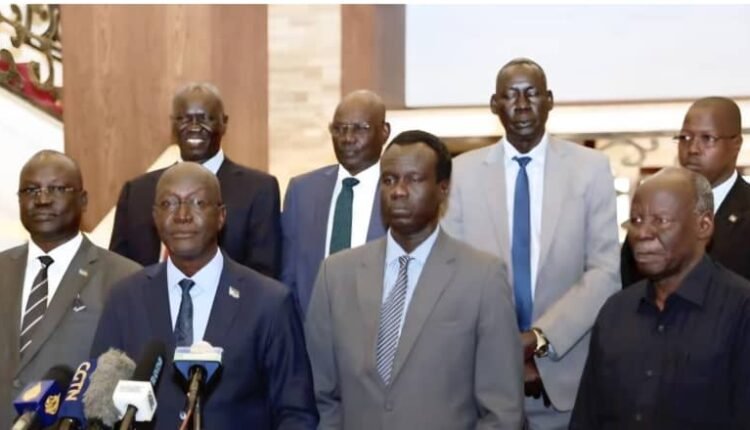
Africano Mandi, Minister of Presidential Affairs, announced on Friday at a press conference in Juba that this decision was reached at an expanded presidential meeting held on Wednesday, chaired by President Salva Kiir Mayardit and attended by several vice presidents and senior government officials.
The minister emphasized that the presidency had made its decision definitively, stating that “there will be no further extension of the transitional period of the revitalized peace agreement beyond the currently agreed date.”
The decision also included unanimous approval of amendments to certain provisions of the agreement and the 2011 Interim Constitution, with the aim of establishing the necessary legal framework for holding elections.
The presidency agreed to form a committee to initiate the required amendments and present them to the leaders of the parties that signed the peace agreement.
The presidency directed the immediate implementation of the transitional security arrangements and the allocation of the required financial resources by the Minister of Finance and Planning for the swift operation of the electoral process. Any other provisions of the agreement that could not be completed before the elections will be considered “post-peace agreement programs.”
It should be noted that officials from the Sudan People’s Liberation Movement-in-Opposition (SPLM-IO), led by Dr. Riek Machar, who is under house arrest and facing trial, did not attend the meeting. However, the SPLM-IO’s interim leadership representative, Stephen Far Kuol, did attend.
The decision not to extend the transitional government comes amidst a deep political crisis between President Salva Kiir and his suspended First Vice President, Riek Machar. In September 2025, the SPLM-IO, led by interim president Awet Nathaniel, declared that the transitional government had “collapsed” and lost its legitimacy after its leader, Dr. Riek Machar, was charged and suspended from his duties. The Sudan People’s Liberation Movement-in-Opposition (SPLM-IO) announced in March 2025 that it was withdrawing its support for the security arrangements mechanisms in protest against the arrest of its senior leaders and the entry of Ugandan forces into the country. Dr. Riek Machar remains under house arrest and is facing trial before a special court in connection with the Nasir incident of March 2025.
Despite the presidency’s declaration that there would be “no extension,” concerns persist about the country’s readiness for the elections scheduled for December 2026. The United Nations has repeatedly stressed the need to avoid another extension, but has indicated that the timelines for implementing key tasks, such as drafting a permanent constitution and conducting an official census, are not currently compatible with the December 2026 election timeframe, raising the fears of a last-minute extension.
It is worth noting that the transitional period of the Revitalized Peace Agreement, signed in September 2018, has been extended twice to date, most recently in September 2024, when elections were postponed from December 2024 to December 2026. The transitional period was then extended for another two years, ending with the start of the new elected government’s term in February 2027. The implementation of the 2018 Revitalized Peace Agreement faces significant challenges and persistent points of contention among the main parties, leading to repeated delays in the transitional process.
The core disagreements hindering the peaceful transition center on the lack of political will among the signatories to the Revitalized Agreement and the absence of mutual trust between the parties. Other obstacles include the incomplete assembly, training, and unification of forces to form a unified national army; a lack of reliable funding for implementing key provisions, particularly security arrangements and the electoral process; delays in drafting the permanent constitution and reforming the judicial and security apparatus; and the need to amend fundamental laws to create a conducive political environment for elections.
Shortlink: https://sudanhorizon.com/?p=9534