

Greetings from Khartoum (3)… A Series of Observations Narrated by the Editor-in-Chief
Last Sunday was a special day. It did not merely carry the longing to return home to Khartoum, nor only the curiosity of rediscovering the capital after years of absence and witnessing the آثار of war. Beyond all that, it was filled with a mixture of nostalgia and personal sorrow, as my programme included a visit to family and relatives in East Nile—specifically in the village of Id Babakir.
To Id Babakir
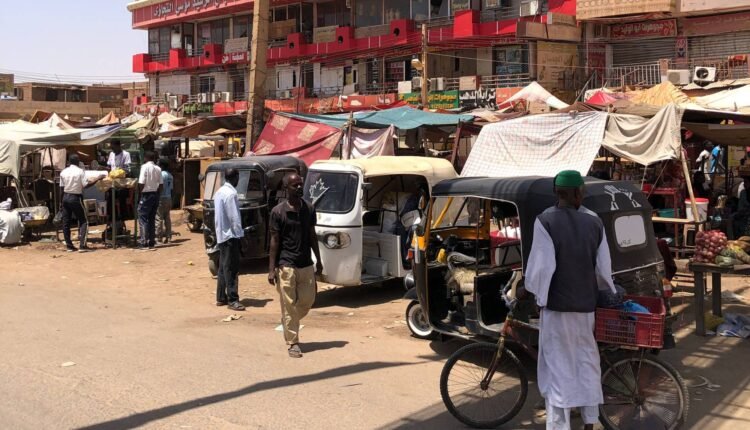
We took the road towards Manshiya Bridge from the Burri side, crossed eastwards to the beginning of the Al-Ailafon road near Al-Qadisiyah neighbourhood, then headed south to the ring road junction before turning east again. The movement of cars, trucks, and public transport buses in East Nile, along with vendors lining both sides of the road, was almost as it had been before the war. What caught my attention at the entrance to the ring road were lorries and dump trucks loaded with red bricks and sand, parked waiting for customers, alongside stacked bundles of fodder.
In the second half of 1992, my small family and my uncle Abdullah’s family completed their move to Id Babakir village. This relocation was the result of efforts initiated five years earlier by my brother Musa Ahmed Marouh—then an English teacher at Banatna Secondary School and later a German teacher at the Goethe Institute—and my cousin Ahmedin Abdullah Marouh, who was at the time a cadet at the Military College and later an officer in the armed forces. They purchased two plots of land in Babakir village from our Batihin relatives. They oversaw the construction of two houses using local materials to accommodate our elders, who had been worn down by years of displacement following the drought that struck the “Damar” areas of Al-Kabashab in Dar Al-Reeh, North Kordofan, in the early 1980s.
The choice of location was no coincidence. We were searching for an environment and community close to the pastoral lifestyle we knew, and we found no better option than our Batihin kin, who indeed proved to be excellent neighbours and extended family.
Stories Passed Through Our Home
Stories passed through our home—comings and goings
Distances were written upon us—time zones apart
At every moment, we would find you—uniting hearts that longed for you
Sudanese, just as we knew you—here or elsewhere
I felt that this “tone” one hears when calling a Sudani number was speaking directly to me this time as I made my way to Id Babakir. In this village, my father, the late Hajj Ahmed Wad Marouh, and my mother, Hajja Saeeda bint Faoum, spent the remainder of their lives. My father passed away in July 2015, and my mother followed him in October last year. I received news of her passing while I was in Cairo, and it weighed heavily on me that I could not be present. Thus, last Sunday became a day of reconnecting with kin, renewing grief, and offering condolences to relatives for those lost during the war years. What eased the burden of sorrow was the companionship of my life partner, Dr Amina Abbas.
The visit also provided an opportunity to hear firsthand accounts of life in an area under the control of the Rapid Support Forces. Whenever they seized “spoils” or held celebrations in houses they had occupied, they would fire volleys of gunfire indiscriminately in all directions, heedless of whom the bullets might kill or injure. Despite the harsh rule imposed there, which forced many—including our own family—to flee to neighbouring states, life quickly began to return to normal once the liberation of Khartoum State was announced. Indeed, one could confidently say that markets, bakeries, fruit and vegetable shops, schools, and rural hospitals have all resumed operations at full capacity.
The Return Journey
On our way back from Id Babakir, we chose the Al-Jereif East road, entering from its southern end and heading north towards the East Nile Hospital junction. The sun was setting, and the scene along both sides of the road closely resembled pre-war days. I noticed the heavy presence of vehicles at the East Nile Hospital parking areas and its adjoining clinics. Throughout the journey, we encountered no checkpoints or security barriers, nor did we see any military presence except for traffic police—apart from what we observed at the entrances to Manshiya Bridge. From the middle of the bridge, I could see life returning to the Nile Corniche near the Telecommunications Tower, and the red-brick kilns had resumed work on the eastern bank of the Blue Nile.
The Day of the Drones
Around midday on Monday, I arranged to meet my friend Wagdi Al-Kurdi, Director of Biladi Radio, at the Ministry Complex in the Sudanese Mineral Resources Company building in Al-Mujahideen district, southern Khartoum. We were planning to visit the Ministry of Culture, Information, and Tourism at its new headquarters. Shortly after we sat with the Undersecretary and congratulated them on relocating from the cramped ministry complex in Port Sudan to the more spacious premises, reports began circulating about a drone attack on Khartoum Airport. Between disbelief and confirmation, the news proved true.
Soon afterwards, building security instructed officials and staff to leave. We were among the last to depart—not in defiance of safety instructions, but out of a sense that what had happened had already occurred. It felt like hearing thunder and seeing lightning after a strike—the ones struck cannot see the lightning or hear the thunder.
It seemed to me that those who had returned to Khartoum—or never left—had grown accustomed to such drone incidents. There was no panic or crowding as people exited offices, nor along Sixtieth Street on our return. My own attention turned to the nature of the strike: was it carried out by a suicide drone, a conventional drone, or a strategic one? Each possibility carries different implications and conclusions.
“I Found It!”
I donned my journalist’s cloak and began contacting sources who might provide answers, while monitoring circulating reports. I found no convincing account. Meanwhile, WhatsApp groups shared news of a press conference to be held that evening by the Ministers of Defence and Foreign Affairs. I felt a surge of anticipation—“I’ve found it, I’ve found it!”—though the phrase here bears no relation to Archimedes’ famous exclamation.
The press conference, held that Monday night, was also an opportunity to reconnect with colleagues from various media outlets. Among them were Mastour Adam from Sudan National TV, Ibrahim (SUNA), Al-Dhafer and Al-Tahir from Al Jazeera, Mohammed Mohammed Othman from the BBC, Bahram Abdelmonem from Anadolu, and others. Among the female journalists present was Heba Morgan from Al Jazeera Mubasher, who attended despite suffering from dengue fever—deserving of commendation.
During the conference, a video was presented showing the types of drones launched since early March from the Bahir Dar base in Ethiopia, operating across Sudan’s airspace and striking in North and South Kordofan and White Nile. These included three strategic drones, one of which had been shot down in mid-March north of El Obeid, with its type and serial number identified. The official spokesperson of the Sudanese Armed Forces, Brigadier General Asim Mohammed Awad, stated that diplomatic channels had been used to contact the manufacturing country, which confirmed that the drone had been sold to the United Arab Emirates.
Not satisfied with the conference alone, I spoke directly with Brigadier Asim afterwards, who elaborated on the details. In summary, the attack on Khartoum International Airport on Monday appears—based on multiple accounts, including the conference briefing—to have been carried out by a strategic drone matching the specifications of the previously downed model. It struck with high precision from great altitude, executed its mission, and exited the airspace.
In the next instalment of these observations, we will return—God willing—to discuss livelihoods, electricity, daily necessities, and the challenges facing those seeking to resume their small businesses.
Shortlink: https://sudanhorizon.com/?p=13610